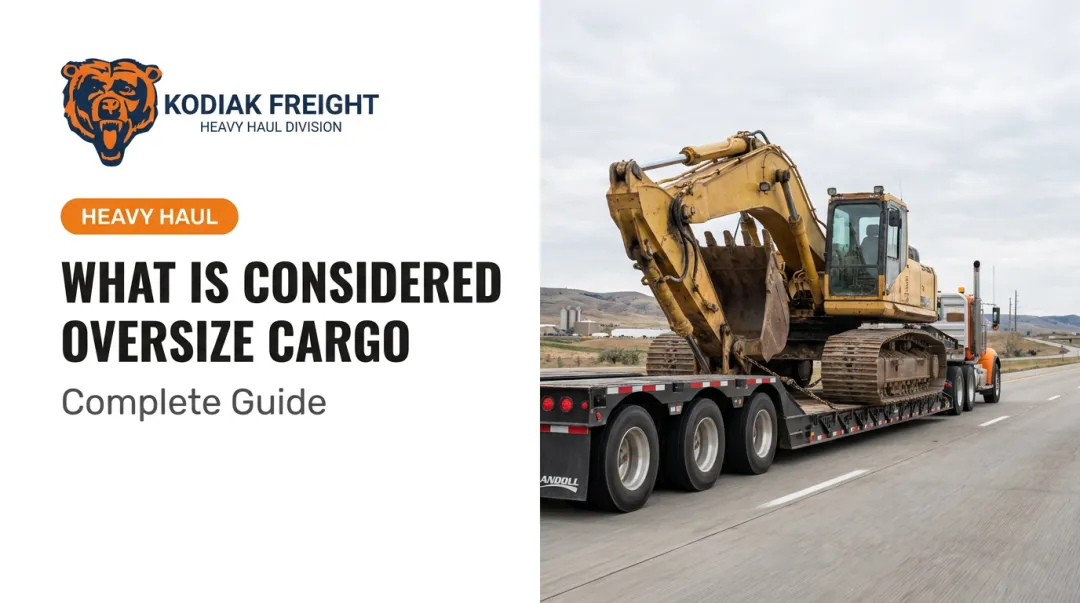

Wide load transportation keeps major industries running, but the regulatory landscape is genuinely complex. Every state sets its own rules, and what's legal in one jurisdiction may require a completely different permit — or a different route — in the next.
This guide covers everything shippers need to know: legal thresholds, permit requirements, escort and signage rules, trailer types, and the industries that rely on this specialized freight category most.
Key Takeaways
- Any shipment wider than 8.5 feet (102 inches) on the National Network qualifies as a wide load and requires oversize permitting
- Every state a load passes through requires a separate oversize/overweight permit
- Loads wider than 12 feet generally trigger pilot car requirements, though exact rules vary by state
- Most states restrict wide load travel to daylight hours and prohibit movement on weekends and federal holidays
- Specialized trailers (lowboys, RGNs, Landoll tilt-decks) are matched to cargo based on dimensions, weight, and loading requirements
- Agriculture, manufacturing, mining, construction, and energy generate the highest volumes of oversize freight
What Is Wide Load Transportation?
"Wide load" and "oversize load" are used interchangeably in the trucking industry. Both refer to shipments whose dimensions or weight exceed standard legal limits for road travel.
In most states, a load must be indivisible to qualify for an oversize permit. Under federal regulation (23 CFR Part 658), a nondivisible load is one that — if separated — would compromise its intended use, destroy its value, or require more than eight workhours to dismantle with appropriate equipment.
Ordinary freight that can simply be split across multiple trucks generally doesn't qualify.
Federal Baseline Thresholds
The federal government establishes a limited set of baseline standards on the National Network and Interstate system:
- Width: 102 inches (8.5 feet) — the federal standard; Hawaii retains a 108-inch exception
- Weight: 80,000 lbs gross, 20,000 lbs on a single axle, and 34,000 lbs on a tandem axle, plus the Federal Bridge Formula for axle groups
- Height: No federal maximum exists — the commonly cited 13 feet 6 inches is a state standard, not a federal threshold
- Length: Federal law prevents states from restricting semitrailers to less than 48 feet on the National Network, but imposes no universal overall combination length cap

Worth noting on weight: a vehicle can be under 80,000 lbs gross and still require an overweight permit if any single axle or axle group exceeds its limit — a detail that catches many shippers off guard.
According to FHWA's study on oversize/overweight permitting, the 50 states and District of Columbia issued more than 3.7 million OS/OW permits in 2012 — a figure that reflects just how embedded oversize transport is in U.S. industrial operations.
Federal and State Legal Limits for Wide Loads
Federal regulations set baseline standards for wide load transportation, but every permit is issued at the state level — and state rules vary significantly.
Why State-by-State Research Is Non-Negotiable
The FHWA does not issue oversize/overweight permits. Every permit comes from a state authority, and each state sets its own dimensional and weight thresholds, travel time rules, and escort requirements. A shipment legal in Florida may need a route adjustment or different permit class in Georgia or Alabama.
For any multi-state move, shippers and carriers must research regulations for each state the route crosses — including any local or county road restrictions that may be stricter than the state standard.
Common State Legal Limits
| Dimension | Typical State Limit | Notes |
|---|---|---|
| Width | 8.5 ft (102 in) | Loads wider than this require an oversize permit |
| Height | 13 ft 6 in (most states) | No federal max; varies by state |
| Length | 48–53 ft (semitrailer) | Combination length rules vary significantly |
| Gross Weight | 80,000 lbs | Per-axle limits apply independently |
The Per-Axle Weight Trap
A load under 80,000 lbs total can still require an overweight permit if it fails the Federal Bridge Formula on any axle or axle group. Redistributing cargo on the trailer can sometimes bring a shipment back into compliance — evaluate this before applying for a permit.
Superloads: A Different Category Entirely
When loads exceed extreme thresholds, standard oversize permits aren't enough. But "superload" definitions aren't uniform:
- California requires a variance permit above 15 ft wide, 17 ft high, or 135 ft long
- Texas classifies loads above approximately 254,300 lbs gross as superheavy, triggering individual structural evaluations for every bridge on the proposed route
- Florida allows self-issued online permits only up to 16 ft wide, 18 ft high, 150 ft long, and 200,000 lbs
Local and County Restrictions
State permits typically cover state highways. City, county, and local road authorities frequently impose stricter limits, particularly on urban routes or roads crossing bridges with posted weight ratings. Minnesota's permits, for example, remain subject to bridge postings and apply only to state roads.
Wide Load Permits: What You Need and How to Get Them
Every oversize or overweight shipment requires a state-issued permit before travel begins. No exceptions.
What a Permit Specifies
A standard oversize permit documents:
- The approved route (deviations can result in violations)
- Travel dates and times
- Load dimensions and weight
- Special conditions — escort requirements, speed limits, curfews
- Any required route survey certifications
Permits are non-transferable and route-specific. If your route changes, your permit may need to change too.
Who Issues Permits and How to Get Them
Each state's Department of Transportation — or a designated permitting office — issues oversize permits. Carriers can apply directly or work through a third-party permit service. For multi-state shipments, separate permits are required for each state.
Some states offer trip permits for one-time moves; others offer annual or blanket permits for carriers with recurring routes.
What Permits Cost
Permit fees vary considerably by state and load type. Verified examples from primary sources:
- Florida: $5 for a 10-day overdimension trip permit up to 12 ft wide; $25 for loads over 14 ft wide
- California: $16 for a single-trip permit; $90 for an annual/repetitive permit
- Texas: $60 for a general legal-weight single-trip permit; $210 for loads in the 80,001–120,000 lb range

These figures illustrate how much fees vary — they don't reflect a reliable national average. Superloads add engineering review, route survey costs, and potentially escort fees on top of base permit charges.
Penalties for non-compliance are significant. In Florida, operating without a valid permit can result in fines up to $1,000 per violation, and overweight vehicles without permits are assessed $0.05 per pound above the legal weight limit.
Route Surveys
For very large or unusual loads, state authorities may require a professional route survey before approving the permit. Minnesota, for instance, requires a physical survey for loads exceeding 16 ft high, 20 ft wide, or 175 ft long — documenting clearances, overhead obstructions, road width, and turns with a required 6-inch clearance margin.
Route surveys add time and cost to planning. Build them into your schedule early.
Timing Your Application
Route surveys are just one factor extending your timeline — permit applications themselves need a head start too. Standard single-state permits may process in 24–48 hours, but multi-state routes, superloads, and loads requiring engineering review can take two to four weeks or more.
Submit applications as early as possible, especially when multiple states are involved. Escort vehicle scheduling and route survey approvals don't happen in parallel — each step gates the next.
Carriers with dedicated permitting teams, like Kodiak Freight, manage this sequencing from the start, coordinating permits, surveys, and pilot car logistics as one integrated plan rather than separate tasks.
Escort Vehicles, Signage, and Travel Restrictions
Pilot Car Requirements
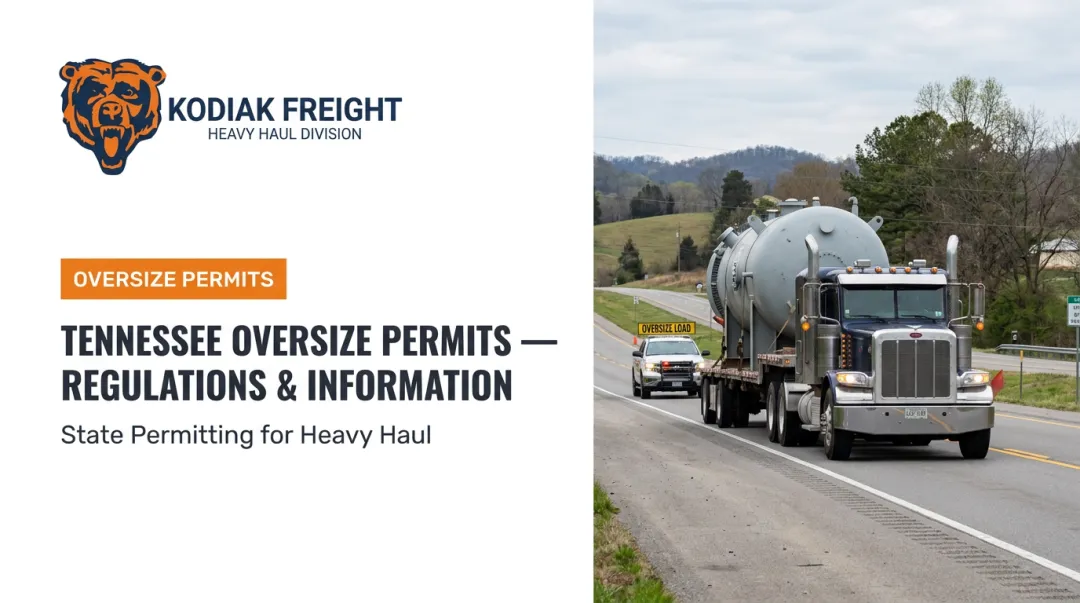
Escort vehicles (also called pilot cars) are required when loads exceed certain dimensional thresholds. Requirements vary by state, but Florida's rules illustrate the structure: loads wider than 12 feet trigger escort requirements, with additional thresholds at larger dimensions.
The FHWA's review of oversize permitting practices confirmed there is no nationally harmonized pilot car standard — state rules differ significantly. What's consistent across states is the escort vehicle's role:
- Warning oncoming traffic of an approaching wide load
- Navigating low clearances, tight turns, and bridge approaches
- Communicating hazards to the driver in real time
For the largest superloads, some states (Texas among them) may require law enforcement escorts in addition to private pilot cars.
Signage and Visibility Requirements
Required markings vary by state and permit class, but standard requirements typically include:
- "WIDE LOAD" or "OVERSIZE LOAD" banners on the front and rear of the vehicle
- Red flags attached to the outermost corners of the load
- Amber warning lights for travel near dawn, dusk, or low-visibility conditions
- Escort vehicles must carry appropriate flags and lights as well
Proper markings tell other drivers to give the load extra clearance. That visibility directly reduces accident risk — and sets the stage for the travel time rules that govern when a wide load can move at all.
Travel Time Restrictions
Wide load travel is restricted in most states to daylight hours, typically 30 minutes before sunrise to 30 minutes after sunset. Many states also prohibit movement on weekends and federal holidays, with some adding restrictions around peak traffic periods or specific weather conditions.
Florida's permit conditions follow this structure, with movement windows tied to daylight periods and listed holiday restrictions. These are state-specific rules, not a universal standard.
The practical implication is significant: a multi-state move that looks like a two-day haul on paper might take four or five days once travel windows, permit timelines, and restricted days are factored in.

Trailers and Equipment Used for Wide Loads
Selecting the right trailer for an oversize shipment isn't just about fitting the cargo. It affects axle load distribution, weight-per-axle calculations, and permit eligibility — all of which determine whether the move is legal and cost-effective.
Common Trailer Types for Oversize Freight
| Trailer Type | Best Suited For |
|---|---|
| Flatbed | Standard oversize freight within moderate dimension ranges |
| Step-deck / Drop-deck | Taller cargo needing additional height clearance |
| Lowboy | Very tall, heavy equipment like construction machinery; lower deck accommodates taller loads |
| Removable Gooseneck (RGN) | Equipment that must be driven or rolled directly onto the trailer; front section detaches for loading access |
| Landoll tilt-deck | Self-propelled or rollable equipment; hydraulic tilt eliminates crane requirement for loading |
| Multi-axle / Modular | Extremely heavy loads requiring weight distributed across many axles |
Kodiak Freight's Landoll Transportation Service uses hydraulic tilt-bed trailers specifically for equipment that can be driven, winched, or rolled onto the deck — making it a practical alternative to crane loading for compatible cargo. For equipment that can't be self-loaded, their crane and rigging capabilities handle the lift at origin and destination.
Cargo Securement
FMCSA's 49 CFR Part 393, Subpart I mandates that all cargo must be contained, immobilized, or secured against shifting or falling. For oversize loads, this includes tiedown working-load limits, blocking and bracing, and commodity-specific requirements for heavy vehicles and machinery.
With oversize loads, a cargo shift doesn't just risk damage — it can alter axle weight distribution mid-transit, affect trailer stability, and trigger permit violations.
Industries That Commonly Ship Wide Loads
Several industries depend on wide load transportation for their core operations. Here's what each typically moves:
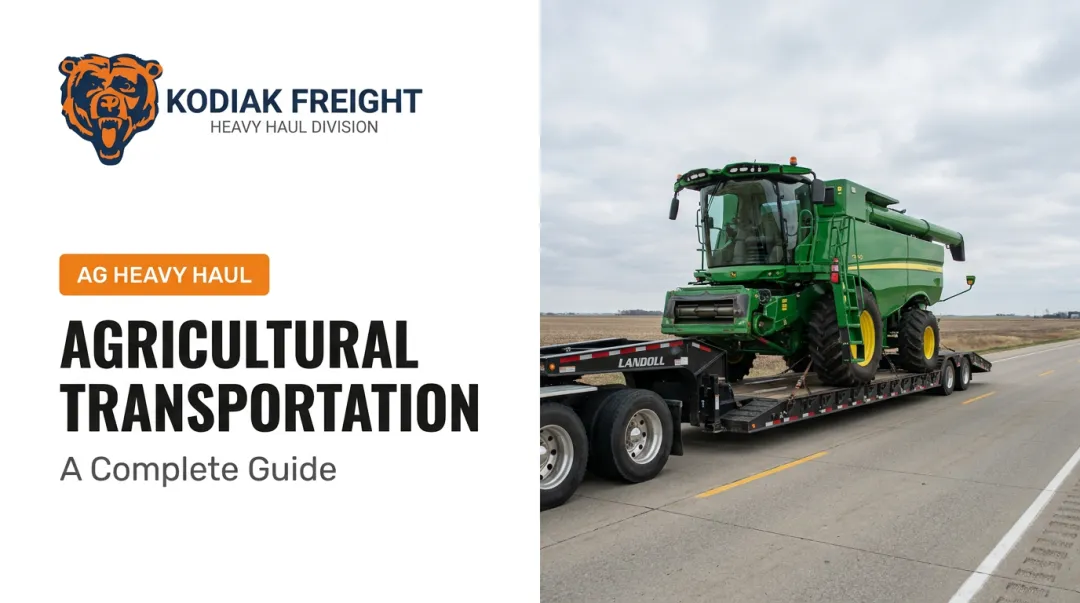
- Agriculture — combines, large tractors, irrigation systems, grain handling equipment; demand concentrated in the Midwest and Great Plains
- Manufacturing — industrial presses, production machinery, prefabricated components; shipments often tied to plant build-outs, factory relocations, or equipment upgrades
- Mining — excavators, haul trucks, drilling rigs, crushers, and processing machinery; loads almost universally exceed standard DOT thresholds
- Construction — structural steel, precast concrete sections, bridge beams, heavy construction equipment
- Energy & Utilities — wind turbine blades (which can, according to the U.S. Department of Energy, reach hundreds of feet in length), tower sections, large power transformers, substation equipment
- Oil & Gas — drilling rigs, pressure vessels, refinery modules, pipeline sections
- Data Centers — modular data hall units, large UPS systems, prefabricated cooling infrastructure

Kodiak Freight's Heavy Haul Division serves all of these sectors, handling permit coordination, pilot car escorts, and specialized equipment for oversize shipments that leave no room for error.
Frequently Asked Questions
What does "wide load" mean?
A wide load — also called an oversize load — is any shipment that exceeds standard legal dimensions for road travel, most commonly a width greater than 8.5 feet. These shipments require a special state-issued permit before they can legally move on public roads.
What is the widest load you can transport?
Standard oversize permits typically cover loads up to approximately 14–16 feet wide depending on the state. Beyond those thresholds, loads enter "superload" territory, which requires additional engineering review, specialized routing, and often law enforcement escort in addition to private pilot cars.
What permits are required for wide load transportation?
A state-issued oversize/overweight permit is required for each state the shipment travels through. Each permit specifies the approved route, travel dates and times, load dimensions, and any special conditions.
Do wide loads need escort vehicles?
Requirements vary by state and load dimensions. Loads wider than 12 feet commonly require at least one pilot car, with larger loads requiring escorts front and rear. Some states mandate law enforcement escorts for superloads in addition to private pilot vehicles.
Are there time restrictions on when wide loads can travel?
Most states restrict wide load travel to daylight hours — typically 30 minutes before sunrise to 30 minutes after sunset — and prohibit movement on weekends and federal holidays. Exact rules vary by state and permit class.
How much does wide load transportation cost?
Costs depend on distance, load dimensions, number of states crossed, permit fees, escort vehicle requirements, and specialized equipment. Permit fees alone range from $5 to over $200 per state depending on load size and state-specific schedules. Contact a heavy-haul specialist like Kodiak Freight for accurate pricing on your specific shipment.