
Key Takeaways
- Mining equipment falls into three functional categories: extraction, material handling, and processing.
- Construction equipment is organized by task — earthmoving, lifting and material handling, and compaction and paving.
- The right equipment choice depends on terrain, project scale, material type, and operating environment.
- Mining equipment is built for continuous heavy-duty output; construction equipment prioritizes versatility and maneuverability.
- Moving oversized equipment between sites requires specialized heavy-haul transport, permitting, and route planning.
Mining and construction are two of the most equipment-intensive industries on earth. The machines you choose directly affect safety, operating costs, and whether a site hits its production targets.
This guide breaks down the most common types of mining and construction equipment by function, explains what each category does, and helps operations and procurement teams understand which type fits which application. It also covers the logistical reality that often gets overlooked during procurement: moving this equipment between sites is a complex undertaking in its own right.
What Is Mining and Construction Equipment?
Mining and construction equipment refers to the broad category of heavy machinery designed to move earth, extract raw materials, handle bulk loads, and prepare surfaces for development.
While both industries share some equipment categories, the versions used in mining are typically scaled for higher output, harsher environments, and longer continuous run times. Common crossover machines include:
- Excavators — used for digging and material handling on both site types
- Wheel loaders — move bulk material at quarries, mines, and job sites alike
- Bulldozers — clear and grade terrain across both industries
Construction equipment, by contrast, is built for flexibility and site adaptability rather than sustained high-volume output.
Operations and procurement teams classify this equipment by function — matching each machine to the specific task it's built to handle, regardless of brand or size.
Types of Mining Equipment
Most mining sites require three functional categories working in coordination: extraction, material handling, and processing. A breakdown in any one of them stalls the entire operation.
Extraction Equipment
Extraction equipment breaks ground and removes raw material through drilling, cutting, or digging. The method varies by deposit type, depth, and material hardness.
| Equipment Type | Primary Use | Key Detail |
|---|---|---|
| Rotary blasthole drill | Open-pit surface mines | Creates blast holes in hard rock; Sandvik's DR416iE drills 270–406 mm holes with a 1,044 kW power group |
| Drilling jumbo | Underground hard rock | Battery-electric models like the Sandvik DD422iE cover 60 m² and drill 43–64 mm holes |
| Continuous miner | Underground coal and potash | Uses tungsten carbide cutting tools; Sandvik MC350 cuts up to 3,100 mm high and 3,500 mm wide |
| Dragline | Surface coal and overburden | Cat 8750 handles 76–116 m³ bucket capacity with boom lengths up to 132.5 m |
| Bucket-wheel excavator | Large-scale lignite and coal operations | TAKRAF models range from 350 to 19,000 m³/hour output |

The Bagger 293 bucket-wheel excavator, recognized by Guinness World Records as the largest land vehicle ever built, weighs 14,196 tonnes and stands 94.5 m tall. Relocating machines at this scale — or even smaller dragline components — requires specialized heavy-haul logistics far beyond standard freight.
Material Handling Equipment
Once material is extracted, it needs to move. Material handling equipment carries raw material from the extraction point to processing facilities or waste areas.
Surface operations use large off-highway haul trucks built for rough terrain and high payloads:
- The Cat 797F and Komatsu 980E-5 both carry 400 US short tons (363 tonnes) per load
- Articulated dump trucks like the Volvo A40 handle 43 short tons on difficult terrain
Underground operations require a completely different approach:
- Load haul dumpers (LHDs) are built low-profile for confined tunnel environments
- The Sandvik LH518iB carries 18,000 kg with a profile height of just 2,300 mm
- Battery-electric LHDs address exhaust and ventilation constraints underground
Haul trucks present a significant logistics challenge when moving between mine sites. The Cat 797F's rated gross machine weight is 1,375,000 lb — well beyond what standard road limits allow.
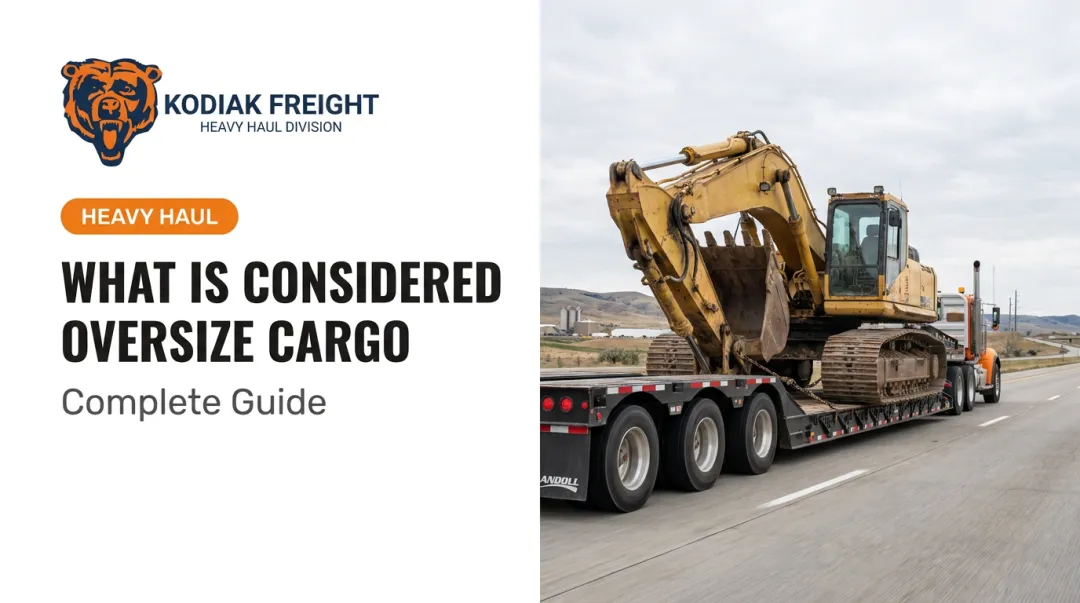
Carriers like Kodiak Freight's Heavy Haul Division, which transports excavators, haul trucks, drilling rigs, and crushers for mining clients, handle the permitting, route surveys, and specialized trailer configurations these moves require.
Processing Equipment
After material reaches the processing facility, it's converted into usable products through crushing, grinding, and separating.
Common processing equipment types include:
- Jaw crushers — primary reduction of large rock, used at the front end of processing circuits
- Cone crushers — secondary or tertiary crushing after initial size reduction
- Ball mills — wet or dry grinding to fine liberation sizes (~100–10 microns)
- Rod mills — open-circuit wet grinding, feed up to 30 mm, producing 0.3–2 mm fractions
- Classifiers — spiral classifiers and hydrocyclones control fine particle sizing
Processing equipment is typically fixed in place at large operations, but modular plants — like Metso's wheel-mounted NW Rapid units — are designed for rapid relocation. When those plants move, the same heavy-haul logistics apply: oversize permitting, crane and rigging for loading, and specialized trailer configurations for transport.
Types of Construction Equipment
Construction projects typically draw on three equipment categories at different phases: earthmoving, lifting and material handling, and compaction and paving.
Earthmoving Equipment
Earthmoving equipment shapes a site by digging, grading, pushing, and moving soil and rock.
Core earthmoving types and their primary roles:
- Excavators (tracked and wheeled) — hydraulic arm and bucket for digging, trenching, demolition, and lifting; tracked models offer stability, wheeled models add road mobility
- Backhoe loaders — rear hoe combined with a front bucket, well-suited for smaller sites
- Bulldozers — front-mounted blade pushes material and clears land
- Motor graders — create flat, graded surfaces for roads and foundations
- Scrapers — cut, load, transport, and spread topsoil efficiently over large flat areas

The key differentiator from mining-grade earthmoving: construction equipment is sized for maneuverability in tighter spaces and shorter project durations. Mining excavators from Liebherr span bucket sizes from 7 to 47.5 m³ — construction-grade machines work at smaller scales suited to their project environments.
Lifting and Material Handling Equipment
Once the ground is shaped, work moves upward. This category covers machines that lift and place materials vertically and horizontally across a job site.
Crane selection follows a specific logic:
- Tower cranes — fixed-height lifting for residential, commercial, and industrial construction
- Mobile cranes — flexible repositioning across a site or between locations
- Crawler cranes — distribute load over tracks for soft or unstable ground. OSHA requires ground that is firm, drained, graded, and adequate for manufacturer specifications — tracks alone don't make soft ground safe
Other key types:
- Wheel loaders — bulk material loading and stockpiling
- Telehandlers — telescoping boom places materials at height; the JLG 2733 carries 26,600 lb rated capacity with 33 ft of maximum lift height
- Skid steer loaders — compact, attachment-driven machines suited to confined sites
When transporting cranes and large wheel loaders between job sites, standard freight carriers can't handle the load. Kodiak Freight's crane and rigging service supports the loading, unloading, and on-site placement of oversized lifting equipment that can't be handled through conventional means.
Compaction and Paving Equipment
Compaction and paving equipment prepares and finishes surfaces for load-bearing use.
The functional sequence on a road project:
- Paver — lays asphalt continuously using a heated screed and automatic grade controls
- Vibratory breakdown roller — follows immediately after the paver; FHWA data shows a 1.5-inch lift cools from 300°F to 200°F in just 9 minutes, so any delay loses the compaction window
- Intermediate and finish rollers achieve specified density before the mat cools
- Cold planer removes deteriorated surface material when resurfacing is needed before paving begins
How to Choose the Right Equipment for Your Project
Equipment selection is driven by operational requirements — not brand familiarity or what's available at the nearest dealer. Mismatches between machine capability and site conditions cause project delays and cost overruns.
Work through these five factors before committing:
Surface vs. underground environment: Underground operations require low-profile, reduced-emission equipment. Surface operations can accommodate larger, more powerful machines.
Material type and volume: Hard rock extraction needs different tools than coal seams or soft earth. High-volume sites demand higher-capacity haulers and loaders to match the production rate.
Project duration: Long-term mining operations justify purpose-built, high-capacity machinery. Shorter construction projects favor versatile multi-use equipment. Caterpillar's guidance suggests renting below 40% utilization, buying above 65%, with a comparison warranted in between.
Site access and terrain: Remote or unprepared sites restrict which machines can be delivered and operated effectively. Confirm access routes before finalizing your equipment list.
Transport and logistics feasibility: Research whether selected equipment can be legally moved on available road infrastructure. FHWA sets Interstate baselines at 80,000 lb GVW, but oversize/overweight permits are issued at the state level — and each state sets its own rules. Factor in permitting timelines and costs before committing to a purchase.

Common selection mistakes to avoid:
- Choosing the most powerful option when a simpler machine would do the job
- Ignoring total cost of ownership: fuel, tires, undercarriage, maintenance, operator training, and transport all contribute
- Underestimating the cost and complexity of moving large equipment to and from the site
Frequently Asked Questions
What are the four types of mining?
The four main types are surface mining (open-pit and strip), underground mining, placer mining, and in-situ mining. Each suits different deposit depths, material types, and extraction methods — from massive open pits to solution mining where minerals are dissolved in place and pumped to surface.
What is the most commonly used piece of construction equipment?
Excavators are widely considered the most versatile piece of construction equipment, used for digging, trenching, demolition, and lifting across nearly every project type in both construction and mining contexts.
What is the difference between surface and underground mining equipment?
Surface mining uses large, high-capacity machines (haul trucks, draglines, open-pit excavators) designed for volume and range. Underground equipment is built smaller and lower-profile, with reduced emissions to operate safely in confined tunnel environments where ventilation is limited.
What equipment is used in both mining and construction?
Excavators, bulldozers, wheel loaders, and motor graders appear across both industries. Mining-grade versions are typically larger and engineered for higher duty cycles and continuous heavy-load operation.
How is large mining and construction equipment transported between job sites?
Oversized equipment (haul trucks, large excavators, crushers) requires specialized heavy-haul carriers — standard freight carriers cannot legally or safely handle these loads. Carriers like Kodiak Freight manage state-by-state permitting, pilot car escorts, crane and rigging, and specialized trailer configurations for each move.
How do I know when to rent vs. buy mining or construction equipment?
Renting suits short-duration or infrequent needs (generally six months or less); purchasing makes sense above roughly 65% utilization. Either way, factor in maintenance, storage, and transport costs — these often shift the math considerably.
Conclusion
Mining and construction overlap in the equipment they use, but remain distinct industries with different demands. Understanding equipment by functional category — extraction, material handling, and processing for mining; earthmoving, lifting, and compaction for construction — gives procurement and operations teams a practical framework for decision-making.
Matching machine capability to site conditions is the single most important factor in controlling costs and keeping projects on schedule. Environment, material type, project scale, and access logistics all shape that decision.
Once the right equipment is selected, moving it deserves the same careful planning. Heavy construction and mining machines are oversize, overweight loads that require permitted routes, specialized trailers, and experienced carriers. That's where Kodiak Freight's heavy-haul division comes in — handling the transport side so your equipment arrives on-site ready to work.