The opportunity is real. The ATA reported a shortage of 78,800 qualified truck drivers across the industry in 2022 — and the need for experienced specialized drivers who can handle complex permitted loads is particularly acute.
This guide is for CDL drivers considering a transition into heavy haul, newer drivers evaluating specialization, and anyone exploring the owner-operator path. You'll find everything needed to understand the requirements, build the right experience, and navigate the career step by step.
Key Takeaways
- Heavy haul covers loads exceeding 8'6" wide, 80,000 lbs gross weight, or state height limits — all requiring a movement permit
- A CDL-A is the minimum license requirement, paired with a DOT medical certificate and clean MVR
- The proven path: CDL-A, then flatbed experience, specialized training, and permitted loads with a carrier
- ZipRecruiter reports heavy haul drivers average $71,196/year, with top earners exceeding $101,000
- Permits are load-specific in most cases and must travel with every shipment
What Is Heavy Haul Trucking?
Heavy haul trucking covers the transport of freight that exceeds standard federal size or weight limits as defined by the FHWA. Cross those thresholds, and you're in permitted-load territory.
Federal baseline limits (Interstate System):
- Width: 102 inches (8'6")
- Single axle weight: 20,000 lbs
- Tandem axle weight: 34,000 lbs
- Gross vehicle weight: 80,000 lbs
Height is regulated at the state level — most states set limits between 13'6" and 14'. Length is similarly state-controlled; federal law protects at least a 48-foot semitrailer, but states regulate longer configurations individually.
Industries That Depend on Heavy Haul
No two loads in this field are identical. Heavy haul serves industries where freight can't be reduced to standard trailer sizes:
- Agriculture — tractors, combines, harvesters, irrigation systems
- Mining — excavators, haul trucks, drilling rigs, crushers
- Manufacturing — production line machinery, factory automation equipment
- Construction — cranes, concrete forms, large structural components
- Energy — wind turbine components, power transformers, utility infrastructure
- Railroad — track equipment and rail infrastructure components
- Data centers — oversized server infrastructure and cooling systems
Kodiak Freight, for example, runs Landoll tilt-deck trailers, flatbeds, and power-only moves for clients across agriculture, mining, manufacturing, and railroad — a cross-section that reflects how broadly heavy haul touches industrial operations.
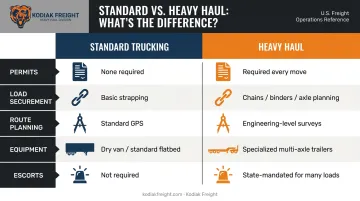
Heavy Haul vs. Standard Trucking
| Factor | Standard Trucking | Heavy Haul |
|---|---|---|
| Permits | None required | Required for every oversized move |
| Load securement | Basic strapping | Advanced chains, binders, axle planning |
| Route planning | Standard GPS | Engineering-level route surveys |
| Equipment | Dry van, standard flatbed | Specialized trailers, multi-axle configurations |
| Escorts | Not required | State-mandated for many loads |
Equipment and Trailers Used in Heavy Haul
Trailer selection in heavy haul is determined by the cargo's dimensions, weight, and loading requirements — not driver preference or availability.
The Four Primary Trailer Types
Step Deck (Single Drop Deck) Two-level trailer that drops after clearing the tractor. Used for tall loads that wouldn't clear a standard flatbed but don't require a full lowboy. Common for construction vehicles and industrial machinery.
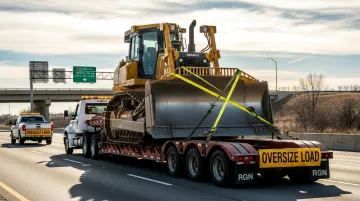
Removable Gooseneck (RGN) The front section detaches to create a ground-level loading ramp, allowing self-powered equipment like bulldozers or excavators to drive on. Payload capacity varies by configuration and axle count — always verify against the specific trailer's rated load plan.
Double Drop / Lowboy A deep "well" between two short deck sections carries the cargo low to the ground, gaining clearance for very tall loads. Used for cranes, large forklifts, and oversized construction equipment. Two-axle models typically rate at 60,000–80,000 lbs; three-axle configurations reach 90,000–110,000 lbs.
Stretch / Extendable Trailers A sliding mechanism extends the cargo bed for long, self-supporting loads — steel beams, lumber, wind tower sections, trusses. One Fontaine configuration, for example, extends from 29.4 feet closed to 50.4 feet open. Available in flatbed, step deck, double drop, and RGN styles.
Axles and the Bridge Formula
Additional axles distribute weight across more contact points, allowing heavier gross weights while staying within per-axle limits. The Federal Bridge Formula governs this:
Formula B: W = 500[(LN)/(N-1) + 12N + 36]
Where W = allowable weight, L = distance between outer axles, N = number of axles. More axles and greater spacing increase the formula allowance — but none of that overrides the federal ceilings:
- 20,000 lbs maximum on a single axle
- 34,000 lbs maximum on a tandem axle group
- 80,000 lbs maximum gross vehicle weight
Super Loads
Super loads sit at the top of the complexity scale. Thresholds vary by state — two examples:
| State | Width | Height | Load Length | Gross Weight |
|---|---|---|---|---|
| Washington | 16' | 16' | 125' | 200,000 lbs |
| Pennsylvania | 16' | — | 160' | 201,000 lbs |
These moves require customized equipment, engineering route surveys, and permitting processes well beyond a standard oversize load.
Licensing and Requirements to Get Started
CDL-A
A Class A Commercial Driver's License is mandatory. Requirements:
- Minimum age: 18 for intrastate, 21 for interstate commerce
- Pass a knowledge test, hold a Commercial Learner's Permit for at least 14 days, then complete vehicle inspection, basic control, and road skills tests
- First-time applicants must complete Entry-Level Driver Training (ELDT) through an FMCSA-registered provider
Some cargo types require additional endorsements (Hazmat for certain chemicals, doubles/triples for multi-trailer configurations).
DOT Medical Certificate
All commercial drivers must hold a valid DOT medical certificate, issued by an FMCSA-licensed examiner. The exam covers:
- Vision of at least 20/40 acuity in each eye, 70-degree horizontal field, and ability to distinguish red, green, and amber
- Hearing tested via forced whisper at 5 feet, or average loss no greater than 40 dB
- Blood pressure, cardiovascular, neurological, and musculoskeletal function
Certification is valid for up to 24 months, though examiners may shorten it based on health findings.
MVR and Background Standards
Employers pull Motor Vehicle Records during hiring. In heavy haul, a clean MVR matters more than in standard freight because oversized loads carry significant liability, and carriers are selective. Disqualifying factors include serious traffic violations, DUI history, and multiple at-fault accidents.
Drug and Alcohol Compliance
DOT drug testing under 49 CFR Part 40 covers five substances: marijuana, cocaine, opioids, amphetamines, and PCP. Testing applies pre-employment, randomly during employment, and post-accident.
A positive result or refusal triggers prohibited status in the FMCSA Clearinghouse. Since November 18, 2024, that status results in CDL downgrade or denial until a driver completes the full SAP (Substance Abuse Professional) return-to-duty process: evaluation, treatment, a negative return-to-duty test, and follow-up testing.
Owner-Operator Registration Requirements
If you're going independent rather than driving for a carrier, you'll need three additional registrations before moving freight:
- A USDOT Number, required for interstate CMVs with GVWR or actual gross weight over 10,001 lbs
- MC Operating Authority, required for interstate for-hire transport of federally regulated property
- A BOC-3 Filing, which designates process agents in states where you operate (only a registered process agent may file this on your behalf)
Step-by-Step Path Into Heavy Haul Trucking
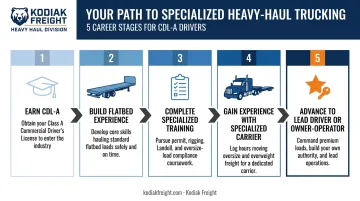
Step 1 — Earn Your CDL-A
Enroll in a CDL-A program at an accredited school or through a company-sponsored program. Focus on passing both the written and skills components. Consider whether optional endorsements (Hazmat, doubles/triples) align with the heavy haul niches you're targeting before you complete your training.
Step 2 — Build Flatbed and Step-Deck Experience
Open-deck experience is the foundation of heavy haul competency. Spend time on flatbed or step-deck positions specifically — these build:
- Load securement skills (chains, straps, binders, correct tension)
- Weight distribution awareness
- Route planning for non-standard freight
Drivers who skip this step and jump directly into permitted loads typically struggle with the fundamentals. Seek out flatbed-specific positions intentionally.
Step 3 — Complete Specialized Heavy Haul Training
Beyond CDL school, heavy haul training covers:
- Advanced tie-down techniques for oversized loads
- OSHA safety guidelines for heavy freight
- Escort vehicle coordination and communication
- Permit acquisition processes
- Bridge Formula calculations and axle spacing compliance
- TWIC card considerations for port-related loads
Step 4 — Gain Real-World Experience with a Specialized Carrier
Training builds the knowledge — real-world reps build the instincts. Starting with a carrier that has a dedicated heavy haul division builds skills faster than a general freight company. Operations like Kodiak Freight's Heavy Haul Division give drivers hands-on experience across mining, manufacturing, agriculture, and other sectors — running Landoll tilt-deck equipment, flatbeds, and power-only OD moves across diverse load types and jurisdictions.
Working within a specialized operation exposes drivers to the exact permit scenarios, escort requirements, and load configurations they'll encounter throughout their careers.
Step 5 — Advance to Lead Driver or Owner-Operator
After accumulating experience across diverse load types and permit scenarios, several advancement paths open:
- Lead driver or trainer — mentor newer drivers, take on more complex loads
- Fleet supervisor — oversee driver schedules, dispatch, and compliance within a carrier's heavy haul operation
- Owner-operator — negotiate rates directly, higher gross potential with higher overhead
The owner-operator transition requires equipment investment, securing MC authority, sourcing loads independently, and managing full business operations — insurance, fuel, permits, and maintenance all come out of gross revenue.
Permits, Compliance, and Safety Essentials
Oversize and Overweight Permits
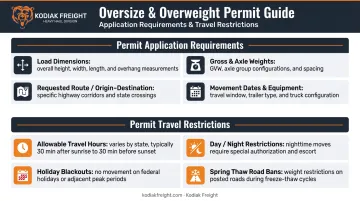
Every state requires a movement permit for loads exceeding legal size or weight thresholds. Most permits for individual shipments are load-specific and authorize one movement between named origin and destination points — though some states also offer annual permit types for qualifying operations.
A typical permit application requires:
- Load dimensions (height, width, length, overhang)
- Gross and axle weights with axle spacings
- Requested route or origin/destination
- Movement dates and equipment description
Permits dictate allowable travel hours, day/night restrictions, holiday blackouts, and speed limits. Spring thaw restrictions in northern states — Minnesota, Wisconsin, and Michigan among them — can limit or prohibit movement entirely during certain periods to protect road infrastructure. Violating permit conditions, even routing errors, can result in fines, load impoundment, or license suspension.
Escort Vehicle Requirements
Escort requirements are state-specific. Texas, for example, generally triggers escort requirements above 14 feet wide. Required equipment varies but typically includes:
- "Oversize Load" or "Wide Load" signage on escort vehicles
- Flashing amber lights
- Red or orange corner flags on the load
- Two-way radio communication between escort and driver
The driver is responsible for coordinating with escort teams before departure and verifying all safety indicators are correctly placed.
Load Securement and Inspections
Proper securement means using the correct number and type of tie-downs for the load weight and distribution: chains, straps, and binders rated appropriately, tensioned correctly, and checked at rest stops. Weight must be distributed evenly across axles within legal limits.
Under 49 CFR Part 396, drivers must confirm the vehicle is safe before operating and report defects found during or after trips. Carriers must repair any safety-affecting defects before the vehicle returns to service. Pre-trip and post-trip inspections are a federal regulatory requirement with real consequences for non-compliance.
Before departure, use routing software or bridge calculators to verify that your planned axle configuration and spacing comply with the Bridge Formula for the specific route — this matters most on routes crossing older infrastructure.
Heavy Haul Career Path and Earnings
Salary Overview
According to ZipRecruiter data from July 2026, heavy haul truck drivers earn:
| Benchmark | Annual | Hourly |
|---|---|---|
| Average | $71,196 | $34.23 |
| Median | $60,300 | — |
| 25th percentile | $49,100 | — |
| 75th percentile | $90,500 | — |
| 90th percentile | $101,000 | — |
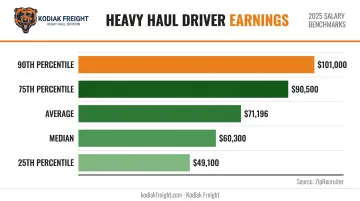
The BLS reported a May 2024 median of $57,440 for all heavy and tractor-trailer truck drivers combined. Heavy haul commands a premium over that baseline due to load complexity, permit management demands, and specialized skill requirements.
Key pay factors include:
- Load type and complexity
- Route difficulty and state permit requirements
- Certifications held (oversize endorsements, HAZMAT, etc.)
- Carrier rate structure and contract terms
Drivers handling super loads or particularly complex permitted freight tend to sit toward the upper end of the range.
Owner-Operator Considerations
Owner-operators in heavy haul can negotiate rates directly and capture more per-load revenue — but gross income doesn't equal net income. Commercial insurance alone runs significantly higher for oversized loads, and that's before factoring in equipment costs, permit fees, fuel, and maintenance. No reliable industry-specific net income data exists for heavy haul owner-operators, so approach income projections conservatively and build detailed cost-per-mile estimates before making the transition.
Career Growth Outlook
The trajectory in heavy haul typically moves through several stages:
- Company driver → lead driver → trainer or fleet supervisor
- Experienced drivers can transition to independent owner-operator
- Permitted load specialists with clean records command consistent work
The industries driving that demand — energy infrastructure, mining, and manufacturing — show no signs of contracting, keeping qualified heavy haul drivers in short supply.
Frequently Asked Questions
How much do heavy haulers make?
Heavy haul drivers average $71,196/year according to ZipRecruiter, with experienced drivers reaching $90,500–$101,000 annually. Owner-operators earn more per load gross but carry higher overhead costs including insurance, equipment, and permits.
Is hauling heavy equipment hard?
It's genuinely demanding: managing oversized loads requires precise securement, permit compliance across multiple states, escort coordination, and often irregular hours. With proper training and real-world experience, most drivers find the complexity more engaging than standard freight.
What CDL do you need for heavy haul trucking?
A CDL-A is required for heavy haul operations. Depending on cargo type, additional endorsements may apply — Hazmat for certain chemicals, doubles/triples for multi-trailer configurations. The CDL-A is the baseline; endorsements are load-specific.
What trailers are used in heavy haul trucking?
The primary types are step deck, removable gooseneck (RGN), double drop/lowboy, and stretch/extendable trailers. Landoll tilt-deck trailers handle equipment that self-loads via hydraulic tilt. Selection depends on cargo dimensions, height, weight, and loading method.
Do you need a permit for every heavy haul load?
Yes. Any load exceeding legal size or weight thresholds requires a state-issued movement permit. Most are load-specific and authorize one movement between defined points. Permits must travel with the shipment and dictate route, timing, and escort requirements.
What industries use heavy haul trucking?
Agriculture, manufacturing, mining, railroad, construction, energy (wind turbines, power transformers), oil and gas, data centers, and utilities all rely on heavy haul. Each industry presents distinct cargo types, dimensional challenges, and load requirements.