
Introduction
Freight delays cost more than time. A missed delivery window can halt a production line, back up a harvest operation, or stall an entire construction project. For businesses moving high-volume, recurring freight, relying on inconsistent carriers or the spot market creates compounding risk — unpredictable costs, variable service quality, and no guarantee of capacity when you need it most.
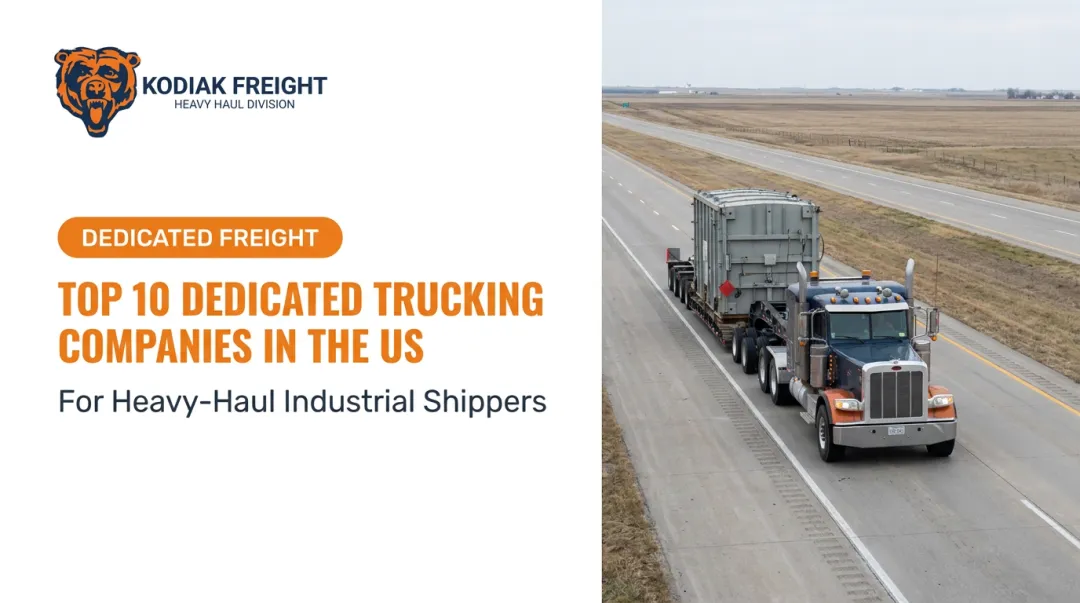
Dedicated trucking solves this by assigning trucks, drivers, and resources exclusively to one client for recurring shipments on fixed routes and schedules. Instead of competing for available capacity each week, you have committed assets that show up on time, every time.
This guide covers what dedicated trucking is, who benefits most from it, its advantages and limitations, and what to look for when choosing a carrier partner. It also examines how companies like Kodiak Freight structure dedicated heavy-haul arrangements for industrial clients.
Key Takeaways
- Dedicated trucking assigns vehicles and drivers exclusively to one client for consistent, scheduled freight runs
- Fixed contract rates protect shippers from spot market volatility and improve budget predictability
- Agriculture, manufacturing, mining, and railroad sectors depend on dedicated trucking for time-sensitive, high-volume freight
- Choosing the right carrier means matching equipment, industry experience, and service culture to your freight needs
What Is Dedicated Trucking?
Dedicated trucking — also called Dedicated Contract Carriage (DCC) — is a logistics arrangement where a carrier exclusively assigns trucks, drivers, and resources to a single client for recurring shipments. Unlike shared freight or the spot market, where capacity rotates between multiple customers at variable rates, dedicated trucking gives one shipper priority access to committed assets.
Two Primary Forms
It takes two main shapes, depending on how broadly a shipper needs coverage:
| Form | Description |
|---|---|
| Dedicated freight lanes | Carrier commits to running a specific route for one shipper at a contracted rate |
| Dedicated fleets | Carrier's full asset set — trucks, drivers — is assigned to one client account long-term |
How It Works Operationally
A typical dedicated arrangement runs on set pickup and delivery times, consistent routes (Point A to Point B), and contracted rates. For example: a manufacturer receiving raw materials from the same supplier every Tuesday and Thursday gets the same driver, the same truck, and the same delivery window — week after week.
Dedicated routes vary in scope:
- Local runs completed multiple times per day
- Regional lanes covering 200–500 mile corridors
- Long-haul assignments spanning multiple states
How It Differs from LTL and Spot Freight
- LTL (less-than-truckload) shares trailer space among multiple shippers — dedicated gives you the entire truck exclusively
- Spot freight is booked ad hoc at whatever the market rate is that day, with no guaranteed capacity and no long-term commitment
According to research on Dedicated Contract Carriage from Logistics Management, combined private and dedicated trucking revenue reached $541 billion in 2024 — a figure that underscores how central this model has become to industrial supply chains.
Key Benefits of Dedicated Trucking for Businesses
Predictability and Cost Stability
Fixed schedules let businesses plan production timelines, warehouse staffing, and inventory management around reliable delivery windows. Contracted dedicated rates extend that same stability to cost — shielding shippers from spot market swings in a meaningful way, given that the delta between contract and spot rates reached historic highs in December 2022.
For high-volume shippers, that cost stability often outweighs a short-term spot premium — and it also makes the next advantage possible: consistent, experienced freight handling.
Fewer Handling Errors and Cargo Damage
When the same driver handles the same freight on the same route repeatedly, familiarity pays off. They know:
- How to secure specific cargo types
- The quirks of each delivery site
- Any route-specific weight or clearance restrictions
This matters especially for heavy, oversized, or high-value cargo — categories where a single mishandled load can mean six-figure damage. Carriers like Kodiak Freight build this expertise specifically around oversize and overweight freight, where securement and delivery protocols are both legally mandated and operationally critical.
Stronger Carrier-Shipper Relationship
With a dedicated carrier, you stop fielding calls from strangers about your freight. Over time, the carrier builds a working knowledge of your specifications, scheduling requirements, and site-specific preferences. That familiarity shifts the dynamic from reactive problem-solving to proactive communication — the carrier flags issues before they reach you.
Improved Safety and Compliance
Drivers who repeatedly run the same route build genuine familiarity with road conditions, weight stations, bridge restrictions, and delivery site layouts. For specialty freight — particularly oversize or overweight loads — this is not a minor advantage. Route planning for oversized cargo is complex: state permitting practices for oversize/overweight loads vary significantly across the U.S., and a carrier who has run your lane dozens of times already knows the permit requirements, escort protocols, and site access constraints.
Kodiak Freight's dedicated heavy-haul operations cover the full compliance picture for repeated lanes:
- State-by-state oversize/overweight permitting
- Pilot car coordination and escort protocols
- Superload permitting
- Route surveys and site access planning

Each of these elements becomes faster and more reliable the more often a carrier runs the same corridor.
Which Industries Rely on Dedicated Trucking?
Manufacturing
Just-in-time (JIT) manufacturers have near-zero tolerance for late deliveries. A parts shipment arriving four hours late can idle an entire assembly line. Dedicated trucking gives JIT operations the schedule reliability that ad hoc freight simply cannot provide.
Agriculture
Agricultural shippers face a combination of time pressure and specialized equipment needs — harvest cycles don't wait for available trucks. Kodiak Freight's agriculture equipment hauling covers:
- Tractors, combines, and harvesters
- Irrigation equipment and grain handling systems
- Oversized farm machinery requiring Landoll tilt-deck transport and permit coordination
A dedicated arrangement locks in the right equipment and driver before planting or harvest season begins.
Mining and Heavy Industry
Mining operations ship excavators, haul trucks, drilling rigs, and crushers — freight that requires specialized trailers, custom axle configurations, superload permits, and detailed route surveys. Kodiak Freight's dedicated Heavy Haul Division serves this sector with a complete service range, including oversize/overweight hauling, crane and rigging, laydown yard staging, and permit coordination.
Railroad and Infrastructure
Railroad and infrastructure projects require coordinated, repetitive transport of oversized components — rail sections, track maintenance equipment, large structural elements. The project-based nature of this work makes dedicated trucking a natural fit: the same carrier shows up on schedule, with consistent capability, across weeks or months of an active project.
Dedicated Trucking vs. OTR: Key Differences
| Factor | Dedicated | OTR |
|---|---|---|
| Schedule | Fixed, recurring | Variable |
| Driver home time | More frequent | Weeks on the road |
| Route variety | Limited/repeat | High variety |
| Rate structure | Stable contract rates | Variable, market-driven |
| Shipper control | High | Lower |

OTR makes more sense for shippers with irregular freight volumes, one-time shipments, or lanes that aren't consistent enough to justify a dedicated contract.
The choice looks different from the driver's seat. Dedicated roles offer predictable schedules, steady home time, and ongoing relationships with the same customers. Drivers who value structure tend to gravitate toward dedicated; those who prefer geographic variety — or the potential for higher spot earnings — often lean OTR.
Potential Drawbacks of Dedicated Trucking
No freight model is without trade-offs. Before committing to a dedicated arrangement, consider:
- Reduced flexibility: Committed resources are harder to scale quickly during demand spikes. Negotiate contract provisions for volume fluctuations upfront
- Higher baseline cost in soft markets: When spot rates drop significantly, a locked-in dedicated contract rate may cost more than booking loads opportunistically. That's the nature of the model — you're paying for consistency, not market timing
- Strict performance expectations: Dedicated arrangements come with on-time delivery accountability on both sides. A missed window can trigger downstream production disruptions, so review performance standards and penalty clauses carefully before signing
How to Choose the Right Dedicated Trucking Partner
Match Equipment to Your Freight
The carrier must have the right trucks, trailers, and permits for your specific cargo. For oversize or overweight shipments, look for:
- A dedicated heavy-haul division with active permit capabilities
- Specialized trailer options (Landoll tilt-deck, custom axle configurations, power-only)
- Experience obtaining superload permits and coordinating pilot car escorts

Evaluate Service Culture
The best dedicated partnerships are built on transparency and accountability. Look for carriers that treat your account as a priority — not just another load. That means a single point of contact who knows your freight, proactive communication on shipment status, and a clear escalation path when something goes wrong. For complex moves — a 90,000-pound excavator crossing three state lines, for instance — that level of operational discipline isn't optional.
Before committing to a carrier, ask:
- Who is my primary point of contact?
- How are shipment status updates communicated?
- What is the escalation process if something goes wrong?
Review Safety Record and Industry Experience
Request carrier safety data through the FMCSA Safety Measurement System, which tracks carrier performance across seven Behavior Analysis and Safety Improvement Categories. Also ask about:
- Route familiarity with your specific lanes
- Regulatory knowledge for your freight type (agriculture, mining, railroad)
- Historical compliance with oversize/overweight permit requirements
Frequently Asked Questions
What is a dedicated trucking job?
A dedicated trucking job means a CDL driver is assigned to run the same route(s) for the same client on a recurring schedule. It offers stable pay, predictable home time, and consistent customer relationships — unlike OTR or spot freight roles where routes and clients change constantly.
Is dedicated better than OTR?
Neither is universally better. Dedicated suits drivers and businesses that value consistency and predictable schedules. OTR offers more geographic variety and potentially higher earnings for drivers willing to spend extended time away from home.
What industries benefit most from dedicated trucking?
Industries with high-volume, recurring, or time-sensitive freight benefit most — including manufacturing, agriculture, mining, railroad, and retail. Any operation where a delayed shipment triggers a costly downstream disruption is a strong candidate.
How is dedicated trucking different from spot freight?
Dedicated trucking assigns exclusive resources to one client on fixed routes, with contracted capacity and predictable scheduling. Spot freight is booked on demand at market rates — no long-term commitment, no guaranteed availability. For high-volume or time-sensitive freight, that uncertainty carries real operational risk.
What should I look for in a dedicated trucking provider?
Evaluate equipment capabilities, industry experience, safety record, service culture, and whether the carrier can handle specialty freight requirements. For heavy-haul needs, confirm the carrier has oversize/overweight permitting experience relevant to your lanes.
Is dedicated trucking more expensive than other options?
Dedicated contracts offer cost stability and are often more cost-effective long-term for high-volume shippers. In a soft spot market, contract rates may temporarily exceed spot pricing. For most operations, the value is in guaranteed capacity and consistent service, not short-term rate shopping.