
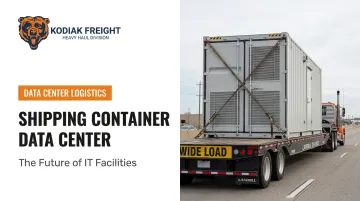
Introduction
AI workloads, high-performance computing, and edge deployments are pushing IT teams to move faster than traditional construction allows.
The modular data center market is projected to grow from $29.93 billion in 2024 to $79.49 billion by 2030, a 17.7% CAGR, according to MarketsandMarkets. Containerized units make up a meaningful slice of that growth.
Here's the problem: a conventional data center build takes 12 to 24 months or longer, from design through commissioning. Many businesses can't wait that long to add capacity, especially when demand for AI compute or edge processing shows up overnight.
This article breaks down what containerized data centers actually are, where they deliver real value, and how they stack up against stick-built facilities. We'll also cover something most planning guides skip: getting a fully outfitted container to its final site without damaging the equipment inside.
Key Takeaways
- Containerized data centers pack full IT infrastructure into a steel shipping container, slashing deployment time
- Modular growth is outpacing traditional builds, driven by AI, 5G, and edge computing demand
- Fully equipped units weigh far more than empty freight containers, often triggering oversize/overweight transport rules
- Site accessibility and heavy-haul logistics can make or break a deployment timeline and budget
- Traditional builds still make sense for hyperscale or highly customized facilities
What Is a Containerized Data Center?
A containerized data center is a prefabricated, self-contained IT facility built inside a standard steel shipping container shell, typically 20 or 40 feet long. Everything a small data hall needs gets integrated at the factory, then shipped to the deployment site as a single unit.
Manufacturers like Huawei, Schneider Electric, and Rittal build these units around ISO container dimensions, then pre-test the systems before the container ever leaves the plant. Huawei's IDS1000A, for example, packs eight IT cabinets and 60 kW of IT power into a 40-foot shell.
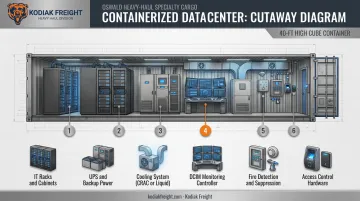
Core components typically include:
- IT racks and cabinets for servers, storage, and networking gear
- UPS systems and backup power to ride through outages
- Cooling systems, ranging from packaged CRAC units to liquid or immersion cooling
- DCIM and remote monitoring controllers for visibility into power, temperature, and capacity
- Fire detection and suppression systems built for enclosed spaces
- Access control and physical security hardware
Here's the detail that matters later: an empty 40-foot shipping container weighs around 8,245 pounds. Once you add racks, batteries, UPS gear, and cooling equipment, that same container can weigh tens of thousands of pounds more.
That shift from "empty box" to "loaded industrial asset" is exactly what turns a routine delivery into a heavy-haul project.
Key Benefits of Containerized Data Centers
Containerized units solve a specific problem: getting compute capacity online fast, without the multi-year commitment of a ground-up build.
Fast deployment. Omdia data cited by Vertiv puts traditional data center construction at 12 to 18 months; the Modular Building Institute puts it as high as 12 to 24 months or more. Containerized products are factory pre-integrated and pre-tested, so on-site work often shrinks to weeks rather than years.
Cost-effectiveness. Instead of one large capital outlay for a full building, containerized deployments let you phase spending. Buy and deploy capacity as you need it, rather than overbuilding for demand that might not arrive for years.
Scalability. Need more capacity? Add another module. Containerized units function like building blocks, letting operators grow compute footprint incrementally instead of re-engineering an entire facility.
Portability and relocatability. Because the unit is self-contained, it can move. That's valuable for edge computing sites, disaster recovery staging, or temporary deployments with a defined end date. Moving a loaded module requires oversize/overweight permitting and an experienced heavy-haul carrier, the kind of specialized transport Kodiak Freight provides for data center component moves.
Weather resistance and durability. Steel container construction, combined with proper coatings, holds up in tough climates. This matters for remote or exposed sites where a conventional building envelope isn't practical.
Energy efficiency. Optimized airflow design inside a compact footprint can support competitive Power Usage Effectiveness figures. Uptime Institute's 2025 survey puts industry-wide average PUE at 1.54, with newer facilities averaging 1.48 — a benchmark containerized designs are built to compete with.
Real-World Applications Across Industries
Containerized data centers show up wherever traditional infrastructure isn't practical, fast enough, or affordable.
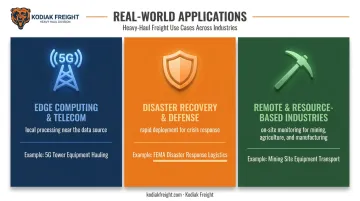
Edge Computing and Telecom
5G rollout and factory-floor processing both need compute close to the source. Huawei has sold IDS1000-series containers to telecom operators like Guatemala's MIC, enabling local processing without building a permanent facility in every location.
Disaster Recovery and Defense
Crisis response can't wait on construction timelines. The US Navy deployed Armada's Galleon containerized data center during its 2025 UNITAS exercise for edge HPC and networking. Australia's Department of Defence trialed similar mobile ICT systems in 2024.
Remote and Resource-Based Industries
Mining, agriculture, and manufacturing sites often sit far from reliable infrastructure. A major Canadian mining company deployed Bulldog mobile data centers across multiple remote sites for on-site monitoring. thyssenkrupp Steel expanded plant-level IT using Rittal Edge containers, keeping data processing close to the production line.
Getting these units to site takes heavy-haul transport. Carriers like Kodiak Freight move oversize, overweight data center components to mining and manufacturing sites that standard freight can't reach.
Traditional Data Centers vs. Containerized Data Centers
Choosing between a stick-built facility and a containerized deployment comes down to timeline, budget, and how much flexibility you need.
| Factor | Traditional Data Center | Containerized Data Center |
|---|---|---|
| Construction/deployment time | 12–24+ months | Weeks to a few months (product-dependent) |
| Scalability | Tied to site design and permitting | Add modules incrementally |
| Initial cost | Large upfront capital outlay | Phased investment, configuration-dependent |
| Flexibility | Fixed once built | Relocatable, reconfigurable |
| Energy efficiency | Industry average PUE around 1.54 | Optimized airflow design, competitive PUE |
| Build location | Integrated on site | Integrated at factory, placed on site |
Moving a prefabricated module from factory to site is its own logistics challenge. These units often qualify as oversize or overweight freight, a niche Kodiak Freight serves through heavy-haul transport for data center components nationwide.
Traditional builds still make sense for:
- Hyperscale campuses that need massive, purpose-built infrastructure
- Facilities with highly custom engineering needs beyond standard containers
- Single enterprise workloads where long-term economics favor custom construction
The Overlooked Challenge: Transporting a Containerized Data Center
Everyone plans for the container. Few plan for the truck.
Once a containerized unit is fully outfitted with racks, batteries, generators, and cooling systems, it frequently exceeds standard legal shipping limits for weight, width, or height. What started as a "standard 40-foot container" on paper becomes an oversize, overweight load in practice.
Permitting and Compliance
Federal rules cap gross vehicle weight at 80,000 pounds on the Interstate System and set a maximum width of 102 inches for standard loads. States issue permits for anything beyond those thresholds. A loaded data center container routinely blows past both limits, which means:
- State-by-state oversize/overweight permit applications
- Route surveys to check bridge clearances, road width, and low overhangs
- Escort vehicle coordination, since requirements vary widely by state and load width
Physical Risks in Transit
IT hardware doesn't tolerate rough handling. Shock and vibration during transport can damage sensitive electronics, loosen rack-mounted equipment, and stress battery systems.
These moves call for specialized trailers, proper load securement, and drivers who understand how to handle a load that behaves nothing like a standard shipping container.
Coordinating the Last Mile
Getting a containerized unit from the manufacturer's yard to a remote mining site, farm, or rural telecom hub takes coordination between three parties: the manufacturer, the carrier, and the receiving site. Miss a step, and the unit sits on a trailer while permits get sorted out.
Kodiak Freight's Heavy Haul Division handles exactly this kind of move. The company specializes in transporting oversize and overweight loads across agriculture, manufacturing, mining, and railroad industries — the exact sectors deploying containerized data centers in remote locations.
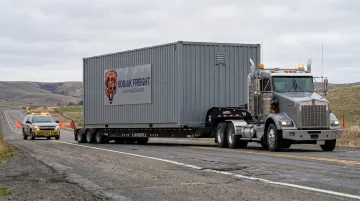
The team manages permitting, route surveys, and escort coordination, backed by technology-driven route planning that keeps last-mile delivery on schedule, even to sites without paved access. If you're planning a move, reach out to Kodiak's Heavy Haul Division to talk through your load specifics.
Cost Considerations When Planning Your Deployment
There's no single published price list for containerized data centers. Pricing depends on container size, power capacity, cooling type, and redundancy level, so vendors quote based on configuration rather than a fixed catalog price.
Beyond the base unit, plan for:
- Power and cooling equipment — UPS systems, batteries, generators, and cooling hardware add substantial cost beyond the base unit
- Site preparation — foundations, utility connections, and pad work
- Racks and networking hardware — IT equipment is usually a separate line item from the container shell itself
- Commissioning — testing and integration once the unit reaches its final site
One line item gets underestimated constantly: transportation. A remote mining site or rural telecom hub with limited road access can add substantial heavy-haul costs, or in the worst case, make a site unreachable without specialized equipment. Kodiak Freight's Heavy Haul Division handles exactly this kind of oversize data center transport, coordinating permitting and rigging for container moves nationwide. Factor transportation and logistics into your budget from day one, not as an afterthought once the container's already built.
Frequently Asked Questions
What is a shipping container data center?
It's a prefabricated IT facility built inside a standard steel shipping container, housing servers, power, cooling, and networking equipment. It offers fast deployment and portability compared to traditional builds.
How much does a shipping container data center cost?
There's no fixed public price range for new or used 20-foot and 40-foot units. Costs vary based on power capacity, cooling type, and configuration, and increase once you add site prep and transport.
What is the difference between modular and containerized data centers?
Modular data centers are a broader category of prefabricated IT facilities. Containerized data centers are one specific type, built inside a standard shipping-container-style shell.
Are containerized data centers secure and reliable?
Yes, with proper engineering. Access control, fire suppression, environmental monitoring, and remote management systems make well-built units highly secure and reliable.
How do you transport a containerized data center to a remote site?
Transport requires oversize/overweight permitting, route surveys, specialized trailers, and escort vehicles where required. Kodiak Freight's heavy-haul division handles these moves with Landoll trailers and CDL-licensed drivers to keep sensitive equipment protected in transit.
What is the average lifespan of a containerized data center?
Many operators plan around 10 to 15 years for the container structure itself, refreshing servers and support components more frequently as technology advances.