
Shippers moving oversize agricultural, mining, or manufacturing equipment across state lines run into the same recurring headaches: figuring out which hauling method fits their cargo, untangling permit rules that change at every state line, and finding a carrier that won't cut corners on securement just to save time.
This guide breaks down what freight hauling actually means, the major hauling types shippers choose between, the logistics process behind every shipment, and how to evaluate a partner — like Kodiak Freight's Heavy Haul Division — for specialized oversize and overweight freight.
Key Takeaways
- Freight hauling spans standard truckload shipping to specialized oversize/overweight heavy-haul transport
- Picking the right hauling type, whether FTL, LTL, flatbed, heavy-haul, or intermodal, shapes cost, speed, and safety
- A defined process covering quoting, permitting, securement, tracking, and delivery separates professional carriers from amateurs
- Agriculture, mining, manufacturing, and railroad operations depend on carriers with genuine heavy-haul expertise
What Is Freight Hauling? Definition, Meaning & Core Components
Freight hauling is the physical transportation of goods, equipment, and raw materials from an origin point to a destination, typically by truck or rail. It's the wheels-on-pavement act of getting cargo from Point A to Point B, distinct from the paperwork and route planning that surround it. This physical layer forms the backbone of the entire supply chain; nothing gets built, sold, or delivered until a hauler moves it.
What Does "Hauling Goods" Mean in the Supply Chain?
"Hauling goods" means loading freight onto a trailer or rail car and physically transporting it. The concept isn't new. It traces back to horse-drawn cartage and drayage operations that moved goods short distances between docks, warehouses, and rail yards long before diesel engines existed. Modern trucking is the mechanized descendant of that same job.
Today, industry professionals use "hauling," "trucking," and "freight transport" almost interchangeably. Every haul involves four key players:
- The shipper: owns the goods and needs them moved
- The carrier/hauler: physically transports the freight using their own trucks and drivers
- The dispatcher: coordinates schedules, routes, and communication between shipper and driver
- The load itself: the cargo, with its own weight, dimensions, and handling requirements
Hauling vs. freight forwarding is a distinction shippers often miss. A hauler physically moves the cargo with their own equipment, while a freight forwarder arranges and coordinates logistics, such as booking carriers and managing paperwork, without ever owning a truck. If you're calling a company because they have trucks and drivers ready to move your equipment, you're calling a hauler.

U.S. trucking generated $906 billion in revenue, moving 72.7% of the nation's freight by weight, according to the American Trucking Associations. This is the primary artery of American commerce, and heavy-haul ranks among its most specialized branches.
Types of Freight Hauling: Which Method Fits Your Cargo?
The right hauling method comes down to four variables: cargo size, weight, fragility, and how fast it needs to arrive. Get the match wrong, and you'll either overpay or risk damaged freight.
Full Truckload (FTL) vs. Less-Than-Truckload (LTL)
FTL dedicates an entire trailer to one shipper's load. It moves faster because there are no intermediate stops, and handling stays minimal since nobody else's freight shares the space.
LTL consolidates multiple shippers' freight into one trailer. It costs less for smaller shipments, but expect longer transit times and more handling as freight moves through multiple terminals.
Choosing between them comes down to load size and timeline: FTL suits loads over 15,000 pounds or time-sensitive freight, while LTL fits smaller loads where cost matters more than speed.
Flatbed & Specialized Trailer Hauling
Flatbed, step-deck, and lowboy trailers exist because plenty of cargo simply won't fit inside a box trailer.
- Flatbed offers a standard open deck, ideal for palletized materials and machinery that can be tarped
- Step-deck offers a lower deck height for taller cargo that would exceed legal height limits on a standard flatbed
- Lowboy sits even lower, often used for equipment with significant height, like excavators or industrial presses
The right choice comes down to the cargo's height and how much overhead clearance the route allows.
Heavy-Haul & Oversize/Overweight Hauling
Heavy-haul covers loads that exceed standard legal weight or dimension limits, generally over 80,000 pounds or wider than 102 inches, per FHWA federal size regulations. These shipments need specialized trailers, state-issued permits, and often pilot car escorts to move legally.
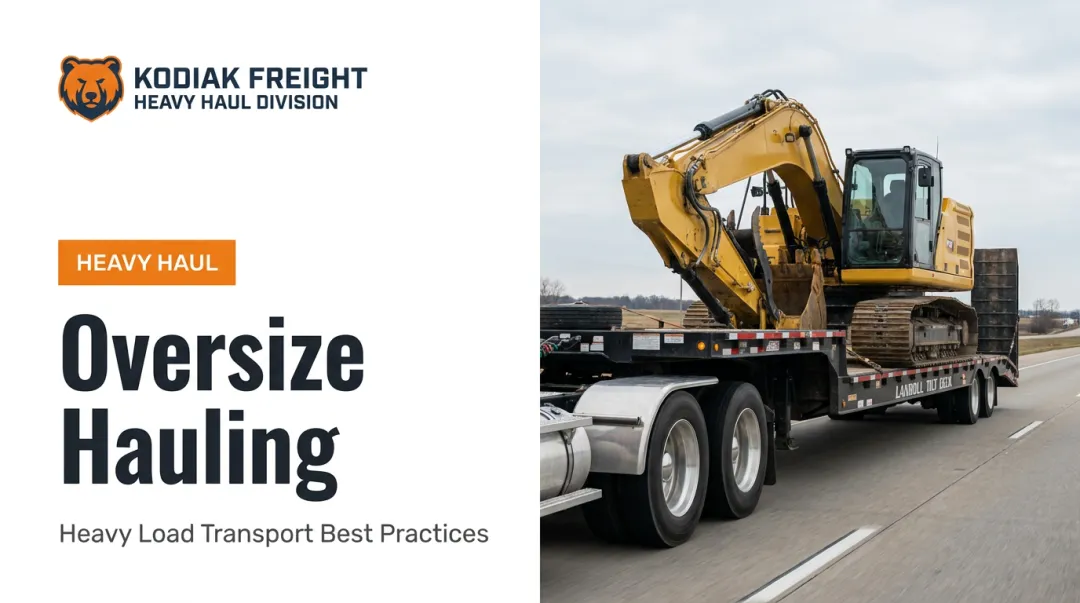
This is exactly where Kodiak Freight's dedicated Heavy Haul Division operates. The team handles oversize agricultural, mining, and manufacturing equipment using Landoll tilt-deck trailers and flatbeds, with close attention to permitting and route planning that generalist carriers often mishandle.
Intermodal, Tanker & Refrigerated Hauling
Three more categories round out the major hauling types:
- Intermodal combines truck, rail, and ship transport for long-haul freight that doesn't need door-to-door trucking the entire way
- Tanker hauling moves liquids and gases in specialized tank trailers, common for fuel, chemicals, and food-grade liquids
- Refrigerated ("reefer") hauling keeps temperature-sensitive cargo, like produce or pharmaceuticals, within a controlled range from pickup to delivery
A shipper moving freight from a coastal port inland, for example, might pair intermodal rail with short truck legs on each end to control costs.
The Freight Hauling Logistics Process: From Quote to Delivery
Professional heavy-haul shipping follows a defined sequence, not a "call a trucker and hope" free-for-all. Here's what happens between a quote request and delivery confirmation.
Quoting & Load Assessment — Carriers evaluate weight, dimensions, distance, and special handling needs, like crane requirements or custom securement, to generate an accurate price. Skip this, and you'll likely see change orders mid-shipment.
Route Planning & Permitting — Oversize and overweight loads need permits issued state-by-state, since requirements and escort rules vary by jurisdiction. A load crossing three states might need three separate permits with conflicting rules, and pilot car escorts kick in once width, height, or weight crosses set thresholds.
Load Securement & Equipment Prep — Chains, tie-downs, and tarps secure cargo during transit, following federal standards that set minimum working load limits and tiedown counts based on cargo weight and length. Cutting corners here endangers everyone on the road and invites steep compliance penalties.
Dispatch, Tracking & Communication — Modern hauling companies use GPS tracking and direct communication channels to keep shippers informed through transit. If a permit delay or weather event pushes back an ETA, shippers should hear about it before they have to ask.
Delivery, Inspection & Proof of Delivery — The final-mile handoff includes a cargo inspection for damage and documentation that closes out the shipment, protecting both shipper and carrier if a dispute surfaces later.

Skip any one of these steps, and the whole shipment gets riskier — legally, financially, or physically.
Industries That Depend on Specialized Freight Hauling
Some industries can't rely on standard trucking at all. Their equipment is simply too big, too heavy, or too time-sensitive.
Agriculture runs on tight seasonal windows. Combines, tractors, and grain equipment often need to move fast during harvest, when a delayed shipment can cost a farm operation real money. Demand concentrates heavily in the Midwest and Great Plains, where harvest timing drives urgency more than almost any other factor.
Manufacturing and mining both generate loads that routinely exceed standard road-legal limits:
- Industrial machinery tied to plant build-outs and factory relocations
- Prefabricated structures for facility expansions
- Excavators, haul trucks, drilling rigs, and crushers for extraction operations
These shipments almost always require the full oversize/overweight compliance stack, because there's no other way to move them legally.
Railroad operations depend on specialized flatbed or heavy-haul trailers to move rail cars, track equipment, and related infrastructure components. This freight doesn't fit any "standard" category, which is why generalist carriers often struggle with it.
Kodiak Freight built its Heavy Haul Division specifically around these four sectors: agriculture, manufacturing, mining, and railroad. The division delivers cost-effective, safety-focused solutions tailored to each industry's freight demands.
That focus matters. A carrier hauling mining equipment on Monday and grain equipment during October harvest needs different permitting knowledge and scheduling flexibility than a generalist dry van operation.
How to Choose the Right Freight Hauling Partner
Not every carrier that says "we handle heavy-haul" actually has the infrastructure to back it up. Before signing a contract, run through this checklist.
Verify industry-specific expertise and safety record. Ask how many years the carrier has spent hauling equipment in your specific industry, and check their FMCSA safety rating through the SAFER system before finalizing the contract. A "Satisfactory" rating means the carrier maintains adequate safety controls; anything less should raise questions.
Evaluate permitting and multi-state compliance capabilities. Since permit requirements shift at every state line, ask directly:
- Do they handle permit acquisition in-house, or outsource it?
- Have they moved freight through your specific route or corridor before?
- Can they coordinate pilot car escorts when required?
A carrier fumbling permits mid-route isn't just inconvenient. It can shut a shipment down entirely.
Prioritize personalized service and technology-driven tracking. Large generalist carriers often treat oversize freight like an afterthought, buried under thousands of standard loads. Kodiak Freight built its Heavy Haul Division around the opposite model, with a dedicated team tracking permitting, routing, and delivery status for every shipment instead of routing calls through a generic dispatch queue. Look for that same level of hands-on tracking in any partner you evaluate.

Frequently Asked Questions
What are the different types of hauling?
The primary categories are full truckload (FTL), less-than-truckload (LTL), flatbed, heavy-haul, and intermodal hauling. Each fits different combinations of cargo size, weight, and delivery timeline.
What is the meaning of hauling goods?
Hauling goods means physically transporting freight from an origin to a destination, typically by truck or rail. This covers only the physical movement of cargo, separate from the planning, permitting, or paperwork that supports the shipment.
What is the difference between hauling and trucking?
The terms are largely interchangeable today. "Hauling" historically referred to any bulk transport method, including horse-drawn carts, while "trucking" specifically means moving freight by truck.
How much does heavy-haul freight shipping typically cost?
Cost depends on weight, dimensions, distance, and how many state permits the route requires. Because every shipment differs, it's best to request a custom quote based on your specific load.
Do I need a permit for an oversize load?
Most states require permits once a load exceeds roughly 80,000 lbs or standard width and height limits. Multi-state routes need a separate permit for each jurisdiction the load passes through.
What industries rely most on heavy-haul freight services?
Agriculture, manufacturing, mining, and railroad top the list, since their equipment routinely exceeds standard road-legal weight and size limits.