Moving a load that exceeds standard federal limits isn't simply a larger version of standard freight. It introduces distinct legal, structural, and physical risks at every stage — from the permit office to the delivery site. Bridge strikes, cargo shifts, permit violations, and forced stops are not freak events. They're predictable outcomes when any phase of the process gets compressed or skipped.
This guide covers the full safety framework for oversize hauling: pre-transport preparation, operational safety, environmental risks, and the most costly mistakes carriers make on the road.
Key Takeaways
- Any load exceeding 8.5 ft wide, 13.5–14 ft high (varies by state), or 80,000 lb gross vehicle weight requires a state-issued permit to move legally
- Most preventable incidents trace back to gaps in pre-transport planning: permits, route surveys, and equipment matching
- Cargo re-inspection is federally required within the first 50 miles and at intervals thereafter under 49 CFR 392.9
- Escort vehicle requirements, travel windows, and banner/light specifications all vary by state and load dimensions — verify each individually
- Each state issues its own permit; a multi-state haul needs authorization from every state on the route
Safety Guidelines for Oversize Hauling
Oversize hauling safety operates across four layers simultaneously: regulatory compliance, physical load management, driver competency, and real-time environmental judgment. A gap in any one of them puts the entire move at risk.
The risks are specific and serious:
- Cargo shift — load movement during transit that causes loss of vehicle control
- Infrastructure strikes — bridge decks, overhead signs, and utility lines hit when height or width is miscalculated
- Road and bridge damage — overloaded axles exceed pavement and structure ratings
- Collision risk — reduced maneuverability increases response time and turning radius
Managing these risks requires consistent attention from permit application through final delivery — not just a checklist at the yard gate.
General Safety Precautions
Every oversize haul must carry specific required equipment before it leaves the yard. Federal regulations under 49 CFR 393.87 require red or fluorescent-orange flags (at least 18 inches square) on cargo projecting beyond the vehicle's sides or rear. Oversize load banners, amber warning lights, and additional marking requirements typically come from state permit conditions, which vary by load dimensions and jurisdiction.
Standard PPE for loading and securing crews includes:
- High-visibility vests
- Hard hats
- Slip-resistant footwear
Beyond equipment, every person involved in the move (driver, escort vehicle operators, and ground crew) must be briefed on the load's exact dimensions, weight, permitted route, and any identified hazards before departure. That shared situational awareness is what enables sound decisions once the load is moving.
Safety During Pre-Transport Preparation
Pre-transport planning carries the most variables and the longest lead times of any phase in a heavy haul move. It's also the phase most likely to get compressed under schedule pressure — and that compression is where safety shortcuts start.
The Permit Process
The federal government does not issue oversize or overweight permits. Each state issues its own, specifying the approved route, travel dates and hours, and required safety measures. A load crossing five states needs five separate permits.
Processing timelines vary by state. California advises allowing at least 14 business days for an annual permit. Texas supports self-issuance for many standard permit types but requires engineering review for complex loads. Florida allows self-issuance up to 16 ft wide, 18 ft high, and 200,000 lb — but loads outside that envelope go through the permit office with no guaranteed turnaround time.
The practical implication: apply early. Permit delays under schedule pressure are a documented path to safety shortcuts.
Route Surveys
Route surveys are not optional for loads that push dimensional limits. They confirm whether the planned route can physically and legally accommodate the load — checking:
- Vertical clearances under utility lines, bridges, and overhead signs
- Bridge load ratings relative to the load's axle weights
- Road surface capacity
- Railroad crossings, construction zones, and tight intersections
Texas, for example, requires a certified route inspection for loads exceeding 20 ft wide, 18'11" high, or 125 ft long. Other states use different thresholds. There's no single federal trigger — operators must check state-specific requirements for every route.
Equipment Matching and Axle Weight Compliance
Trailer selection isn't an afterthought. The right trailer type — lowboy, flatbed, multi-axle, modular, or Landoll tilt-deck — must be matched to the load's dimensions, center of gravity, and weight distribution.
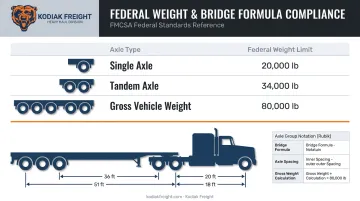
Federal axle limits set the baseline:
| Axle Configuration | Federal Weight Limit |
|---|---|
| Single axle | 20,000 lb |
| Tandem axle | 34,000 lb |
| Gross vehicle weight | 80,000 lb |
Meeting the gross weight limit isn't sufficient on its own. The Federal Bridge Formula controls axle spacing to prevent excessive bridge stress. The formula — W = 500[LN/(N-1) + 12N + 36] — determines the maximum weight allowed on any axle group based on the number of axles and distance between the outermost ones. Non-compliance triggers both infrastructure risk and permit violations.
Managing these variables — permit timelines across multiple states, route surveys, axle compliance, and trailer selection — requires coordination that spans weeks, not days. Kodiak Freight's Heavy Haul Division handles this entire pre-transport phase as a single integrated service for clients in agriculture, manufacturing, mining, oil and gas, construction, and data center sectors. One point of contact covers permitting, route surveys, escort coordination, and trailer matching from the start.
Safety While Operating an Oversize Load
Driving Dynamics
Oversize loads change how a truck handles in ways that demand constant, conscious adjustment. Extended braking distances, wider turning arcs, and limited sightlines around the cargo require specific behavioral discipline:
- Maintain greater following distances than standard freight
- Signal lane changes and turns significantly earlier
- Avoid any sudden steering or braking inputs
- Account for low-speed offtracking on longer combinations — the trailer does not track the same path as the tractor through turns
The physics back this up. FHWA's Comprehensive Truck Size and Weight Limits Study confirmed that higher gross weight and elevated center of gravity directly worsen vehicle stability and braking performance — two factors that define every oversize move.
Escort Vehicle Coordination
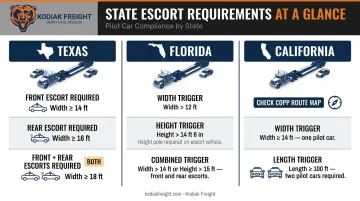
Escort requirements depend on load dimensions and the state being traveled. Some examples:
- Texas: Loads over 14–16 ft wide require one front escort on two-lane roads or one rear escort on four-or-more-lane roads; loads over 16 ft require front and rear
- Florida: Widths over 12 ft require at least one escort; overheight moves from 14'6" through 18 ft use a lead escort with a height pole set 6 inches above the load
- California: Pilot car requirements follow color-coded route maps; widths over 12 ft or lengths over 120 ft on Blue/Brown routes require two pilot cars
Escort drivers are responsible for clearing intersections, communicating road hazards to the haul driver, managing traffic flow, and detecting clearance conflicts. Communication protocols must be established before departure — not improvised on the road.
Operational Discipline
Three behavioral patterns create both safety hazards and serious legal exposure:
- Skipping mid-route cargo inspections — Under 49 CFR 392.9, drivers must inspect cargo before driving, within the first 50 miles, and then after each duty status change, every 3 hours, or every 150 miles, whichever comes first
- Deviating from the permitted route — The permit specifies an exact route; deviating from it voids the legal authorization for the move
- Driving beyond permitted hours — Time-of-day restrictions exist for safety reasons; violations carry fines and forced stops that cost more than compliance would have
Each of these violations is avoidable with pre-trip planning — and each one carries consequences that far outweigh the time saved by cutting corners.
Environmental and Route Safety Considerations
Weather and timing restrictions exist because oversize loads already operate with reduced safety margins. Adverse conditions shrink those margins further — sometimes to zero.
Weather risks:
- High crosswinds destabilize wide, tall loads
- Ice and heavy rain reduce braking effectiveness and directional control
- Many states restrict movement in specific weather conditions
When conditions deteriorate, stopping is the right call — even when not legally required.
Time-of-day and calendar restrictions vary by state:
- Texas defines daytime movement as 30 minutes before sunrise to 30 minutes after sunset; loads above 14 ft wide, 16 ft high, or 110 ft long face holiday movement restrictions
- Florida prohibits holiday movement for loads over 10 ft wide, 14'6" high, or 80 ft long, and imposes morning and evening curfews in specific counties
- California allows 24/7 movement on some routes while prohibiting darkness and limiting weekend travel on others
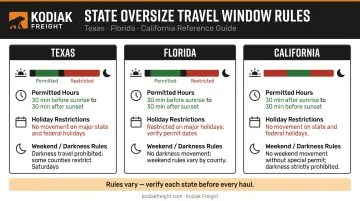
Operators must verify each state's rules for every route — there is no nationally uniform daylight rule.
Infrastructure contact risk is severe. The 2013 collapse of the I-5 Skagit River Bridge shows the direct consequences of failed clearance verification. An oversize combination carrying an 11'6"-wide, 15'9"-high load struck overhead bridge members with insufficient vertical clearance. The span collapsed, sending two vehicles into the river. The NTSB cited three contributing factors:
- Inadequate route planning
- The pilot car driver's failure to communicate the impending clearance conflict
- Deficient state permit oversight
Clearance verification wasn't the only failure — but it was central to the chain.
Common Oversize Hauling Safety Mistakes to Avoid
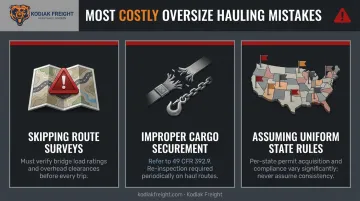
Most preventable oversize hauling incidents trace back to one of three mistakes:
1. Skipping or shortcutting the route survey
Assuming a route is passable based on a map or prior experience — without confirming current bridge ratings, verified clearance heights, and active utility crossings — is how structural incidents happen. Roads change. Bridge ratings get updated. A route that was fine last year may not be today.
2. Improper or incomplete cargo securement
Using the wrong tie-down type, an insufficient number of devices for the load's weight and shape, or failing to re-inspect after the first 50 miles creates conditions for cargo shift or loss. Per 49 CFR 392.9, re-inspection is a legal requirement, not an optional precaution.
The LTCCS linked cargo securement failures to roughly 3% of crash-involved trucks — a figure drawn only from crashes that occurred, not near-misses or unreported incidents. The actual exposure is higher.
3. Assuming rules are consistent across state lines
Each state has its own permit requirements, approved routes, safety equipment specifications, and travel window rules. Treating a multi-state haul as if one state's permit covers the journey is a compliance failure that results in fines, equipment impoundment, and schedule collapse. It's avoidable with proper permit coordination, state-by-state route approval, and compliance checks completed before the truck moves.
Conclusion
Oversize hauling safety rests on four interdependent pillars: thorough pre-transport planning, strict compliance with state and federal regulations, proper cargo securement and mid-route inspection, and coordinated communication between driver, escorts, and operations teams. No single pillar holds without the others.
Treat safety as standard operating discipline built into every stage of the haul — not a reactive obligation triggered by something going wrong. For organizations moving high-value oversize freight across agriculture, manufacturing, mining, oil and gas, or construction sectors, Kodiak Freight's dedicated Heavy Haul Division handles permitting, route planning, and escort coordination with the operational care these moves demand.
Reach the team at ops@kodiakfreight.com or 913-210-5144.
Frequently Asked Questions
What qualifies as an oversize load in the United States?
Any load exceeding 8.5 ft (102 inches) in width, roughly 13.5–14 ft in height (the exact limit varies by state — there is no federal height ceiling), or 80,000 lb gross vehicle weight generally qualifies as oversize or overweight. Most qualifying loads are nondivisible and require a state-issued permit to transport legally.
Do I need a separate permit for each state my oversize load travels through?
Yes. The federal government does not issue oversize or overweight permits — each state issues its own, specifying the approved route, travel dates, and required safety equipment. A haul crossing four states needs four separate permits, each obtained from that state's permitting authority.
What safety equipment is required for oversize loads?
Federal law requires red or fluorescent-orange flags on cargo projecting beyond the vehicle's sides or rear. State permit conditions typically add oversize load banners front and rear, amber warning lights, and — depending on load dimensions — pilot or escort vehicles. Specific requirements vary by state and load size.
What time-of-day restrictions apply to oversize haul transport?
Most states limit oversize movement to daylight hours and prohibit travel on certain holidays and weekends, though exact rules differ by state. Texas defines daytime as 30 minutes before sunrise to 30 minutes after sunset; California and Florida apply different frameworks by route and load category. Verify each state's conditions before every haul.
How much does oversize hauling cost?
Costs depend on load dimensions and weight, total distance, number of state permits, escort vehicle requirements, and trailer type. There is no standard rate — contact Kodiak Freight with your load specifics for an accurate quote.
How much does an oversize permit cost in Florida?
Florida permit fees vary by load dimensions, permitted weight, route mileage, and permit duration under Florida Administrative Code Rule 14-26.008. A basic single-trip overdimension permit starts at $5 for 10 days; overweight trip fees run approximately $0.27 per mile. Fees shift based on your specific load — confirm current rates with FDOT or a permit coordination specialist.