Introduction
Supply chains run on predictability — and dedicated trucking is how serious industrial shippers buy it. Unlike spot-market freight or standard contract truckload, dedicated contract carriage (DCC) assigns drivers, equipment, and routes exclusively to a single customer's ongoing freight program. The result: consistent lane performance, reduced variability, and carrier accountability that ad hoc arrangements cannot replicate.
Industries like manufacturing, agriculture, mining, and railroad depend on this model to protect supply chain continuity. For high-frequency or oversize freight, the stakes are even higher.
The numbers back that up. According to Transport Topics' 2025 3PL market analysis, the asset-heavy dedicated contract carriage segment generated $32 billion in 2025 gross revenue — up 1.6% year over year — driven by shippers seeking longer, "stickier" capacity contracts over volatile spot market exposure.
This guide covers the ten most trusted dedicated trucking companies in the US, what sets each apart, and how to choose the right partner for your freight program.
Key Takeaways
- Dedicated trucking commits drivers, equipment, and routes exclusively to your freight program, with no capacity shared across other accounts
- The top 10 range from publicly traded carriers with 8,000+ dedicated trucks to specialized operators serving heavy industrial freight
- Fleet size matters less than industry fit, equipment capability, and program management depth
- Oversize and overweight freight requires specialty equipment, permitting expertise, and operational experience — fleet size alone doesn't cut it
- For precision heavy-haul programs, personalized dedicated providers often outperform mega-carriers
What Is Dedicated Trucking and Why Does It Matter?
Dedicated contract carriage is a transportation model where a carrier supplies drivers, equipment, and management exclusively for a single shipper's ongoing routes — funded under contract, not sourced load by load. Penske Logistics defines it as third-party transportation that contractually dedicates vehicles and drivers to one customer, with the provider assuming fleet and operating responsibilities while the shipper retains operational control resembling a private fleet.
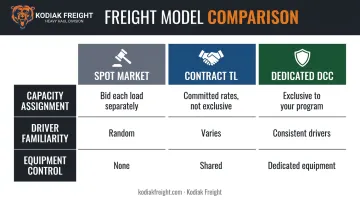
How It Differs from Standard Truckload
| Model | Capacity Assignment | Driver Familiarity | Equipment Control |
|---|---|---|---|
| Spot Market | Bid each load separately | Random | None |
| Contract TL | Committed rates, not exclusive | Varies | Shared |
| Dedicated DCC | Exclusive to your program | Consistent | Dedicated |
Why It Matters for Industrial Shippers
According to Logistics Management, fixed schedules, facility familiarity, and driver consistency improve loading efficiency, equipment availability, and cost predictability across a shipper's network. These advantages compound over time, particularly for high-frequency, time-sensitive, or oversize freight where a single missed load carries real operational and financial consequences.
Industries with the highest DCC adoption include:
- Retail and grocery distribution
- Food and beverage manufacturing
- Agriculture and farm equipment
- Automotive parts and assemblies
- Metals, energy, and industrial manufacturing
If your operation runs consistent lanes with predictable freight volumes, dedicated carriage is worth a close look.
Top 10 Dedicated Trucking Companies in the US
Companies were selected based on dedicated fleet capacity, industry reputation, technology integration, safety performance, and the maturity of their dedicated contract carriage offerings. Each profile below covers the carrier's service model, industries served, and the differentiator that sets it apart from a standard truckload relationship.
J.B. Hunt Transport Services — Lowell, AR
J.B. Hunt's Dedicated Contract Services (DCS) division is the largest standalone dedicated operation in the US, generating $3.376 billion in FY2025 revenue with an average of 12,659 trucks running exclusively for single-customer programs.
Its scale enables multi-site dedicated programs across retail, manufacturing, food, and beverage — supported by the J.B. Hunt 360 platform for shipper visibility and supply chain transparency.
| Attribute | Detail |
|---|---|
| Dedicated Service Type | Full-service DCC: driver management, equipment, routing, and fleet administration |
| Industries Served | Retail, manufacturing, consumer goods, e-commerce, bulk freight |
| Key Differentiator | Largest dedicated fleet network in North America with proprietary technology integration |
Ryder System — Miami, FL
Ryder's Dedicated Transportation Solutions (DTS) generated $2.343 billion in total revenue in 2025, serving approximately 210 US customer accounts. Its turnkey model covers dedicated vehicles, professional drivers, management, routing, fleet engineering, safety, and regulatory compliance — all under one contract.
RyderShare provides real-time visibility and collaboration, and the model is DCC — separate from Ryder's fleet leasing business.
| Attribute | Detail |
|---|---|
| Dedicated Service Type | Fully outsourced DCC with maintenance, compliance, and driver management |
| Industries Served | Consumer goods, grocery, industrial, automotive, metals, agriculture |
| Key Differentiator | End-to-end fleet management including maintenance infrastructure and safety compliance |
Penske Logistics — Reading, PA
Penske's dedicated division starts with supply chain engineering — modeling route scenarios, delivery frequency, and equipment configurations before a program launches. Supported equipment includes lift-gate, Moffett, flatbed, and temperature-controlled trailers across 48 states and Canada.
The ClearChain platform and GPS dashboards provide ongoing visibility during execution.
| Attribute | Detail |
|---|---|
| Dedicated Service Type | Engineered DCC with supply chain design and continuous improvement |
| Industries Served | Retail, food and beverage, automotive, industrial manufacturing, healthcare |
| Key Differentiator | Pre-launch supply chain engineering that optimizes programs before the first truck rolls |
Schneider National — Green Bay, WI
Schneider has become one of the fastest-growing dedicated operators through three acquisitions: Midwest Logistics Systems (January 2022), M&M Transport (August 2023), and Cowan Systems (announced November 2024). By mid-2025, the company reported nearly 8,600 dedicated trucks — roughly 70% of its entire truckload fleet — with first-half 2025 dedicated revenue of $875.9 million.
| Attribute | Detail |
|---|---|
| Dedicated Service Type | Multi-site DCC with driver training integration and asset management |
| Industries Served | Retail, manufacturing, food and beverage, East Coast distribution |
| Key Differentiator | Rapid dedicated fleet expansion through acquisitions and a national driver pipeline |
Werner Enterprises — Omaha, NE
Werner ended 2025 with 4,850 dedicated trucks, representing 68% of its truckload fleet. Dedicated contracts typically run two to five years with annual rate renegotiation. Werner reported near 20-year lows in DOT-preventable accidents per million miles, reflecting its safety-first culture.
Its regional fleet density makes it a strong choice for consistent coverage across the central and eastern US.
| Attribute | Detail |
|---|---|
| Dedicated Service Type | Regional and national DCC with long-term customer program focus |
| Industries Served | Retail, grocery, manufacturing |
| Key Differentiator | Consistent driver-to-lane assignment and above-average driver retention metrics |
NFI Industries — Camden, NJ
NFI is privately held with a dedicated contract carriage division spanning the US and Canada, including spotting, shuttling, and yard management services connecting plants and distribution centers. Its integrated logistics suite — combining dedicated trucking with warehousing — suits shippers consolidating vendor relationships under a single provider.
| Attribute | Detail |
|---|---|
| Dedicated Service Type | Integrated DCC with warehousing and distribution bundling options |
| Industries Served | Retail, food and beverage, industrial, home goods |
| Key Differentiator | Single-source model combining dedicated trucking with 3PL warehousing |
Covenant Logistics — Chattanooga, TN
Covenant's Dedicated segment generated $403.18 million in total 2025 revenue, operating approximately 1,500 tractors on three- to five-year contracts. Services include committed truckload capacity, shuttle operations, and trailer/container switching for manufacturers, retailers, food shippers, and agricultural operations.
| Attribute | Detail |
|---|---|
| Dedicated Service Type | High-frequency DCC for consistent lane programs |
| Industries Served | Retail, manufacturing, food and beverage, agriculture |
| Key Differentiator | Strong capacity commitment model with consistent driver-to-lane assignments |
Marten Transport — Mondovi, WI
Marten's Dedicated segment generated $278.4 million in 2025 revenue using refrigerated trailers, dry vans, and specialized equipment. Its value to mixed-freight shippers: temperature-controlled and standard dry van dedicated capacity under a single carrier relationship.
| Attribute | Detail |
|---|---|
| Dedicated Service Type | Temperature-controlled and dry van DCC programs |
| Industries Served | Food and beverage, pharmaceutical, consumer goods |
| Key Differentiator | Combined reefer and dry van dedicated capability in one carrier contract |
Crete Carrier Corporation — Lincoln, NE
Crete is a privately held truckload carrier with dedicated dry van, refrigerated, and flatbed divisions. Its PLUS program reports driver turnover at one-third the industry average — a metric that directly translates to route consistency and shipper familiarity on recurring dedicated programs.
| Attribute | Detail |
|---|---|
| Dedicated Service Type | Dry van and flatbed DCC with long-term driver assignment focus |
| Industries Served | Manufacturing, food processing, general freight |
| Key Differentiator | Industry-recognized low driver turnover resulting in reliable route consistency |
Universal Logistics Holdings — Warren, MI
Universal offers dedicated contract carriage alongside intermodal, drayage, and value-added services — allowing shippers to combine modes without switching providers. Its strength lies in industrial and heavy freight, including automotive, steel and metals, and manufacturing, where specialized equipment and multimodal coordination matter.
| Attribute | Detail |
|---|---|
| Dedicated Service Type | Asset-based DCC with intermodal and specialized freight integration |
| Industries Served | Automotive, industrial, steel and metals, manufacturing |
| Key Differentiator | Specialized and heavy freight capability within a dedicated contract framework |
How We Chose the Best Dedicated Trucking Companies
Selection focused on carriers with proven, active dedicated divisions — not general truckload carriers that occasionally commit a truck to a single lane. True dedicated trucking requires its own management infrastructure, driver retention programs, and technology systems built around a single customer's operation.
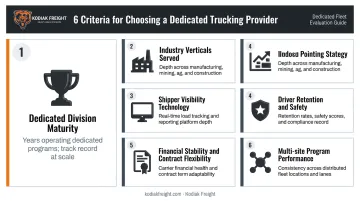
Evaluation criteria:
- Size and maturity of the dedicated division (revenue, fleet count, program tenure)
- Industry verticals actively served with dedicated equipment
- Technology for shipper visibility and driver management
- Driver retention rates and safety category trends (FMCSA SMS percentiles, not a single "CSA score")
- Financial stability and contract flexibility
- Documented program performance across multi-site or high-volume accounts
For industries moving oversize, overweight, or non-standard loads — agriculture, manufacturing, mining, and railroad in particular — fleet size alone is not the right filter. The right dedicated partner must have the equipment capability (flatbeds, specialized trailers, crane and rigging) and the permitting expertise to handle freight that falls outside standard DOT dimensions and weights.
Load-specific operational knowledge matters just as much as equipment.
Large general carriers handle dedicated freight at scale. Specialized providers like Kodiak Freight's heavy-haul division operate differently — with load-by-load precision, state-by-state permitting, and pilot car coordination built into every move. When equipment is irreplaceable and project timelines are fixed, that level of oversight isn't optional.
Conclusion
Choosing the right dedicated trucking partner comes down to fit, not fleet size. A retailer running high-frequency distribution lanes needs something entirely different from a mining operation moving excavators across three states. The carrier that works for one will fail the other.
Before committing to a dedicated contract, evaluate:
- Contract flexibility and performance guarantee structure
- Driver retention metrics and lane assignment consistency
- Technology and visibility tools available to your team
- Equipment fit for your freight type — including whether the carrier can handle oversize or overweight loads
- Scalability as your freight program grows or changes
For businesses in agriculture, manufacturing, mining, or railroad moving oversize or overweight freight on a regular basis, Kodiak Freight's dedicated heavy-haul division offers contracted capacity, Landoll tilt-deck transport, crane and rigging services, state-by-state permitting, and load-level oversight that general carriers — built for volume and standardization — aren't set up to provide. Contact Kodiak Freight at ops@kodiakfreight.com or 913-210-5144 to discuss your dedicated shipping needs.
Frequently Asked Questions
What is dedicated trucking and how is it different from standard truckload shipping?
Dedicated trucking assigns drivers, equipment, and management exclusively to a single shipper's ongoing freight program under contract. Standard truckload books capacity load by load — or on a lane basis — without exclusive driver or equipment commitment. The core difference is consistency: dedicated programs deliver the same drivers and trucks on every run, while standard TL does not.
What industries benefit most from dedicated trucking services?
Manufacturing, retail, food and beverage, grocery, agriculture, mining, and railroad are the primary users. Any industry with high-frequency, consistent freight volumes — or specialized equipment requirements including oversize and overweight loads — benefits from the predictability and accountability dedicated arrangements provide.
How much does dedicated trucking cost compared to spot or contract TL?
Dedicated programs carry a higher baseline cost than spot market freight, but predictable capacity, driver familiarity, and fewer service failures often offset the premium. Compare total cost per load across a full program — not rate per mile on a single shipment — to get an accurate picture.
What should I look for when choosing a dedicated trucking company?
Prioritize these factors when evaluating carriers:
- Maturity and track record of the carrier's dedicated division
- Driver retention rates and FMCSA safety category trends
- Technology and real-time visibility tools
- Equipment capabilities for your freight type (including specialty or oversize equipment)
- Contract structure with clear performance guarantees
Can mid-sized businesses use dedicated trucking, or is it only for large shippers?
Mid-sized businesses with consistent lane structures and regular freight frequency can qualify. Specialized dedicated providers often offer more flexibility on program minimums than mega-carriers, whose dedicated sales teams typically target very high-volume accounts. Lane repeatability and weekly utilization determine fit — company size is secondary.
What is the difference between dedicated contract carriage and a private fleet?
A private fleet is owned and operated by the shipper — capital, drivers, maintenance, and administration all stay in-house. Dedicated contract carriage outsources that entire function to a carrier, delivering fleet-like consistency without the capital investment or operational overhead of running your own trucks.