The cost of a lowboy haul responds to a specific set of variables: load weight and dimensions, distance, state permit requirements, escort needs, and timing. Misread any one of these, and a quote that looked competitive on paper turns into a final invoice nobody budgeted for.
This guide breaks down current rate realities, explains what drives pricing at each tier, walks through every line item on a real lowboy invoice, and helps you build a budget that holds up before your equipment moves.
Key Takeaways
- Lowboy rates vary by load tier — legal loads, permitted oversized loads, and superloads each carry different cost structures
- Permit fees, pilot car costs, and fuel surcharges are separate from the base rate and can add up fast
- Short hauls cost more per mile than long ones because fixed costs spread across fewer miles
- Oversized loads trigger state permits in every state crossed — and those fees stack quickly
- Accurate quotes depend on exact weight, full dimensions, origin/destination, and a confirmed timeline
How Much Does Lowboy Trucking Cost?
There is no fixed price for a lowboy haul. Two loads that look nearly identical on paper can produce quotes that differ by thousands of dollars once weight, dimensions, permits, and routing are factored in.
One data point from a 2025 Overdrive report on heavy and oversize hauling gives a useful reference point: specialized heavy/oversize operators commonly price their work at $11–$14 per mile all-in, with one operator citing $12–$14 per mile as standard for his operation. These figures reflect the all-in cost after permits, escorts, and accessorials: not just the base linehaul rate. They apply to specialized heavy and oversize work, not commodity flatbed moves.
Shippers who underestimate total cost typically make one of three errors:
- Budgeting only the base per-mile rate and treating permits and escorts as incidentals
- Choosing a carrier based on a low base rate that doesn't include oversize costs
- Ignoring seasonal surcharges or peak-period capacity constraints
Legal Loads vs. Permitted Loads vs. Superloads
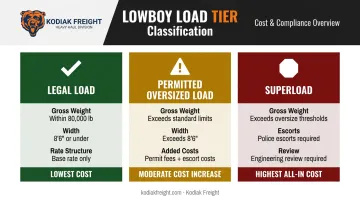
Lowboy hauls generally fall into three tiers, each with a different cost structure:
| Load Tier | What It Means | Cost Impact |
|---|---|---|
| Legal load | Within federal/state weight and dimension limits (80,000 lb gross, 8'6" wide, 13'6"–14' tall) | Base rate only; no permit or escort fees |
| Permitted oversized load | Exceeds standard dimensions or weight; requires state permits and possibly pilot cars | Base rate + permit fees + escort costs |
| Superload | Exceeds standard oversize permit thresholds; requires police escorts, engineering review, and route surveys | Highest all-in cost; longest lead times |
The shorter the haul, the higher the effective per-mile rate. A $60 Texas state permit costs $0.60 per mile on a 100-mile move but only $0.06 per mile on a 1,000-mile move. Fixed costs (permit fees, positioning the truck, loading time, paperwork) don't compress with distance. That's why short local moves are sometimes quoted as flat day rates rather than per-mile figures.
Sample Costs by Equipment Type
These estimates reflect typical market ranges based on equipment weight and common haul distances. Loads that exceed standard width, height, or length thresholds will push total costs higher once permits and escorts are added.
| Equipment | Approx. Operating Weight | Example Distance | Estimated Cost Range |
|---|---|---|---|
| Mini excavator (e.g., Cat 303.5 CR) | ~9,200 lb | 200 miles | $800–$1,500 |
| Mid-size excavator (e.g., Cat 320) | ~49,800 lb | 300 miles | $2,500–$4,500 |
| Bulldozer (e.g., Cat D6) | ~48,800 lb | 300 miles | $2,500–$4,500 |
| Large farm tractor (e.g., John Deere 9RX 710) | ~74,000 lb | 400 miles | $4,000–$8,000+ |
| Rough-terrain crane (e.g., Grove GRT655) | ~75,500 lb | 400 miles | $5,000–$10,000+ |
Important note: Always verify actual dimensions and weight before using any estimate. A few specifics worth flagging:
- The Cat 320 has a transport width of approximately 9.8 feet, exceeding the federal 8'6" standard — a permit is likely on most routes
- The John Deere 9RX 710 weighs 74,000 lb before attachments; with a trailer, the gross combination almost certainly requires permitting
Key Factors That Affect Lowboy Trucking Rates
Lowboy pricing is determined by load-specific, route-specific, and market-driven variables working in combination. Understanding each one lets you evaluate quotes accurately instead of comparing apples to oranges.
Load Weight and Axle Configuration
Federal interstate weight limits set the baseline: 80,000 lb gross, 20,000 lb on a single axle, and 34,000 lb on a tandem axle, with every consecutive axle group also subject to the Federal Bridge Formula. Trailer selection isn't a matter of cargo weight — it requires calculating the combined weight of the tractor, trailer, equipment, and attachments, then verifying every axle group against both the formula and each state's specific limits.
Equipment with an unusual center of gravity compounds this: uneven weight distribution may require additional axles, specialized securement hardware, or route detours around weight-restricted bridges. Texas alone charges weight-tier permit fees ranging from $150 for loads between 80,001 and 120,000 lb up to $375 for loads above 200,000 lb, plus a $35 supervision fee above 200,000 lb — all on top of the base $60 single-trip permit.
Load Dimensions and Permit Triggers
The federal commercial vehicle width limit is 102 inches (8 ft 6 in). There is no single federal height limit; most states set their limits between 13 ft 6 in and 14 ft, but this varies by jurisdiction.
Escort and permit requirements are not nationally standardized. State rules diverge sharply:
- Washington: Front and rear pilot cars required above 11 ft wide on two-lane roads; front height-pole escort above 14 ft 6 in
- Texas: One escort required for loads 14–16 ft wide, two escorts above 16 ft; police escort may also be required
- Oregon: Superload classification applies above 16 ft wide on interstates, 17 ft high, or 150 ft overall length
State permit fees also vary considerably:
| State | Dimension-Only Single Trip | Overweight Treatment |
|---|---|---|
| Washington | $10 | Starts at $14; varies with weight |
| Arizona | $15 | Oversize/overweight single trip: $75 |
| California | $16 | Additional variance rules may apply |
| Texas | $60 | Weight-tier surcharges added above 80,000 lb |
| Oregon | $8 administrative fee | Road-use assessment may apply |
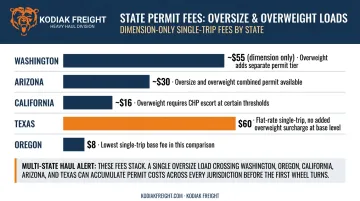
A four-state western move through Arizona, California, Oregon, and Washington starts at $49 in base permit fees before overweight assessments, county permits, escort costs, or police charges. Cross-country hauls stack these fees across every state on the approved route.
Distance, Route Complexity, and Seasonality
Per-mile rates soften on longer hauls as fixed costs dilute over more miles — but total cost still rises with distance. Short local moves are often quoted as flat day rates rather than per-mile.
Route complexity can push costs just as much as mileage. Urban corridors add tight turns, bridge weight limits, and restricted travel windows. Remote destinations create deadhead risk: specialized heavy-haul operators report almost no backhaul opportunity in this niche, so carriers often price the empty return leg into your rate.
These route variables combine with seasonal demand to shape the final rate. Agricultural hauls spike during planting and harvest; construction equipment peaks from spring through fall.
Booking well in advance — particularly for permitted or superload moves — limits both cost exposure and permit delays. Texas recommends submitting superheavy permit applications 3–4 weeks before movement; Oregon warns that superload permits can take up to 10 days, longer in complex situations.
What's Included in a Lowboy Trucking Quote
A lowboy invoice goes well beyond the base per-mile rate. Shippers who compare quotes on base rate alone frequently find their final bill looks nothing like their initial expectation.
Base Transport Rate
The base rate covers driver time, fuel (or part of it), and standard equipment use. It's the starting point, not the all-in cost. Some carriers present this number without disclosing that permits, escorts, and surcharges are billed separately.
Permit Fees and Escort Costs
Oversize permits are charged per state. Private pilot car costs run approximately $3 per mile per escort vehicle, per 2025 market reporting. Police escort rates vary by jurisdiction: New York State Police rates effective April 2026 are $101.89 per regular hour, $144.66 per overtime hour, and $0.725 per mile, with a three-hour overtime minimum per officer. Texas may require law enforcement at certain width or weight thresholds at the state's discretion.
Fuel Surcharges and Accessorial Charges
Fuel surcharges are calculated against a diesel price baseline (many carriers reference the EIA weekly retail diesel index) and fluctuate as diesel prices move. No law requires a surcharge, but most heavy-haul carriers apply one — the specific formula and percentage vary by carrier and contract terms.
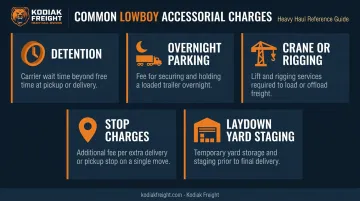
Common accessorial charges to ask about:
- Detention — delays at loading or unloading beyond the free time window
- Overnight parking — required for oversized loads that cannot travel at night
- Crane or rigging — when the carrier must arrange loading because equipment cannot self-load
- Stop charges — for multi-stop routes
- Laydown yard staging — when equipment needs temporary storage between moves
Route Survey and Compliance Costs
Loads exceeding height thresholds often require a route survey to verify bridge clearances and identify overhead obstacles. California requires a written route survey above 17 ft.
Oregon's structural route review expressly excludes utility and signal lines. The shipper must coordinate those conflicts separately, which can mean arranging temporary power line lifting through the affected utility. That cost depends on the route, crew time, and required outage windows.
How to Estimate the Right Budget for Your Lowboy Haul
Accurate budgeting starts with giving your carrier complete, verified information. Vague or estimated inputs produce quotes that expand once the carrier sees the actual equipment.
Four Inputs Every Carrier Needs
- Exact equipment weight including all attachments — not the base machine spec; the actual field-ready weight
- Full dimensions at the widest and tallest points — including any protrusions, mirrors, or buckets that change the envelope
- Pickup and delivery addresses with site access notes — tight driveways, low-clearance structures, or soft ground affect trailer selection and routing
- Preferred timeline and flexibility window — more flexibility often means better rates and smoother permit coordination
Evaluating Competing Quotes
When comparing quotes from multiple carriers, ask three questions before accepting any figure:
- Is this quote all-in (base rate + permits + escorts + fuel surcharge) or base-rate-only?
- What cargo insurance coverage is included, and at what declared cargo value limit?
- Who handles permit applications and route planning — the carrier directly, or a third-party service?
Carriers like Kodiak Freight — which handles permit coordination, pilot car escorts, and route surveys as part of every heavy-haul move — build quotes around the specifics of the load from the start. That distinction matters when comparing all-in pricing against base-rate-only estimates.
Timing Matters
Quote accuracy also depends on when you book. Permit processing alone takes 10 days to 4 weeks depending on the state and load complexity. Book as early as possible — last-minute requests compress that timeline, reduce your negotiating leverage, and raise the risk of capacity constraints during peak agricultural and construction seasons.
What Most People Get Wrong When Budgeting for Lowboy Transport
Comparing Base Rates Without Asking What's Included
The most common budgeting error is treating base rate per mile as the total cost. A carrier quoting $6/mile base might bill $10/mile all-in once permits, escorts, and fuel surcharges are added. Another carrier quoting $8/mile might be providing a fully itemized all-in figure. These quotes are not comparable without knowing what each one covers.
Always ask for an itemized breakdown before comparing. The right question is specific: "What does this quote include?"
Booking During Peak Season Without Planning Ahead
Agricultural planting, harvest, and spring-through-fall construction periods all tighten heavy-haul capacity. Shippers who recognize this cycle and book 3–6 weeks in advance generally avoid the rate pressure that hits last-minute requests. Shifting a move by even two or three weeks into an off-peak window can cut rates noticeably — demand drops fast once peak season passes.
Providing Estimated or Incomplete Load Specs
Carriers who receive incomplete dimensions quote conservatively — meaning they pad rates to cover uncertainty. When the carrier later inspects the actual equipment and finds it wider, taller, or heavier than stated, the quote changes. In the worst cases, the load arrives at the pickup site and requires a different trailer entirely.
Trailer type is where incomplete specs most often cause last-minute problems. Two configurations get confused regularly:
- RGN (Removable Gooseneck): Gooseneck detaches so tracked or wheeled equipment drives directly onto the deck — best for self-loading equipment; reduces loading angle.
- Fixed-gooseneck lowboy: Neck stays attached; loading uses rear ramps, side access, or a crane. Works when the right loading equipment is already on-site.
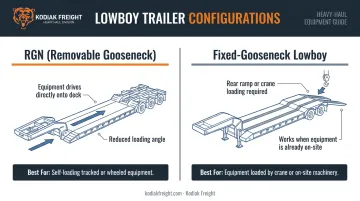
Confirming the trailer type before dispatch prevents a truck arriving with equipment that simply won't work for the load.
Conclusion
Lowboy trucking rates vary significantly based on load weight and dimensions, route complexity, state permit requirements, and timing. The per-mile rate is just the starting figure — permits, pilot cars, fuel surcharges, and accessorial charges determine what you actually pay.
Getting an accurate budget requires complete load specifications, an itemized quote breakdown, and a carrier with real experience managing oversize and overweight freight. One that coordinates permits, escorts, and route planning upfront — not as line-item surprises after the fact — protects both the equipment and the project budget.
For a quote built around your specific load, contact Kodiak Freight at ops@kodiakfreight.com or 913-210-5144.
Frequently Asked Questions
What is a good rate per mile for lowboy trucking?
Specialized heavy and oversize hauls commonly run $11–$14 per mile all-in based on 2025 operator data, with some operators citing $5/mile as a truck-only minimum before accessorials. Legal loads on standard routes will generally cost less; superloads with multiple escorts cost more. Short hauls typically carry a higher effective per-mile cost because fixed expenses spread across fewer miles.
How much can a 35-ton lowboy haul?
A standard lowboy rated at 35 tons (70,000 lb) refers to cargo capacity only. The legal gross combination weight must stay within federal and state limits, typically 80,000 lb gross on interstates without a permit. Loads approaching or exceeding that threshold require permit review and may need multi-axle configurations to meet weight distribution rules.
What information do I need to get an accurate lowboy trucking quote?
Carriers need the following to quote accurately:
- Exact equipment weight, including all attachments
- Full dimensions at the widest and tallest points
- Pickup and delivery addresses with any site access notes
- Preferred timeline
Incomplete or estimated specs lead to quotes that expand once the carrier sees the actual equipment.
Do lowboy trucking rates include permits and pilot cars?
Not always. Some carriers quote base rate only and bill permits, escorts, and fuel surcharges separately. Others provide all-in pricing. Always ask whether a quote is all-in or base-rate-only before comparing figures, since a lower base rate can easily become a higher final invoice once the extras are added.
How do seasonal factors affect lowboy trucking rates?
Agricultural equipment hauls spike during planting and harvest seasons; construction equipment peaks from spring through fall. These demand increases tighten capacity and put upward pressure on rates. Booking 3-6 weeks in advance, or scheduling during off-peak windows, reduces both rate exposure and the risk of permit-processing delays.