
Price swings come down to five variables: tractor size and weight, distance, trailer type, permit requirements, and seasonal demand. Misread one of them — say, assuming a front loader won't trigger an oversized permit — and you're looking at unexpected fees that can add $500 or more to the final bill.
This guide breaks down 2026 hauling cost ranges by distance and tractor class, explains what drives pricing up or down, and gives farmers practical ways to budget accurately and avoid overpaying.
Key Takeaways
- Cost ranges from $400 to $6,000+ depending on distance, tractor size, and trailer type
- Compact tractors on short hauls cost far less than large row-crop or 4WD tractors on long interstate routes
- Oversized load permits, escort vehicles, and fuel surcharges add significant costs on top of base quotes
- Removing attachments before transport is often the single biggest cost-saving action available
- Booking 1–2 weeks out — with flexible dates — opens access to better rates and backhaul opportunities
How Much Does It Cost to Haul a Tractor in 2026?
There is no flat rate for tractor hauling. The final cost depends on distance, equipment class, and logistical complexity. Farmers who end up surprised by the bill usually underestimated at least one of those factors.
Two pricing models are common:
- Per-mile rates — the standard for professional hauls; the rate per mile decreases as distance increases, but total cost still rises
- Flat-rate quotes — more common for short local moves within a single county or service area
Cost by Distance
VeriTread's 2026 tractor shipping guide puts the commonly quoted rate at around $3/mile within 500 miles, which aligns with the broader benchmark range. The table below reflects published rate-guide figures from Freedom Heavy Haul — these are provider benchmarks, not nationally audited averages, but they represent what farmers are actually being quoted.
| Distance | Rate Range (per mile) | Estimated Total Cost |
|---|---|---|
| Under 100 miles | $4.00–$7.00/mile | $400–$700 |
| 100–300 miles | $3.50–$5.00/mile | $350–$1,500 |
| 300–500 miles | $2.50–$4.00/mile | $750–$2,000 |
| 500–1,000 miles | $2.00–$3.50/mile | $1,000–$3,500 |
| 1,000+ miles | $1.75–$3.00/mile | $1,750–$5,000+ |
Short hauls carry the highest per-mile rates because fixed costs (driver time, fuel, equipment setup) get spread over fewer miles. A 60-mile haul might cost $6/mile while a 600-mile haul drops to $2.50/mile — yet the longer trip still costs more in total.
Cost by Tractor Class
Tractor weight and dimensions determine trailer type and permit requirements, which directly shapes the quote.
| Tractor Class | Weight | Estimated Trip Cost |
|---|---|---|
| Compact/utility | Under 5,000 lbs | $800–$1,500 |
| Mid-size | 10,000–20,000 lbs | $1,500–$3,500 |
| Large agricultural | 20,000+ lbs | $2,500–$5,000+ |
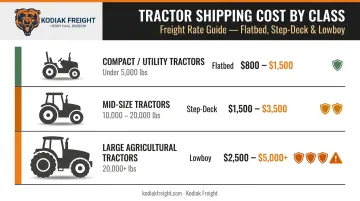
Large row-crop and 4WD tractors sit at the top of this range — not just because of weight, but because their dimensions often require RGN or lowboy trailers, oversize permits, and sometimes pilot car escorts. Compact tractors, by contrast, typically fit standard flatbeds and clear permit thresholds with minimal added cost.
Key Factors That Drive Tractor Hauling Costs
Five core variables determine nearly every tractor transport quote. Understanding them puts farmers in a stronger position when comparing bids.
Tractor Size, Weight, and Attachments
Federal regulations set the baseline: 80,000 lbs gross combination weight on the Interstate System, and 102 inches (8 feet 6 inches) as the maximum width on the National Network without a special permit. Height limits vary by state — there is no single universal federal ceiling.
Once a load crosses those thresholds, permits, route restrictions, and escort vehicles get added to the bill.
Front loaders, backhoe attachments, and wide-span implements can push a tractor into oversized territory on width alone, even when the base tractor would otherwise clear the limit. Removing those attachments before transport often avoids the oversized classification.
Distance and Route Complexity
Rural pickup and delivery locations add cost. Farms in remote areas should expect a location surcharge when a driver must travel 30+ miles off an interstate — that empty "deadhead" drive gets factored into every quote.
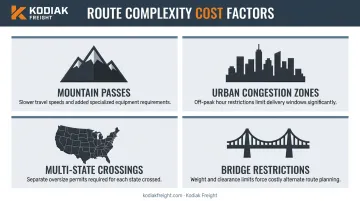
Route complexity adds cost in several other ways:
- Mountain passes and elevation changes that require slower travel or additional equipment
- Urban congestion zones that limit travel windows to off-peak hours
- Multiple state line crossings that each require separate permit coordination
- Bridge height and weight restrictions that force longer alternate routes
Seasonal Demand and Timing
Spring planting and fall harvest are peak periods for agricultural equipment hauling. Carrier availability tightens, and rates move accordingly. Industry carriers commonly observe rate increases of 15–25% during peak season, though this varies by region and isn't tracked as a formal national index.
Booking during winter months — December through February — typically offers the most favorable off-season rates. If the move isn't time-sensitive, planning around peak season can produce real savings.
LTL vs. FTL Shipping
- Full Truckload (FTL): The tractor occupies the entire trailer; the farmer pays for full capacity
- Less Than Truckload (LTL): Smaller equipment shares trailer space, reducing cost but potentially extending transit time
Large farm tractors almost always require FTL due to their dimensions. Compact tractors may qualify for LTL, but confirm dimensions with the carrier before assuming this option is available.
Trailer Types and Their Cost Impact
The trailer type used is one of the most significant cost variables in a tractor haul. Using the wrong trailer — or failing to match the trailer to the equipment — can create permit complications that cost more than the trailer upgrade would have.
Flatbed Trailers
Standard flatbeds are the most common and affordable option for compact and mid-size tractors that fall within legal height and width limits. They work well for operational tractors that can drive onto the trailer via ramps. Published flatbed rates run $2.50–$5.00/mile for tractor transport. Weather exposure is rarely a concern — field equipment is built for it.
Step-Deck Trailers
Step-deck (drop-deck) trailers have a lower deck height, which accommodates taller tractors without triggering overheight permits. They cost slightly more per mile than standard flatbeds, but often save money by avoiding permit fees — making them worth considering for mid-size tractors that are borderline on height.
RGN and Lowboy Trailers
RGN (Removable Gooseneck) and lowboy trailers are required for the heaviest, largest agricultural tractors. The detachable gooseneck allows equipment to drive directly onto the trailer, simplifying loading for machines that can't use ramps. Published rates for RGN/lowboy transport run $4.00–$8.00/mile, reflecting both the specialized equipment and the added complexity of moving oversized loads.
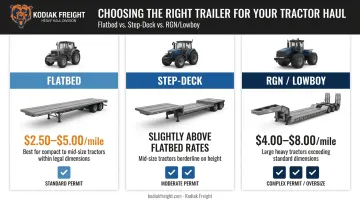
Here's how the three trailer types compare at a glance:
| Trailer Type | Best For | Typical Rate |
|---|---|---|
| Flatbed | Compact to mid-size tractors within legal dimensions | $2.50–$5.00/mile |
| Step-Deck | Mid-size tractors borderline on height limits | Slightly above flatbed rates |
| RGN/Lowboy | Large, heavy tractors exceeding standard dimensions | $4.00–$8.00/mile |
The larger and heavier the tractor, the more permit complexity comes into the picture — and managing that compliance work adds time and cost if it's not handled by the carrier. Kodiak Freight's Heavy Haul Division coordinates permits and escort requirements for agricultural equipment hauls, including moves using Landoll tilt-deck trailers, so farmers don't have to navigate state DOT requirements independently.
Hidden Costs Farmers Frequently Overlook
The base hauling rate is rarely the final number. Add-on costs routinely appear on invoices that weren't reflected in the original quote — and they add up fast.
Permits and Escort Vehicles
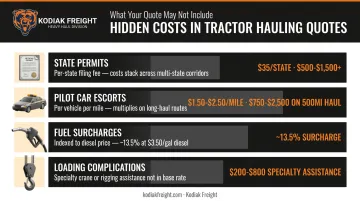
Oversized loads require state-specific permits, and each state a load crosses charges separately. Iowa's published schedule (effective October 27, 2025) lists $35 for a single-trip permit, with additional ton fees possible for overweight moves. Exact fees depend on the states crossed, load classification, and route.
For a multi-state haul, permit costs can accumulate quickly. Freedom Heavy Haul estimates $500–$1,500+ in combined permit fees for multi-state routes, though the actual total depends on the states crossed and load specifications.
Escort vehicle (pilot car) requirements add further cost for wide or tall loads. Published pilot car rates run $1.50–$2.50/mile per escort vehicle. On a 500-mile haul requiring one escort, that's $750–$1,250. Two escorts: $1,500–$2,500. These figures exclude minimum-day charges or repositioning costs.
Fuel Surcharges
Most haulers index fuel surcharges to current diesel prices. DOE tender data shows how surcharges shift with diesel costs — at $3.50/gallon (the late-2025 national average), truckload surcharges ran approximately 13.5%, or around $0.26/mile. When diesel prices spike, surcharges rise accordingly.
Always ask upfront: is the quoted rate fuel-inclusive, or subject to adjustment at time of transport? That distinction can mean hundreds of dollars on a long haul.
Loading and Unloading Complications
Operational tractors that can drive onto a flatbed via ramps typically incur no loading fee. Non-operational tractors — or sites with poor access, steep grades, or soft ground — may require crane, forklift, or winch assistance. Specialty loading help can add $200–$800 to the invoice depending on equipment needed and site conditions.
Preparing the site ahead of time — firm, flat surface and a clear access path — reduces the chance of on-site surcharges. Confirming the tractor is operational before the driver arrives helps too.
Insurance Coverage
Cargo insurance coverage varies by carrier. FMCSA requires public liability coverage for for-hire carriers but sets no federal minimum for cargo insurance specifically.
Before signing, confirm:
- What cargo coverage is included in the quote
- What the policy limits are
- Whether high-value equipment requires supplemental coverage
For a $100,000 tractor, that conversation is worth having before transport day.
How to Reduce Your Tractor Transport Bill
Farmers who plan ahead consistently pay less. The strategies below are available to anyone — they just require a bit of advance work.
Remove Attachments and Measure Accurately
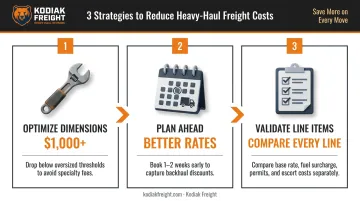
Removing front loaders, backhoe attachments, and wide implements before transport is frequently the single most impactful cost-saving action. A tractor that clears the 102-inch width limit without its loader avoids oversized classification — eliminating permit fees and escort vehicle costs that could add $1,000 or more to the bill.
Provide carriers with accurate dimensions and weight upfront. Overestimating adds unnecessary cost; underestimating leads to rebooking fees or quote revisions at pickup.
Book Early and Stay Flexible on Timing
- Book 1–2 weeks in advance for standard hauls; more lead time during spring planting and fall harvest
- Flexible pickup and delivery windows increase the chance of matching with a carrier on a backhaul — returning empty from a nearby delivery — which often comes at a discounted rate
- Last-minute bookings limit carrier options and reduce negotiating leverage
Get Multiple Itemized Quotes and Compare Correctly
Request at least three quotes. Ask for itemized breakdowns that separate:
- Base rate
- Fuel surcharge methodology
- Permit fees
- Escort vehicle requirements and cost
- Insurance coverage and limits
A quote that excludes permits and escort vehicles may look attractive until those line items appear at billing.
Verify that any carrier has valid USDOT registration and FMCSA compliance before booking. Carriers like Kodiak Freight that specialize in agriculture equipment moves handle permitting in-house, so the correct approvals are in place before the truck rolls — not sorted out after problems arise.
Frequently Asked Questions
How much does it cost to transport a tractor?
Tractor transport typically runs $2.50–$5.00/mile based on published provider benchmarks, with total costs ranging from around $400 for short local hauls to $6,000+ for cross-country moves. Compact tractors on short routes fall at the low end; large row-crop or 4WD tractors on long interstate hauls sit at the high end.
How do I ship a tractor to another state?
Hire a licensed carrier with valid USDOT registration and FMCSA compliance. If the tractor exceeds federal width or weight limits, state-specific oversize permits are required for each state crossed. Confirm cargo insurance coverage and provide exact tractor dimensions — including attachments — before finalizing any quote.
What trailer type is best for hauling a large farm tractor?
Large agricultural tractors (20,000+ lbs or wide/tall dimensions) typically require a step-deck, RGN, or lowboy trailer. Standard flatbeds work well for compact and mid-size tractors that stay within legal height and width limits without attachments.
Does removing attachments lower tractor shipping costs?
Yes — often significantly. Removing front loaders, backhoes, and wide implements can drop a tractor below oversized thresholds, eliminating permit fees and escort vehicle costs that might otherwise add hundreds or thousands of dollars to the bill.
How far in advance should I book tractor transport?
Book at least 1–2 weeks ahead for standard hauls. During peak planting (March–May) and harvest (September–October) seasons, book earlier — carrier availability tightens and rates rise as demand spikes.
What hidden costs should farmers watch out for in hauling quotes?
Watch for these common additions not included in base rates:
- Fuel surcharges billed separately
- Per-state permit fees for oversize loads
- Pilot car escort charges for wide or tall equipment
- Specialty loading fees for non-operational tractors or difficult site access
Always request an itemized quote.