Introduction
Between 2011 and 2017, 297 workers died in crane-related incidents across the US — roughly 42 fatalities per year, with more than half caused by struck-by events tied directly to load-zone and rigging failures. Those numbers don't account for the financial damage: Travelers documented individual crane losses of $387,000 from a single ignored warning alarm and $1.3 million after wind shifted a gantry crane into adjacent equipment.
The operational consequences compound quickly. A failed lift or transport incident means production shutdowns, cargo replacement costs, legal exposure from permit non-compliance, and potential OSHA citations. The 2013 Skagit River bridge collapse — caused by an oversize load striking a span — resulted in roughly $15 million in emergency and permanent repair costs alone.
Heavy lift operations carry this level of risk because every job is custom. No two lifts share the same load geometry, route conditions, rigging configuration, or environmental factors. This guide covers the core safety disciplines that govern each phase — from pre-lift planning and rigging selection to route permitting, environmental assessment, and load securement.
Key Takeaways
- Load weight must be independently verified before every lift — documented estimates have caused overloads exceeding 100% of rated capacity
- Rigging inspection is a before-each-use requirement, not a periodic task
- Exclusion zones and stop authority must be defined before the operation begins, not improvised mid-lift
- Environmental conditions require continuous assessment and can justify halting any operation
- Escort vehicles carry active safety responsibilities — skipping them creates legal exposure and route blind spots
What Is a Heavy Lift Operation?
Heavy lift operations involve the handling, transport, and placement of cargo that is indivisible — meaning it cannot be broken down into smaller loads without destroying its value or function — and that exceeds standard size or weight thresholds. While there is no single federal definition establishing a universal weight cutoff, the term is commonly applied to loads exceeding standard interstate limits of 80,000 lb gross vehicle weight and the federal width baseline of 102 inches.
These operations span multiple transport modes:
- Road (heavy haul) — the most common mode for industrial cargo in the US
- Rail — using flatcars or specialized schnabel cars for extreme loads
- Sea — heavy lift vessels and crane ships for international or coastal moves
- Air — large cargo aircraft for time-critical, high-value components
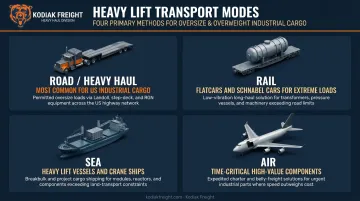
For industries like agriculture, manufacturing, mining, and railroad, road-based heavy haul is the primary method. Each sector brings its own demands: agricultural combines, mining excavators, manufacturing production equipment, and railroad components all present distinct handling and securement requirements based on weight distribution, dimensions, and center of gravity.
Every heavy lift move requires individual planning. Equipment type, route conditions, permit requirements, rigging approach, and environmental factors shift from job to job — which is why no two operations run the same playbook.
Safety Guidelines for Heavy Lift Operations
Safety in heavy lift spans four distinct phases: planning, rigging and securing, active transport, and handoff. Each phase carries its own hazard profile, and no phase can be abbreviated without transferring risk to the next one.
The primary hazard categories are operational and mechanical: load instability, rigging failure, vehicle overload, and insufficient route clearance. These are documented causes of fatalities and multi-million dollar losses — not theoretical edge cases.
General Safety Precautions
PPE requirements for heavy lift personnel are hazard-based under OSHA 1910.132. Employers must conduct a formal written hazard assessment before specifying equipment. Baseline requirements for most heavy lift environments include:
- Hard hats (OSHA 1910.135 for falling-object hazards)
- High-visibility vests
- Steel-toed boots (OSHA 1910.136 for falling/rolling load hazards)
- Work gloves and eye protection
Additional requirements apply by site condition: fall protection is required above 6 feet for non-assembly work and above 15 feet during crane assembly/disassembly under OSHA 1926.1423. Hearing protection applies where noise exposure warrants it.
Exclusion zones must be established before any load moves. Under OSHA 1926.1424, swing-radius crush zones must be marked with control lines, warning lines, or barriers. Under 1926.1425, only personnel essential to the lift — hooking, unhooking, or guiding — may enter fall zones. The specific zone radius is determined by the equipment and the foreseeable struck-by area, not a universal distance.
Stop authority is clearly assigned by OSHA 1926.1419: anyone who observes a safety problem may issue a stop signal, and the operator must comply. Under 1926.1418, the operator may independently stop and refuse a load until a qualified person confirms safety.
Safety During Pre-Operation Planning and Load Securing
Every heavy lift requires a pre-operation risk assessment covering:
- Load dimensions and verified weight
- Lift points and rigging plan
- Ground bearing capacity at pick-up and set-down locations
- Overhead clearance and power line proximity
- Equipment configuration and rated capacity match
Load weight verification is non-negotiable. OSHA 1926.1417(o)(3) requires operators to verify load weight through a recognized source, calculation, or equally reliable method. In one documented OSHA case, an operator estimated a forklift at 6,000 lb — the actual weight was 13,680 lb, producing a 128% overload at the operating radius. In another, a crane overturned lifting a rebar cage approximately 7,000 lb over load-chart capacity. Paperwork from the shipper is not sufficient on its own.
Rigging inspection requirements under OSHA 1926.251 and ASME B30.9 specify that all slings, shackles, hooks, and chains must be inspected before each use. Removal criteria include:
- Wire rope: 10 randomly distributed broken wires in one rope lay, one-third wear on outside wire diameter, kinking, or bird-caging
- Hooks: throat opening exceeding 15% or twist exceeding 10 degrees
- Alloy chain: periodic inspections no more than 12 months apart; removal for deformation, wear, or cracks
Any equipment showing damage or below rated safe working load (SWL) comes out of service immediately — not after the current job.
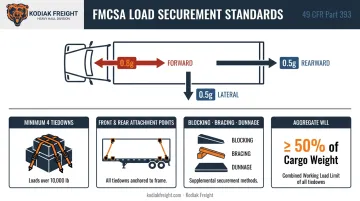
**Load securing for road transport** must meet FMCSA standards requiring securement to withstand 0.8g forward and 0.5g rearward and lateral forces. Aggregate working load limit across all tiedowns must equal at least half the cargo weight.
Heavy vehicles and equipment over 10,000 lb require at least four tiedowns attached near the front and rear, with appropriate blocking, bracing, and dunnage suited to the load's geometry.
Carriers that manage permitting, route surveys, load engineering, and escort coordination as an integrated service reduce the risk of field-level surprises during this phase — a core part of what Kodiak Freight's Heavy Haul Division handles for industrial clients.
Safety During Active Transport
Safe operating conditions during heavy haul transport are defined by state permit conditions, not a single federal standard. State permits specify route, travel windows, lane restrictions, speed limits, and escort requirements on a load-by-load basis.
Communication protocols must be established and rehearsed before departure. The FHWA's Pilot/Escort Vehicle guidelines — while best practices rather than regulations — specify:
- Primary and backup radio channels selected and tested
- Each team member identified by name and role
- Lead and rear escort duties assigned and understood
- Stop signals established before the convoy moves
Any loss of communication during transit triggers a safe, controlled stop. That's the protocol — no discretion involved.
In-transit load monitoring is required under 49 CFR 392.9: drivers must inspect cargo and securement within the first 50 miles, then when duty status changes or after 3 hours or 150 miles, whichever comes first.
Escorts conduct continuous monitoring of load condition, overhead clearances, and traffic ahead. Any sign of load shift, strap loosening, or abnormal vehicle behavior is an immediate stop condition — not something to monitor and reassess while rolling.
Environmental and Situational Safety Considerations
Environmental factors don't pause for schedule pressure. Every active heavy lift or transport operation requires continuous environmental assessment, and the authority to postpone must rest with a named, qualified individual — not a group consensus reached under time pressure.
Weather Conditions
OSHA does not publish a universal wind speed cutoff for crane operations. The applicable limit comes from the crane manufacturer's procedures for the specific configuration in use, adjusted by a competent person based on conditions. The 20 mph threshold often cited applies specifically to personnel-platform work, not general crane operations.
The consequences of ignoring configuration-specific wind limits are documented. In the 2016 collapse at 40 Worth Street in New York, wind gusts of 22-30 mph combined with an operator lowering the boom below the required 75-degree minimum angle. The collapse killed one person and injured three. That limit was an engineering constraint specific to that configuration, not a general advisory.
Road transport carries its own weather exposure. Key hazards include:
- High winds destabilizing tall or wide loads and increasing lane drift
- Rain and ice reducing braking effectiveness and tire grip
- Ground softening under the concentrated point load of a heavy haul rig
Ground and Surface Conditions
OSHA 1926.1402 places responsibility for firm, drained, graded ground on the controlling entity, including disclosure of known underground hazards. Before any crane is set or heavy rig traverses a surface, ground bearing capacity must be assessed. Common failure points include:
- Soft or saturated ground beneath outrigger pads
- Uneven pavement and utility covers under point loads
- Bridge decks rated below the rig's gross weight
Route surveys identify bridge weight limits, pavement conditions, and surface hazards before a load moves — not after a rig gets stuck or a structure is compromised.
Common Safety Mistakes to Avoid
These aren't hypothetical risk scenarios. Each represents a documented failure mode with real consequences.
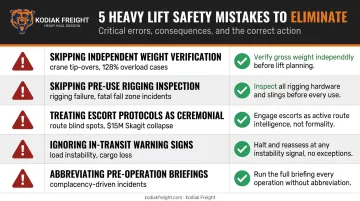
Verify load weight independently. Relying on manufacturer documentation or shipper estimates alone has produced overloads exceeding 100% of rated capacity — resulting in crane tip-overs, rigging failures, and OSHA citations. Regulation requires it. Field practice demands it.
Inspect rigging before every lift — without exception. Using slings or hardware past inspection intervals, or with visible wear, is a choice to accept unknown failure risk during active lifts or in transit. A single rigging failure can kill workers in the fall zone and destroy cargo. The 2024 Fort Lauderdale incident cited unrepaired corroded components as a contributing factor in a fatal 30-story rigger fall.
Treat escort vehicle protocols as operational — not ceremonial. Per FHWA guidelines, lead and rear escort drivers actively monitor clearances, alert traffic ahead, manage lane changes, and observe load condition from outside the cab.
The Skagit River bridge collapse was partly attributed to inadequate route planning and pilot car distraction. The result: $15 million in damages from a failure in escort and route review protocols.
Stop immediately when something feels wrong. Unusual vibrations, abnormal vehicle handling, unfamiliar sounds, or visible cargo movement are indicators of load instability — not conditions to monitor and hope resolve. Pull over, inspect, and confirm the load is secure before continuing.
Run the full pre-operation briefing every time. Experienced personnel are the most likely to abbreviate or skip it — and complacency is a documented factor in heavy lift incidents. Every job introduces new variables: a different load, site, driver, or weather condition. Prior experience doesn't cover what's different today.
Conclusion
Safety in heavy lift operations isn't a phase that ends when the load is secured and the truck pulls out. It runs from the first load assessment through final placement, and each phase depends directly on the quality of decisions made in the one before it.
For shippers in agriculture, manufacturing, mining, and railroad, the choice of heavy haul partner is a safety decision. A carrier that integrates permitting, route surveys, rigging, escort coordination, and load engineering into a single managed operation closes the field-level gaps where most preventable incidents occur.
Kodiak Freight's Heavy Haul Division is structured around that integrated approach — handling the full heavy haul cycle so shippers in these industries aren't piecing together safety-critical services from multiple vendors. If you're planning a heavy lift move, that's the right place to start the conversation.
Frequently Asked Questions
What is a heavy lift operation?
A heavy lift operation involves the handling, transport, and placement of indivisible cargo that exceeds standard size or weight thresholds — typically above federal interstate limits of 80,000 lb or 102 inches in width. Each job demands specialized equipment and route-specific planning based on load geometry, weight, and site conditions.
What are the types of heavy lift operations?
The four primary modes are road (heavy haul trucking), sea (heavy lift vessels and crane ships), rail (flatcars and schnabel cars), and air (large cargo aircraft). Road transport is the most common method for industrial and manufacturing cargo in the US, and the most frequently regulated through state oversize/overweight permits.
What are the OSHA guidelines for heavy lifting at work?
OSHA does not set a single maximum weight limit for mechanical heavy lifts. Limits are determined by equipment-rated capacity, load charts, and configuration. Employers must assess lifting hazards, use properly rated equipment, and train personnel. Key standards include 29 CFR 1910.179, 1910.184, 1926.251, and 1926 Subpart CC.
What is the 3-3-3 rule for heavy lifting?
The 3-3-3 rule is a manual handling guideline for ergonomic workplace lifting — not a standard for crane or mechanical heavy haul operations. No authoritative OSHA or NIOSH source applies it to mechanical lifts; those are governed by equipment load charts and standards like 29 CFR 1926 Subpart CC.
What permits are required for heavy lift transport on public roads?
States issue oversize and overweight permits; there is no single federal permit. Requirements vary by load dimensions, weight, and route. Permits may specify travel windows, speed limits, escort requirements, and law enforcement coordination. Applications typically require documented load dimensions, axle weights, and route details.
What equipment is used in heavy lift road transport?
Common equipment includes lowboy trailers, Landoll hydraulic tilt-deck trailers, hydraulic modular trailers (HMTs), self-propelled modular transporters (SPMTs), ballast tractors, mobile cranes, and pilot/escort vehicles. Equipment selection depends on load geometry, weight distribution, and site access conditions at origin and destination.