Choose the wrong transport partner and you're looking at permit delays, equipment damage, compliance violations, and cost overruns that bleed into your project timeline.
This article lists 10 of the top construction equipment transport companies in the US — what each does well, how their fleets are configured, and what separates them from general freight carriers.
Key Takeaways
- Carriers need OSOW permitting expertise and the right trailer type — lowboys, RGNs, or drop-decks — for each piece of equipment
- The US construction equipment market is projected to grow from $34.4B in 2025 to $60.7B by 2033 — demand for specialized transport will grow with it
- Fleet size doesn't determine service quality; smaller specialists frequently outperform large carriers on complex, detail-sensitive hauls
- Always confirm whether permits, escort coordination, and route surveys are included in a quote before signing
- Kodiak Freight's Heavy Haul Division handles construction, mining, and manufacturing freight with a detail-first approach
What Is Construction Equipment Transport?
Construction equipment transport is the specialized movement of heavy, oversized, and overweight machinery — excavators, cranes, bulldozers, and similar heavy machinery — that exceeds standard legal weight or dimensional limits on US roads.
Moving this equipment legally requires navigating a patchwork of federal and state rules:
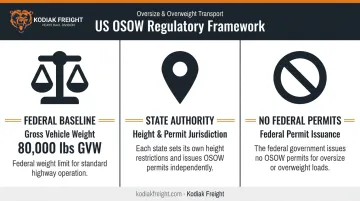
- Federal baseline: 80,000 lbs GVW; no federal height limit or general length limit for most tractor-semitrailers on the National Network
- State authority: Each state sets its own height restrictions and issues its own oversize/overweight (OSOW) permits
- No federal permits: The federal government doesn't issue OSOW permits — every state runs its own program independently
That regulatory complexity becomes more consequential as the market grows. According to Grand View Research, the US construction equipment market generated $34.4B in revenue in 2025 and is projected to reach $60.7B by 2033 at a 7.4% CAGR. More machinery moving across state lines means greater demand for carriers with the trailers, permits, and experience to haul it legally and safely.
Top 10 Construction Equipment Transport Companies in the US
These companies were selected based on fleet capability, construction-sector experience, permitting expertise, geographic reach, and customer reliability — not brand recognition alone.
1. Landstar Transportation Logistics
One of the largest heavy-haul and over-dimensional carriers in North America, Landstar operates through an asset-light network of independent agents and leased owner-operators under non-forced dispatch. That model gives them extraordinary breadth — agents source from a massive pool of specialized equipment across the country.
| Category | Details |
|---|---|
| Fleet & Equipment | 2,700+ specialized trailers: step-decks, RGNs, stretch trailers, multi-axle, perimeter, and custom configurations |
| Geographic Coverage | National US coverage; Mexico cross-border heavy-haul confirmed |
| Key Differentiator | Agent/owner-operator network enables flexible capacity for large-volume construction moves |
Landstar manages permitting, route engineering, and escort coordination in-house — a practical structure for construction companies running complex, multi-state hauls with tight coordination requirements.
2. Keen Transport
Part of the Wallenius Wilhelmsen Group since 2017, Keen Transport has spent more than 50 years focused specifically on construction, mining, and agricultural equipment. That sector focus — rather than general freight — is their defining characteristic.
| Category | Details |
|---|---|
| Fleet & Equipment | 400+ specialized trailers: step-decks, RGNs, lowboys, I-beams, multi-axle combinations |
| Max Payload Capacity | Up to 160,000 lbs with up to 13 axles |
| Key Differentiator | Construction/mining/ag specialization plus ocean transport option through parent company |
For construction companies moving equipment internationally — or simply needing a carrier that won't mistake a crawler excavator for a standard flatbed load — Keen's depth of experience matters.
3. Bennett Motor Express
Founded in 1974, Bennett handles everything from standard oversized loads to freight weighing over 1,000,000 lbs. Their super-heavy haul division operates some of the most complex trailer configurations in the industry.
| Category | Details |
|---|---|
| Fleet & Equipment | Drop-deck extendables, double-drop extendables, 9–13 axle units, 19-axle steerable, dual-lane dolly systems, up to 55-axle custom configurations |
| Payload Range | 100,000 lbs to over 1,000,000 lbs |
| Key Differentiator | Super-heavy haul capability with custom-engineered trailer configurations for extreme loads |
Bennett's inventory of more than 450 pieces of specialized equipment means load-specific configurations are the rule, not the exception.
4. ATS Specialized, Inc.
Based in St. Cloud, Minnesota, ATS (Anderson Trucking Service) has been moving heavy freight since 1955. What sets them apart is the depth of their in-house resources — they don't outsource permitting, routing, or safety training to third parties.
| Category | Details |
|---|---|
| Fleet & Equipment | Flatbeds, step-decks, lowboys, standard RGNs, extendable RGNs, multi-axle configurations |
| In-House Resources | Permitting department, route surveys, pilot/escort coordination, in-house securement training, safety team |
| Key Differentiator | ATS Customer Portal for real-time tracking; heavy-haul drivers require 6+ years of verifiable OTR experience |
For construction projects with tight schedules and no tolerance for permit surprises, ATS's single-point coordination model reduces the risk of delays that come from fragmented vendor management.
5. TMC Transportation
Iowa-based TMC calls itself a premier open-deck carrier, with a specialized division focused on machinery and equipment — including construction and agricultural freight across the 48 contiguous states.
| Category | Details |
|---|---|
| Fleet & Equipment | Flatbeds, step-decks, RGNs, stretch multi-axle configurations |
| Coverage Area | 48 contiguous states |
| Key Differentiator | Dedicated Specialized Division with focused construction/agricultural equipment experience |
TMC Logistics Special Operations also provides access to expanded carrier capacity, including stretch multi-axle and additional RGN equipment, useful for oversize construction moves requiring specific configurations.
6. Mercer Transportation
Louisville-based Mercer runs a 100% owner-operator model with more than 1,700 leased owner-operators and a full open-deck trailer mix. Their freight management overlay is a practical advantage for construction companies coordinating multiple loads simultaneously.
| Category | Details |
|---|---|
| Fleet & Equipment | Flatbeds, step-decks, double-drop, lowboy/RGN configurations |
| OSOW Specializations | Permit management, specialized-trailer selection, oversize freight coordination |
| Key Differentiator | Managed transportation services — centralized planning, carrier management, tracking, and logistics oversight |
The detachable RGN in Mercer's fleet allows front-loading and maximizes height clearance, which is particularly useful for tracked construction equipment.
7. Maxim Crane Works
Maxim is built differently from the carriers above — they combine heavy hauling with crane rental, rigging, and engineering under one roof. That integration is valuable when a construction equipment move requires more than a trailer.
| Category | Details |
|---|---|
| Fleet & Equipment | Modular platform trailers, SPMTs (Self-Propelled Modular Transporters), hydraulic gantries, jack-and-slide systems |
| Added Services | Site evaluation, engineering, lift planning, project management, rigging |
| Key Differentiator | One-stop provider: transport + crane + engineered lift, across 50+ locations nationwide |
When construction equipment needs to be removed from a confined site, loaded onto transport, and placed precisely at its destination, Maxim's combined model eliminates the coordination gap between transport and lift contractors.
8. Deep South Crane and Rigging
Established in 1968 in Louisiana, Deep South specializes in heavy lift and transport for construction, petrochemical, and industrial projects. Their Versacrane fleet is rated from 750 to 3,000 tons in lift capacity, and their SPMT assets support multi-modal moves that combine road transport with barge.
| Category | Details |
|---|---|
| Fleet & Equipment | Cranes, Scheuerle SPMTs, barge ramps, bridge ramps, jack-and-slide systems, transport saddles |
| Maximum Capacity | Crane lifts from 750 to 3,000 tons; documented SPMT moves with individual loads up to 640,000 lbs |
| Key Differentiator | Multi-modal capability: road + barge transport for moves that standard highway hauls can't accommodate |
Deep South suits projects involving extreme-weight industrial or construction equipment where conventional transport options aren't feasible.
9. Barnhart Crane & Rigging
Headquartered in Memphis, Barnhart operates more than 70 branch locations across North America and serves construction, energy, chemical processing, nuclear, and infrastructure markets. Their engineered approach to lifting and transport is a core differentiator.
| Category | Details |
|---|---|
| Fleet & Equipment | Cranes (18 to 1,800 tons), Goldhofer hydraulic platform trailers/SPMTs, strand jacks, hydraulic gantries, modular lift towers |
| Industry Focus | Heavy civil construction, power generation, nuclear, renewable energy, petroleum refining |
| Key Differentiator | Engineered lift + transport integration across a true national branch network |
For large-scale construction or infrastructure projects requiring precision rigging, multi-state transport coordination, and local support at both origin and destination, Barnhart's branch density means local resources are available at both ends of the move — not just at headquarters.
10. Kodiak Freight
Kodiak Freight is a Texas-based heavy-haul carrier with a dedicated Heavy Haul Division serving oversize and overweight freight across construction, agriculture, manufacturing, mining, oil and gas, utilities, railroad, and data center sectors.
| Category | Details |
|---|---|
| Fleet & Equipment | Landoll tilt-deck trailers, flatbeds, power-only OD capability (customer-supplied specialized trailers) |
| Industries Served | Construction, agriculture, manufacturing, mining, oil & gas, utilities, railroad, data centers |
| Key Differentiator | Personalized, detail-first service model; crane and rigging, laydown yard staging, permit and escort coordination, and dedicated fleet options available as an integrated service |
Kodiak's model differs from larger fleet carriers in how each move is managed: direct contact, load-specific coordination, and hands-on compliance oversight from booking through delivery. For construction companies running multi-phase projects, the laydown yard staging and dedicated fleet options mean Kodiak can stay engaged across the full duration — not just for a single haul.
How We Chose the Best Construction Equipment Transport Companies
Selecting a construction equipment transport company isn't the same as choosing a general freight carrier. The evaluation framework here weighted:
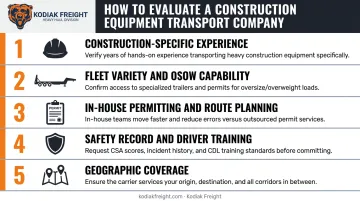
- Construction-specific experience — not just heavy freight volume, but documented experience with tracked machinery, excavators, cranes, and job-site scheduling demands
- Fleet variety and OSOW capability — carriers need the right trailer types (lowboys, RGNs, multi-axle configurations) for the actual equipment being moved
- In-house permitting and route planning — carriers that manage permits internally reduce the risk of documentation errors that cause delays or compliance violations
- Safety record and driver training — FMCSA's SAFER database provides public safety data on carriers; verify active operating authority and insurance before engaging any provider
- Geographic coverage — multi-state construction projects need carriers licensed and experienced across all relevant jurisdictions
Two common mistakes buyers make: choosing a general freight carrier for a specialized OSOW move, and prioritizing price without confirming what's included. A low quote that excludes permits, escorts, and route surveys can end up costing far more once those additions hit the invoice.
A third mistake worth flagging: treating fleet size as a proxy for capability. Smaller, specialized carriers like Kodiak Freight routinely outperform large fleet operators on load-specific coordination, scheduling flexibility, and direct communication — areas where scale often works against you, not for you.
Conclusion
The right construction equipment transport partner isn't the one with the biggest fleet — it's the one whose trailer types, permitting experience, and service model match the specific requirements of your shipment.
Before committing to a carrier, evaluate three things beyond their initial quote:
- Can they scale to your next project, not just this one?
- Are permits, escorts, and route surveys included in the quote — or billed separately?
- What does their track record look like with loads similar to yours?
If those answers point you toward a carrier with dedicated heavy-haul operations, permitting expertise, and hands-on service, Kodiak Freight's Heavy Haul Division handles exactly that — oversize and overweight freight across construction, manufacturing, mining, and more. Reach out at ops@kodiakfreight.com or call 913-210-5144 for a quote.
Frequently Asked Questions
What type of trailer is used to transport construction equipment?
The most common options are lowboys (very low deck for tall, heavy equipment), RGNs (removable gooseneck, allows tracked equipment to drive on), step-decks (for machinery taller than a standard flatbed allows), and flatbeds (for legal-height equipment). Trailer choice depends on the equipment's height, weight, and whether it's wheeled or tracked.
Do construction equipment transport companies handle oversize load permits?
Reputable carriers typically manage OSOW permits, route surveys, and escort car coordination . Confirm this service is included — and at what cost — before signing, since permit complexity varies by state and load dimensions.
How much does it cost to transport heavy construction equipment?
Costs vary based on equipment dimensions, weight, distance, permit requirements, and trailer type. Key cost drivers include axle configuration, route surveys, escort vehicles, and scheduling constraints. Request itemized quotes from multiple carriers and confirm what each quote includes.
What is the difference between heavy haul and construction equipment transport?
Heavy haul is the broader category covering all oversize and overweight freight. Construction equipment transport is a subset requiring carriers with specific experience handling tracked machinery, job-site access conditions, and construction-sector scheduling demands — verify that any carrier you consider has hands-on experience with construction loads specifically, not just general heavy freight.
How do I prepare my construction equipment for transport?
Clean the equipment, remove or secure all attachments, drain fluids if required by the carrier, confirm exact dimensions and weight, and schedule loading with adequate lead time. Accurate measurements upfront prevent permit errors and loading delays.
How long does it take to transport construction equipment across the US?
Transit itself typically takes several days to over a week depending on distance, route complexity, and escort requirements. Permit processing time varies by state and often adds days before the truck rolls — factor that lead time into your schedule, not just the transit window.