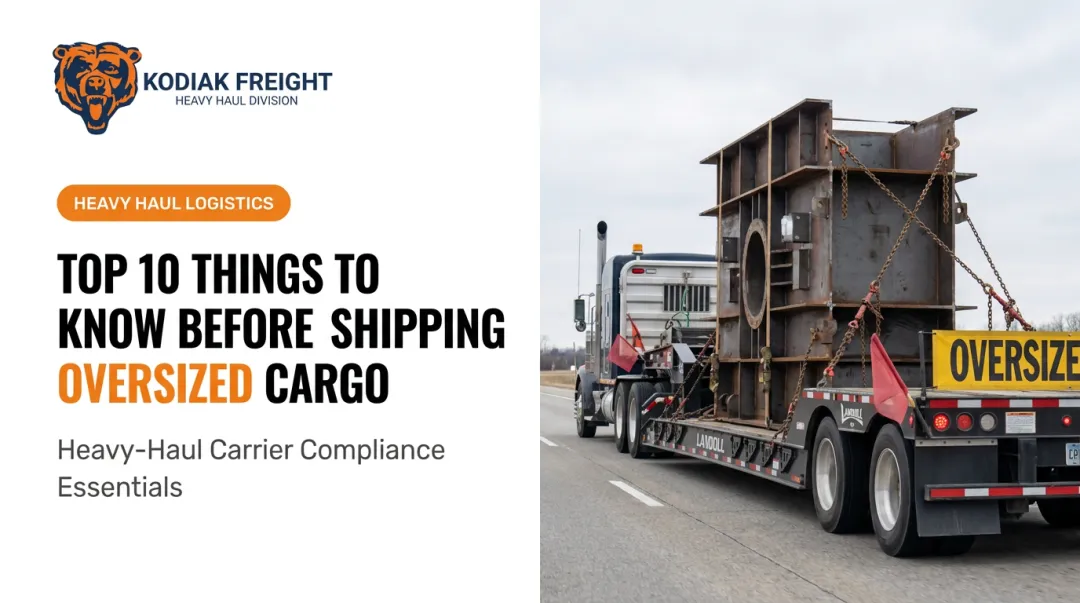

The stakes are real. Choosing the wrong OSOW carrier can mean blown project timelines, permit violations, damaged cargo, or a load stranded roadside while your job site sits idle. The right partner protects both your timeline and your budget.
This article covers the top 10 oversize and overweight load carriers in the US — evaluated on fleet capability, permitting expertise, safety record, industry focus, and national coverage — along with what to look for when making your selection.
Key Takeaways
- Loads exceeding 80,000 lbs. GVW or 102 inches wide on the National Network require state-by-state permits, specialized trailers, and often escort vehicles
- The best OSOW carrier for your shipment depends on cargo type and weight class, not carrier name recognition alone
- Each state issues its own OSOW permits; there is no federal OSOW permit
- Carriers range from massive owner-operator networks to integrated lift-and-transport specialists — match the model to your move
- Agriculture, manufacturing, mining, and railroad shippers often benefit most from carriers with dedicated heavy-haul divisions and hands-on permitting coordination — not just general freight capacity
What Are Oversize & Overweight (OSOW) Loads?
An OSOW load exceeds the federal legal thresholds set for the National Network: 80,000 lbs. gross vehicle weight, a single-axle limit of 20,000 lbs., a tandem-axle limit of 34,000 lbs., or 102 inches (8.5 ft.) in width. Height and length limits vary by state — FHWA confirms there is no universal federal height limit, and 53 ft. is not a fixed federal semitrailer threshold.
Any shipment crossing these thresholds requires:
- Special oversize/overweight permits for each state on the route
- Route surveys to identify clearance hazards and weight-restricted roads
- Pilot car escorts for loads exceeding width or height thresholds
Industries That Generate OSOW Freight
| Industry | Common OSOW Cargo |
|---|---|
| Energy | Wind turbine towers, blades, nacelles, transformers |
| Construction | Cranes, excavators, pedestrian bridges |
| Agriculture | Combines, tractors, irrigation systems, harvesters |
| Mining | Haul trucks, drilling rigs, crushers, processing equipment |
| Manufacturing | Industrial presses, storage tanks, aerospace components |
| Railroad | Locomotives, chassis, rail equipment |

OSOW moves are more complex than standard heavy haul. Shipments can involve superloads (Washington State defines these as exceeding 200,000 lbs. or 16 ft. wide), multi-state permit coordination, utility line lifts, and travel window restrictions.
Permitting adds another layer: FHWA confirms that the federal government does not issue OSOW permits. Each state along the route issues its own authorization independently.
Top 10 Oversize & Overweight Load Carriers in the US
These carriers were selected based on OSOW-specific experience, fleet capability, safety record, industry coverage, and national presence — not general trucking volume alone. Each entry below covers equipment types, industries served, and the specific capability that sets that carrier apart.
1. Landstar Transportation Logistics
Headquartered in Jacksonville, FL, Landstar operates one of the largest asset-light heavy specialized networks in the country. Its model relies on independent agents and owner-operators — as of Q4 2025, that network includes 7,712 BCO contractors, 8,514 trucks, and 17,400+ total trailers.
Landstar's flexibility is its defining strength. Need a perimeter trailer for an oddly-shaped industrial load on short notice? Landstar's agent network can source specialized equipment configurations across all 48 contiguous states.
| Category | Details |
|---|---|
| Equipment Types | RGN, double-drop, multi-axle, perimeter trailers, flatbed, specialized open-deck |
| Industries Served | Energy, construction, agriculture, automotive, government, data storage |
| Key Differentiator | Massive owner-operator network provides broad, flexible OSOW coverage without a fixed fleet ceiling |
2. Bennett Motor Express
Founded in 1974 and headquartered in McDonough, GA, Bennett is a go-to carrier for ultra-heavy and super-heavy haul. Its specialized equipment handles freight from 100,000 lbs. to over 1,000,000 lbs., using configurations ranging from 9-axle to 19-axle and dual-lane dolly setups.
Bennett serves wind energy, oil and gas, construction, mining, agriculture, aerospace, and industrial machinery markets. Its focus on driver qualification for heavy haul work — routing the most complex loads to the most experienced operators — makes it the right call when weight is the primary constraint.
| Category | Details |
|---|---|
| Equipment Types | RGN, step-deck, double-drop, extendable trailers, 9–19 axle configurations, dual-lane dollies |
| Industries Served | Wind energy, oil and gas, construction, mining, agriculture, aerospace, industrial machinery |
| Key Differentiator | Super-heavy haul capability from 100,000 lbs. to 1M+ lbs. with documented multi-axle configurations |

3. TFI International (Daseke)
TFI International completed its acquisition of Daseke on April 1, 2024, for approximately $1.1 billion enterprise value. At the time of acquisition, Daseke's Specialized Solutions segment alone had 2,430 tractors and 6,820 trailers — covering aerospace, wind energy, heavy construction, mining, agricultural machinery, structural steel, and defense.
The combined entity brings significant fleet depth and a portfolio of specialized operating companies, each with distinct OSOW expertise.
| Category | Details |
|---|---|
| Equipment Types | Flatbed, specialized open-deck, multi-axle configurations |
| Industries Served | Aerospace, wind energy, construction, mining, agriculture, structural steel, defense |
| Key Differentiator | Scale and diversification from the Daseke acquisition; one of the largest specialized flatbed fleets in North America |
4. Maxim Crane Works
Maxim combines heavy haul transport with crane, rigging, and engineering services, functioning as a single-source contractor for complex industrial moves. Its equipment includes Scheuerle SPMTs (40 metric tons per axle line) and Goldhofer modular platforms (36 metric tons per axle), alongside heavy-duty lowboys and expandable hydraulic trailers.
For projects requiring both haul and lift — power plant components, refinery modules, large industrial installations — Maxim's integrated model eliminates the coordination risk of managing separate contractors.
| Category | Details |
|---|---|
| Equipment Types | Scheuerle SPMTs, Goldhofer modular platforms, perimeter trailers, heavy-duty lowboys, expandable hydraulic trailers |
| Industries Served | Petrochemical, power generation, pulp/paper manufacturing, mining |
| Key Differentiator | Integrated crane + heavy haul model; one contractor for engineering, transport, lifting, and rigging |
5. Deep South Crane and Rigging
Founded in 1968 and based in Baton Rouge, LA, Deep South has over 55 years solving heavy lift and over-dimensional transport challenges in Gulf Coast industrial and energy corridors. A documented project involved a 500-ton hydraulic gantry and 12-line double-wide SPMTs to transport three 400,400-lb boilers at a refinery.
Deep South's combination of road transport, barge ramp capabilities, and heavy lift rigging makes it well-suited for industrial projects near ports or waterways.
| Category | Details |
|---|---|
| Equipment Types | SPMTs, hydraulic gantry systems, specialized transport trailers, barge roll-off equipment |
| Industries Served | Petrochemical, energy, port/marine industrial construction |
| Key Differentiator | Marine and barge capabilities integrated with OSOW road transport; 55+ years in Gulf Coast industrial projects |
6. Mercer Transportation
Founded in 1977 and headquartered in Louisville, KY, Mercer operates through a network of over 2,200 owner-operator trucks. Its equipment spans flatbed, step-deck, double-drop/lowboy, and RGN configurations, with OSOW-specific logistics covering permits, routing, escorts, and military and construction freight.
Mercer's owner-operator model gives it broad geographic reach and flexibility for open-deck and OSOW freight across the US.
| Category | Details |
|---|---|
| Equipment Types | Flatbed, step-deck, double-drop/lowboy, RGN |
| Industries Served | Military, construction, industrial manufacturing |
| Key Differentiator | Large owner-operator network with OSOW logistics management and military freight experience |
7. TMC Transportation
Founded in 1972, TMC Transportation is a Des Moines, IA-based, employee-owned carrier with a Specialized Division covering the 48 contiguous states. Its fleet includes flatbed, step-deck, and RGN equipment, with a focus on agricultural and construction machinery transport.
TMC's company-managed asset model — as distinct from a pure owner-operator network — means more direct control over equipment standards and driver performance.
| Category | Details |
|---|---|
| Equipment Types | Flatbed, step-deck, RGN |
| Industries Served | Agriculture, construction, manufacturing |
| Key Differentiator | Employee-owned, asset-focused model with Specialized Division coverage across the 48 states |
8. Keen Transport
Founded in 1968 and headquartered in Carlisle, PA, Keen Transport has been part of the Wallenius Wilhelmsen Group since 2017 — giving it access to ocean transport capabilities alongside its domestic heavy haul operations. Its fleet handles up to 13 axles and 160,000 lbs., with RGN, lowboy, I-beam, and multi-axle configurations serving construction, mining, and agriculture markets.

For shippers with both domestic and international project cargo needs, Keen's Wallenius Wilhelmsen connection is useful for managing both domestic and international project cargo legs under one relationship.
| Category | Details |
|---|---|
| Equipment Types | RGN, lowboy, I-beam decks, multi-axle combinations (up to 13 axles) |
| Industries Served | Agriculture, mining, construction |
| Key Differentiator | Ocean transport access via Wallenius Wilhelmsen; strong niche in ag/mining OSOW with international project cargo reach |
9. Combined Transport
Incorporated in 1980 and based in Central Point, OR, Combined Transport specializes in heavy haul over 55,000 lbs., with its specialized fleet handling loads up to 175,000 lbs. The company handles permits, route approvals, and escorts in-house, with a diverse trailer fleet including schnable cars for uniquely shaped cargo.
Combined's Pacific Northwest base and project cargo management capabilities make it a strong regional option for complex western US moves.
| Category | Details |
|---|---|
| Equipment Types | Lowboy, RGN, schnable cars, double-drop, step-deck, A-frame flatbed, multi-axle |
| Industries Served | Construction, manufacturing, energy |
| Key Differentiator | Schnable car capability for unusual cargo shapes; in-house permits and route approvals; strong western US presence |
10. Anderson Trucking Service (ATS)
Founded in 1955 and headquartered in St. Cloud, MN, ATS brings decades of heavy haul experience with a particularly strong internal infrastructure. Its in-house teams handle OSOW permits, route planning, physical route surveys, and pilot/escort arrangements. Heavy-haul drivers must have at least 6 years OTR experience and 2 years OSOW experience before qualifying for complex moves.
Documented ATS work includes wind turbine components up to 56 meters long and nearly 235,000 lbs., mining equipment transport, and a 198,000-lb railroad locomotive — demonstrating cross-sector OSOW depth across energy, mining, and railroad.
| Category | Details |
|---|---|
| Equipment Types | Multi-axle, RGN, flatbed, specialized heavy haul configurations |
| Industries Served | Energy, mining, railroad, construction |
| Key Differentiator | In-house permitting, route survey, and driver qualification infrastructure; documented superload execution across energy, mining, and railroad |
How to Choose the Right OSOW Carrier
The Evaluation Framework
Not all OSOW carriers are built the same. Use these criteria when shortlisting:
- Equipment match — Does the carrier have the specific trailer type, axle configuration, and payload capacity your cargo requires? A generic fleet list isn't sufficient; request a load-specific configuration drawing
- Permitting depth — Can they handle multi-state permit coordination in-house? FHWA confirms each state issues permits independently, making this a meaningful operational capability
- Safety record — Check FMCSA SAFER records and SMS scores for alerts, inspection history, and out-of-service orders — not a single CSA summary score
- Driver qualification — What experience requirements does the carrier impose for OSOW-specific moves?
- Industry-specific experience — Regular wind turbine experience doesn't translate directly to mining haul truck moves — dimensional and weight profiles differ significantly
- Geographic coverage — Confirm they actively operate in your specific lanes, not just theoretically

Common Selection Mistakes
Shippers often make these avoidable errors:
- Choosing on brand name alone without verifying equipment compatibility
- Ignoring CSA scores and FMCSA safety ratings
- Requesting a single-line quote instead of an itemized breakdown that includes permit costs, escort fees, and fuel surcharges
- Not asking about driver qualification standards for OSOW-specific loads
- Failing to request a route survey plan for complex or restricted corridors
For agriculture, manufacturing, mining, and railroad shippers, the right carrier is the one whose core freight experience matches your specific cargo — not just your industry category.
Kodiak Freight's dedicated Heavy Haul Division covers this full cycle: Landoll transport, crane and rigging, laydown yard staging, and in-house permit coordination, with one point of contact from permitting through delivery. That matters most when your load requires precise sequencing and you can't absorb delays from a carrier managing volume freight in the same queue.
Conclusion
Choosing an OSOW carrier is a fit decision, not a popularity contest. The right partner depends on cargo type, weight class, route complexity, and which carrier's equipment and experience genuinely aligns with your shipment — not which company has the most name recognition.
Before finalizing any carrier, check FMCSA safety records, verify equipment specificity, confirm permit capabilities, and request itemized quotes from at least three providers. Those details are where project deliveries succeed or stall.
If you're in agriculture, manufacturing, mining, or railroad and need a partner built around precision and personalized attention, Kodiak Freight's Heavy Haul Division is ready to help. Reach the team at ops@kodiakfreight.com or 913-210-5144 to discuss your next oversize or overweight shipment.
Frequently Asked Questions
How much does an oversized load cost?
OSOW shipping costs vary widely based on distance, cargo dimensions and weight, trailer type, state permit fees, escort vehicle requirements, and route complexity. No standard nationwide rate exists. Request itemized quotes from multiple carriers to compare accurately.
What qualifies as an oversize or overweight load in the US?
Under federal rules, loads exceeding 80,000 lbs. GVW, 20,000 lbs. on a single axle, 34,000 lbs. on a tandem axle, or 102 inches wide on the National Network are subject to OSOW requirements. Height and length thresholds are set by individual states and vary by jurisdiction.
Do I need permits for every state my OSOW load travels through?
Yes. The federal government does not issue OSOW permits — each state along the route issues its own authorization independently. Reputable OSOW carriers handle multi-state permit coordination as part of their service, but confirm this capability before booking.
What types of trailers are used for oversize and overweight loads?
Common OSOW trailer types include lowboys, RGNs (removable gooseneck), step-decks, double-drops, multi-axle configurations, perimeter trailers, modular platforms, and SPMTs (self-propelled modular transporters) for the heaviest moves. The right trailer depends on your cargo's dimensions, weight, and ground clearance requirements.
What is the difference between a heavy haul carrier and an OSOW carrier?
The terms are used interchangeably, but OSOW specifically refers to loads exceeding legal size or weight limits requiring permits. Heavy haul more broadly describes transport of heavy freight — all OSOW loads are heavy haul, but not all heavy haul loads technically exceed OSOW thresholds.
How far in advance should I book an OSOW carrier?
Lead time depends on complexity. Washington State, for example, requires 30 days advance notice for moves above 200,000 lbs. and 7 days for loads above 16 ft. wide. Multi-state superload moves requiring route surveys, utility coordination, and multiple state permit approvals typically need 60–90 days of advance planning.