
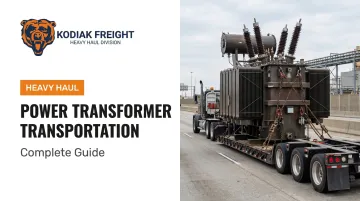
Shippers face a brutal combination: extreme weight, oversize dimensions, internal components sensitive enough to be damaged by a hard bump, and a patchwork of state regulations that don't play nice with each other. This guide walks through transformer types, the full transport process, realistic timelines, required documentation, and how to pick a heavy-haul partner who won't leave you stranded at a state line.
Key Takeaways
- Large power transformers weigh 150-400 tons and need engineered multi-axle trailers, not flatbeds.
- Each state issues its own permits, so multi-state moves need route-by-route coordination.
- Oil-filled units ship drained or nitrogen-padded, per the manufacturer's spec.
- Permitting and utility coordination often add weeks beyond actual drive time.
- Pick a heavy-haul partner with real oversize experience over the lowest quote.
Understanding Power Transformers: Types, Sizes & Why They're Complex to Move
Power transformers step voltage up or down at every stage of the grid: generation, transmission, and distribution. There's no quick swap when one fails. These units are custom-engineered for a specific substation, often built to order, and a replacement can take 12 months or longer to manufacture. That makes the transport leg just as critical as the manufacturing process itself.
Shippers typically move four categories of units:
- Power transformers – the large units connecting transmission lines to substations
- Distribution transformers – smaller units stepping power down for local delivery
- Mobile substation units – trailer-mounted or skid-based systems for emergency grid support
- Specialty transformers – dry-type, traction, or rail-specific configurations
Why Size Varies So Dramatically
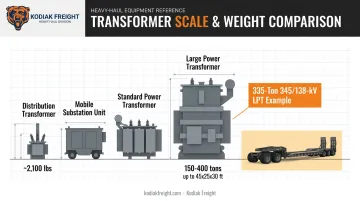
The scale gap between transformer classes is enormous. A pad-mounted distribution unit might weigh around 2,100 pounds. A large power transformer (LPT), defined by the Department of Energy as 100 MVA or greater, typically runs 150 to 400 tons and can measure over 40 feet long.
According to a Department of Energy report on large power transformer resilience, a typical 345/138-kV LPT weighs roughly 335 tons and measures around 45 by 25 by 30 feet.
The Fragility Problem
Transformers aren't just heavy. They're sensitive.
- Vibration and shock can loosen internal windings or shift the core, causing insulation failures that show up only after energization
- Tilt restrictions exist because most units aren't designed to travel at steep angles without internal displacement
- Oil containment becomes a factor any time the unit ships filled, since a leak during transit is both an environmental hazard and a safety risk
Weight also drives a practical handling divide. Units under roughly 80 tons are often simpler to manage since they may travel with oil intact. Heavier units frequently ship with oil drained and replaced with dry nitrogen or gas padding to cut weight and reduce leak exposure. We'll dig into that trade-off later in this guide.
How Are Power Transformers Transported? A Step-by-Step Breakdown
This is the question most shippers actually want answered: what does the process look like from the moment you schedule a move to the moment the unit lands on its pad?
Pre-Transport Planning & Site Assessment
Before anything moves, teams survey the route and both sites. Planners check road grades, turn radii, bridge weight ratings, and overhead clearances.
Minnesota, for example, requires a physical route survey for loads exceeding 16 feet high, 20 feet wide, or 175 feet long, with a minimum of six inches of vertical clearance documented at every crossing.
Coordination happens in parallel:
- Cranes and rigging crews confirm lift capacity and ground bearing at both ends
- Utility crews schedule any temporary power line raises along the route
- Destination readiness gets confirmed, since a transformer arriving to an unprepared pad creates costly idle time
Equipment & Trailers Used for Transformer Hauling
Equipment selection follows the load, not the other way around. Depending on weight, dimensions, and what the route and bridges can support, a haul might use:
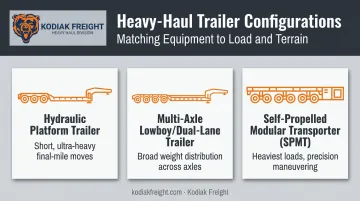
- Hydraulic platform trailers for shorter, ultra-heavy moves like the final stretch into a substation
- Multi-axle lowboys or dual-lane trailers for units that need broad weight distribution across more axles
- Self-Propelled Modular Transporters (SPMTs) for the heaviest, most extreme loads requiring precision maneuvering
A 2024 Wyoming project moved 335-ton transformers 80 miles using a 28-axle configuration, then switched to a hydraulic platform trailer for the final quarter-mile approach, according to The Drive's report on the shipment.
Kodiak Freight's Heavy Haul Division approaches equipment selection the same way, matching trailer configuration to the certified weight, axle plan, and route conditions rather than defaulting to one trailer type for every job.
Route Planning, Permits & Regulatory Compliance
States, not the federal government, issue oversize/overweight permits. Each one traversed sets its own rules on width, height, weight, and escort requirements.
Federal baselines exist as a starting point: 20,000 pounds per single axle, 34,000 pounds per tandem, and 80,000 pounds gross on the Interstate system, with the Federal Bridge Formula determining how weight distributes across axle spacing.
Route surveys map bridge clearances and turning radii state by state, and permit packages typically bundle in:
- Pilot car or escort vehicle requirements, which vary by width and length thresholds
- Bridge engineering reports confirming structural capacity for the load
- Curfew windows or travel restrictions specific to certain corridors
Loading, Transit Monitoring & Unloading
Loading a transformer isn't a forklift job. Crane lifts, jack-and-slide systems, and cribbing or bracing all work together to stabilize the unit before it moves an inch.
Once it's rolling, GPS tracking and shock/tilt monitoring protect the internal windings from damage that wouldn't be visible until the unit is energized.
The IEEE's dedicated transportation guide for transformers rated 10,000 kVA or higher recommends at least two impact recorders per shipment, precisely because damage from a hard jolt often isn't obvious on arrival.
Transformer Oil Handling & Environmental Protocols
Oil-filled transformers carry two risks at once: environmental exposure from a leak, and weight that pushes a shipment into a higher permit category. That's why the industry doesn't apply one blanket rule.
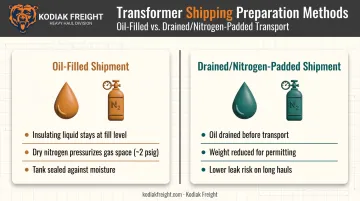
Crews commonly drain larger LPTs of insulating oil before transport specifically to cut shipping weight, per the Department of Energy's LPT study. Smaller or substation-class units often ship differently:
- Insulating liquid stays at the proper fill level
- Crews pressurize the gas space with dry nitrogen, typically around 2 psig
- Technicians seal the tank against air and moisture intrusion
The manufacturer's shipping specification decides which method applies. There's no universal cutoff weight that determines drained versus filled.
For any unit shipping with oil onboard, secondary containment and a spill response plan aren't optional. Carriers need to understand EPA and DOT expectations around oil-filled cargo, and if the fluid meets a DOT hazardous material classification, additional shipping paperwork kicks in.
Partnering with a carrier like Kodiak Freight, which builds spill response into its planning from the start rather than treating it as an afterthought, avoids a scramble if something goes wrong on a rural highway two states from home.
How Long Does It Take to Move a Transformer? Key Timeline Factors
There's no single answer here. A short in-state move might wrap up in days. A multi-state haul crossing five or six jurisdictions can take several weeks of lead time before the truck even leaves the yard.
The DOE benchmarks the actual road-movement stage at 3 to 10 days, averaging around 7 days for heavy-haul transport. That number, though, only covers driving. It doesn't include:
- Permit processing across every state on the route, which can stall if a state doesn't turn around approvals within 7 to 10 days
- Escort and utility coordination, including scheduling crews to temporarily raise power lines along the corridor
- Weather delays, especially for routes crossing mountain passes or flood-prone regions
- Crane and rigging scheduling, since specialized lift crews often book out weeks in advance
Permitting, escort coordination, and crane scheduling all add to drive time. Together, these steps can stretch a full replacement cycle (from transport through energization) to 3 to 4 weeks or more, based on DOE's expedited replacement modeling.
Experienced shippers book equipment, permits, and crane services months ahead of a planned outage window. This lead time protects capital projects from six-figure delay penalties.
Documentation Required for Transformer Shipments
Paperwork gaps cause more delays than most shippers expect. A missing permit or an incomplete bill of lading can hold a load at a state line or complicate a damage claim months later.
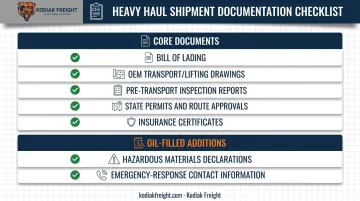
Core documents every transformer shipment needs:
- Bill of lading and packing list detailing weight, dimensions, and cargo description
- Transport and lifting drawings from the OEM, including certified weight and center of gravity
- Pre-transport inspection reports documenting condition before the load leaves the origin site
- State-by-state permits and authorized route approvals
- Insurance certificates confirming coverage for the shipment's value
For oil-filled units, add:
- Hazardous materials declarations if the fluid meets a DOT hazard classification
- Emergency-response contact information for spill or leak scenarios
Federal rules under 49 CFR Part 373 require carriers to issue a proper receipt or bill of lading for interstate shipments. Carriers must retain a copy for at least a year, so this isn't paperwork you can skip and fix later.
Choosing the Right Transformer Transport Partner
Not every heavy-haul carrier is built for transformer work. The stakes are different. You're moving a custom-built unit worth millions against a tight energization deadline, and cargo damage from careless handling often doesn't surface until after installation.
Look for these qualities before signing a contract:
- Proven oversize/overweight experience, not just a mention of it in marketing copy
- Permit and routing expertise across the specific states your shipment will cross
- A safety-first operating culture backed by clear compliance practices
- Proactive communication that flags problems before they become delays
Personalized, detail-oriented service matters more here than it does for standard freight. A missed clearance calculation on a dry van load is an inconvenience. The same mistake on a 300-ton transformer can mean a bridge closure, a damaged transformer, weeks of schedule slippage, or costly emergency rerouting.
Kodiak Freight operates a dedicated Heavy Haul Division built for exactly this kind of work, serving agriculture, manufacturing, mining, and railroad clients who need oversize and overweight cargo moved safely and cost-effectively. The company pairs personalized, detail-driven service with technology that supports safe, on-time delivery, not a one-size-fits-all trailer and a hope for the best.
If you've got a transformer move on the horizon, request a customized heavy-haul plan and quote before you're up against a tight energization deadline. Planning early gives your team room to lock in permits and crane services without the panic of a compressed timeline.
Frequently Asked Questions
How are electrical transformers transported?
Transformers move via specialized flatbed, lowboy, or SPMT trailers depending on weight and dimensions, under state-issued permits and escort coordination. Oil-filled or gas-padded units require additional handling to prevent leaks and pressure loss during transit.
How long does it take to move a transformer?
Timelines range from a few days for short, in-state moves to several weeks for multi-state hauls. Permit processing, escort scheduling, and site readiness usually add more time than the actual drive.
What size transformer requires special permits to transport?
Any load exceeding a state's standard legal weight or dimension limits needs an oversize/overweight permit. Since most power transformers exceed those limits by a wide margin, they almost always need one.
Can transformers be transported with oil inside?
Smaller units often ship with oil intact and dry air padding for protection. Crews typically drain larger power transformers of oil and fill them with dry nitrogen gas instead, mainly to reduce shipping weight and leak risk.
How is transformer transport different from standard freight shipping?
Transformer hauls require specialized trailers, multi-state permits, escort vehicles, and shock/tilt-sensitive handling that standard freight never touches. A misstep in any of these areas can damage cargo worth millions.
What does it cost to transport a power transformer?
Costs vary widely based on weight, distance, permit fees, escort requirements, and crane or rigging needs. There's no standard per-mile rate, so request a custom quote for an accurate number.