Introduction
Agriculture runs on tight windows. A combine that needs to reach a new farm before planting season, a load of perishables that can't sit idle for 48 hours — missed logistics mean missed revenue, and in farming, the calendar doesn't negotiate.
According to a BTS data spotlight published in 2024, 3.3 billion tons of agricultural products moved across the U.S. in 2018 — a figure that underscores how much of American agriculture depends on getting freight decisions right.
This guide covers the full picture: transportation modes, the critical difference between product and equipment transport, oversize haul compliance requirements, and the cost factors that determine what you'll pay.
Whether you're managing a farm operation or coordinating equipment moves across state lines, the right freight decision — made before the window closes — is often what separates a productive season from a costly one.
Key Takeaways
- Trucks handle 64% of U.S. grain tonnage; rail and barge scale efficiently for long hauls and exports
- Agricultural product transport and farm equipment transport require completely different carriers, trailers, and compliance frameworks
- Loads exceeding federal size or weight thresholds require state-by-state oversize/overweight permits
- Seasonal demand spikes during planting and harvest push transport rates up — book early
- Under-qualified carriers for oversize equipment moves risk damaged machinery and permit violations
Why Transportation Is the Backbone of U.S. Agriculture
Agriculture is a two-direction logistics problem. Outputs — grain, produce, livestock — must move from farms to processors, elevators, and export terminals. Inputs — seeds, fertilizers, and heavy equipment — must travel the opposite direction before any of that production is possible.
Disrupt either flow and the entire supply chain stalls.
The scale of this dependency is significant. AAR data shows that railroads alone move roughly 1.6 million carloads of grain and other farm products per year, plus more than 60,000 carloads of food and agricultural products every week — and that's just rail.
The Seasonal Pressure Factor
What makes agricultural logistics especially demanding is timing. Unlike manufacturing supply chains that operate on relatively steady schedules, farming compresses enormous transport demand into narrow windows:
- Planting season requires equipment, fuel, and inputs on-site before the window opens
- Harvest season demands grain trucks, combine moves, and processing capacity simultaneously
- Post-harvest drives intense competition for transport capacity as grain elevators fill and export demand peaks
USDA data documented a 1% quarter-to-quarter increase in grain truck rates driven by post-harvest demand — real cost pressure that compounds quickly across large-scale operations. Missing a transport window during these periods can mean a delayed planting or a crop that sits too long before processing.
Transportation Modes Used in Agriculture
No single mode handles all of U.S. agricultural freight. Each has a role defined by distance, volume, cargo type, and destination.
Trucks
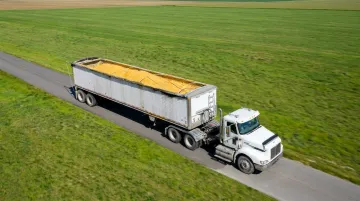
Trucks are the dominant mode for good reason: door-to-door flexibility that no other mode matches. They pick up at the farm gate and deliver directly to a grain elevator, processing plant, or distribution center, with no intermediate handling required. For perishables, refrigerated (reefer) trucks extend that reach to temperature-sensitive cargo.
Trucks handle 64% of all U.S. corn, soybean, and wheat tonnage, and their share of domestic movements climbs to 82% when exports are excluded. For short- and medium-haul domestic freight, trucking is essentially irreplaceable.
Rail
Rail's strength is scale over distance. Lower cost per ton-mile than trucking makes it competitive for long-haul bulk commodities — and grain is a natural fit. Rail handles 17% of domestic grain tonnage and 38% of grain export movements, with wheat particularly rail-dependent at 50% of all movements.
Barge
Barges on the Mississippi River system and Great Lakes waterways are the export workhorse for U.S. grain. A single 15-barge tow carries 22,500 tons — the equivalent of 870 tractor-trailers. Close to 60% of U.S. corn, soybean, and wheat exports move down the Mississippi by barge, which means river levels and barge availability directly affect export pricing.
The trade-off: barges are geographically constrained and slower. They're not a factor for domestic short-haul movements.
Air Freight
At the opposite end of the spectrum from barge, air freight handles the highest-value, most time-sensitive agricultural cargo: cut flowers, live seafood, and specialty produce where speed justifies the cost premium. It has no role in bulk commodity or equipment transport.
Multimodal
Most large-scale agricultural logistics chains combine modes. A typical export grain movement might look like this:
- Truck moves grain from farm to local elevator or rail terminal
- Rail hauls bulk grain to a Gulf port facility
- Barge or vessel handles the export leg
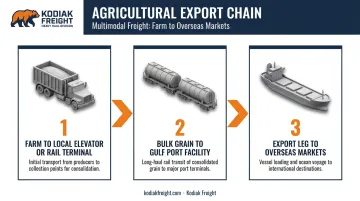
Each mode is selected for what it does best at that stage. The result is a chain where cost, speed, and geography drive the decision — not habit.
Agricultural Product Transport vs. Farm Equipment Transport: What's the Difference?
Agricultural product transport and farm equipment transport are two distinct logistics categories — and conflating them creates real operational problems.
| Category | Product Transport | Equipment Transport |
|---|---|---|
| What moves | Grain, produce, livestock, dairy | Tractors, combines, planters, irrigation systems |
| Primary constraints | Food safety, temperature, time | Dimensions, weight, road clearances |
| Governing rules | FMCSA commodity definitions, food safety regs | State size/weight limits, oversize permits |
| Trailer types | Grain hopper, reefer, livestock trailer | Lowboy, step-deck, RGN, Landoll tilt-deck |
| Key risk | Spoilage, contamination, delays | Permit violations, equipment damage, route failures |
A reefer truck configured for produce cannot haul a 12-row planter. A lowboy set up for a combine is not appropriate for grain. Cargo type dictates the entire logistics approach: trailer selection, regulatory requirements, and risk profile. Treating these as interchangeable categories is where expensive mistakes begin.
Moving Heavy and Oversize Agricultural Equipment
Modern agricultural machinery has grown substantially in size and weight. A large combine with its header attached can exceed 20 feet in width. Grain carts, pull-type sprayers, wide planters, and irrigation pivots all routinely exceed standard highway dimensions. Moving any of it legally requires coordinating trailer selection, permitting, securement, and route planning before a single mile is driven.
Trailer Selection
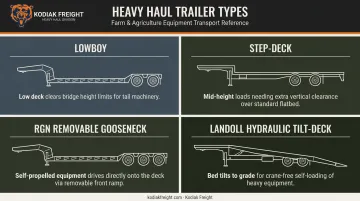
The right trailer depends on the equipment's specific dimensions, weight, and how it loads:
- Lowboy trailers — For tall, heavy machines; the low deck height creates clearance for bridges and overpasses that taller configurations would strike
- Step-deck trailers — For mid-height equipment that doesn't require the lowest possible deck
- RGN (Removable Gooseneck) trailers — The gooseneck detaches, creating a ramp that allows self-propelled equipment to drive directly onto the deck
- Landoll hydraulic tilt-deck trailers — The bed tilts to ground level for loading without requiring a crane
Loading and Securement
Under 49 CFR 393.130, wheeled or tracked machinery weighing 10,000 lbs or more must be restrained against movement in all directions, with at least four tiedowns attached at front and rear or manufacturer-designated mounting points. Beyond the federal minimum:
- Equipment must be balanced across axles to stay within per-axle weight limits
- Attachments (headers, cutting platforms) are typically removed or secured separately
- Fluids may need to be drained depending on transport angle and duration
- Manufacturer-specified tie-down points must be used — improvised securing can cause frame damage
Route Planning
Oversize moves don't follow the most direct path — they follow the legal path. Route planning for wide agricultural equipment must account for:
- Bridge weight and clearance limits
- Weight-restricted local and state roads
- Tight turns in rural areas
- Utility line heights on back-road routes
For extreme-width loads common in row-crop farming, advance physical route surveys may be necessary. Kodiak Freight's Heavy Haul Division manages this full process — trailer selection, axle configuration, permitting, escort coordination, and route verification — for agricultural equipment moves across the U.S., including the Midwest and Great Plains states where demand is most concentrated.
Permits and Compliance for Agricultural Equipment Transport
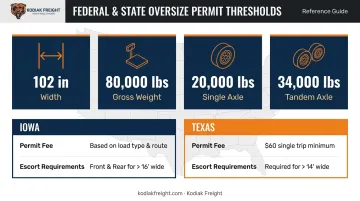
Any load exceeding federal baseline limits requires permits before it moves. The federal thresholds are:
- Width: 102 inches (8'6") on the National Network
- Weight: 80,000 lbs gross, 20,000 lbs single axle, 34,000 lbs tandem axle
- Height: No federal limit — states set their own (13'6" is common but not universal)
- Length: States must allow at least 48 feet on the National Network; no simple federal maximum applies
Every state beyond these baselines applies its own rules. For example:
- Iowa requires a permit over 8'6" wide, 13'6" high, or 80,000 lbs gross; annual oversize permits run $50, annual oversize/overweight permits run $400
- Texas offers general single-trip permits at $60; loads exceeding 16 feet wide require one escort vehicle, and loads over 18 feet require two
Multi-state moves require a permit from each state the load passes through. Permit fees, processing timelines, automated-issuance thresholds, and escort requirements vary widely from state to state — which is why permit coordination for interstate agricultural equipment moves is handled by specialists, not improvised by operators.
Agricultural Exemptions: Know the Limits
Some states exempt farm vehicles operating within a specific radius of the farm from certain CDL and permitting requirements. Those exemptions apply at the local level — they don't extend to commercial transport across state lines.
Any long-distance or interstate equipment move requires proper oversize/overweight permits regardless of the equipment's agricultural classification. Kodiak Freight's Permit & Escort Services team manages state-by-state permit acquisition and pilot car coordination for every heavy agricultural equipment haul.
What Affects the Cost of Agricultural Transportation?
Transport costs for agricultural equipment aren't fixed. Several distinct factors interact on every job, and understanding them helps you plan moves without surprises.
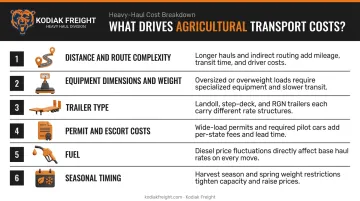
Primary cost drivers:
- Distance and route complexity: Longer hauls and routes requiring detours or multiple state permits cost more
- Equipment dimensions and weight: Wider, heavier loads trigger more restrictive permit categories and escort requirements
- Trailer type: Lowboys, RGNs, and Landoll configurations carry different rate structures than standard flatbeds
- Permit and escort costs: Multi-state moves multiply permit fees; wide loads requiring two escort vehicles add significant cost
- Fuel: USDA uses weekly diesel benchmarks as a proxy for grain truck rate trends — and those benchmarks move trucking rates directly
- Seasonal timing: Harvest season creates peak demand; last-minute bookings during those windows typically come at a premium
The Value of Booking Early
Scheduling transport in advance — particularly around planting and harvest windows — makes a measurable difference in both cost and availability. Carriers with available equipment and experienced operators book out quickly during peak agricultural periods.
The other side of timing: choosing a carrier based on the lowest quote without verifying experience with oversize agricultural loads creates real risk. Permit violations, damaged equipment during loading, or a delivery that misses a critical planting window all carry costs that dwarf any initial savings.
Working with a carrier who specializes in agricultural oversize loads addresses those risks directly. For recurring equipment moves, Kodiak Freight offers dedicated fleet arrangements that provide committed capacity on an ongoing basis — more stable than chasing spot market availability season after season.
Contact their team at ops@kodiakfreight.com or 913-210-5144 to discuss what your specific transport needs require.
Frequently Asked Questions
Do I need a CDL to haul my own grain?
Farmers hauling their own grain within a set radius may qualify for CDL exemptions under the federal Covered Farm Vehicle definition, but conditions vary by state and don't apply to commercial hauling across state lines. Check with your state DOT for the rules specific to your operation.
What are farmer trucks called?
Trucks used on farms are commonly called grain trucks (for hauling harvested grain), farm trucks, or ag trucks. The broader category includes straight trucks, dump trucks, and flatbeds used to move equipment, feed, and supplies around or between farm operations.
What is the difference between agricultural product transport and farm equipment transport?
Agricultural product transport moves harvested goods — grain, produce, livestock — from farm to market or processor. Farm equipment transport moves the machinery itself. Each requires different trailer types, carrier expertise, and regulatory compliance. Treating them as interchangeable typically leads to the wrong trailer, wrong permits, and the wrong carrier.
What permits are required to transport oversized farm equipment?
Any load exceeding standard legal size or weight limits requires an oversize/overweight permit from each state the route crosses. Wide or heavy loads may also require escort vehicles, travel time restrictions, and coordinated law enforcement escorts arranged in advance.
What types of trailers are used to haul heavy farm equipment?
The most common options are lowboy trailers for tall, heavy equipment; step-deck trailers for mid-height loads; RGN (Removable Gooseneck) trailers that allow self-propelled equipment to drive on and off; and Landoll hydraulic tilt-deck trailers that load equipment without a crane.
How much does it cost to transport farm equipment?
Costs depend on distance, equipment dimensions, trailer type, required permits, escort needs, and seasonal demand. For an accurate number, contact a heavy-haul specialist like Kodiak Freight directly with your equipment specs and route — there's no reliable ballpark without those details.