Shippers in agriculture, manufacturing, mining, and rail often learn this the hard way. A combine or a haul truck doesn't follow the same rules as a pallet of retail goods, yet many teams assume standard freight logic still applies. The result: fines, blown schedules, or damaged equipment sitting on the side of a highway.
This guide breaks down the 10 things every shipper needs to know before booking an oversized load, from cargo classification to picking a heavy-haul partner like Kodiak Freight that actually specializes in this kind of freight.
Key Takeaways
- Oversize and overweight status depends on measured dimensions and weight, not appearance
- Permit and escort rules shift by state, county, and city, so lead time matters
- Costs hinge on dimensions, permits, escorts, and route complexity, not a flat rate
- A dedicated heavy-haul carrier reduces compliance risk generic freight companies can't manage
Know Your Cargo Classification Before You Book
Before requesting a single quote, you need to know exactly what you're shipping in legal terms, not just physical ones.
Thing 1: Understand What Qualifies as Oversized vs. Overweight Cargo
"Oversized" and "overweight" aren't interchangeable terms, even though shippers use them that way constantly.
- Oversized refers to dimensions, including width, height, or length, that exceed a state's standard legal limits
- Overweight refers to gross weight or axle loading that exceeds legal thresholds
- A load can be oversized, overweight, or both at the same time
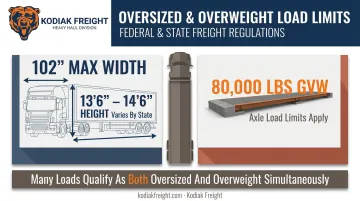
The federal Interstate baseline sits at 80,000 lbs gross weight, with a 102-inch width allowed on the National Network. Height has no single federal maximum. States generally set limits between 13 feet 6 inches and 14 feet 6 inches, according to FHWA's Commercial Vehicle Size and Weight Program. These are baselines, not guarantees. Every state layers its own rules on top.
Thing 2: Know the Legal Thresholds That Trigger Special Permits
Cross a state's dimension or weight threshold, and permits and escorts become mandatory. There's no gray area here.
Measure the actual load, not the spec sheet. Packaging, rigging, and mounting hardware all add inches and pounds that blueprints don't account for. A tractor that looks legal on paper can be oversized once it's loaded and secured.
Equipment that regularly triggers these thresholds includes:
- Tractors, combines, and harvesters in agriculture
- Haul trucks, excavators, and drilling rigs in mining
- Production line machinery and industrial presses in manufacturing
- Rail cars and rail components in railroad operations
Thing 3: Determine If Your Load Is Divisible
A divisible load can sometimes be broken into smaller shipments to dodge oversize classification entirely. This can cut permit costs and simplify routing.
But disassembly and reassembly aren't free. They add labor hours, equipment risk, and time on both ends of the move. This decision needs to happen early, with input from your carrier's routing team, not the night before pickup.
Nail Down Permits, Escorts, and Compliance
Getting a state permit feels like clearing the hurdle. It's really just the first one.
Thing 4: Permits Vary by State, County, and City
A state DOT permit doesn't automatically clear you through every city or county on your route. Municipalities can layer on their own restrictions: school-hour bans, mandatory local escorts, or road closures that state permits don't address.
Lead times vary wildly:
- Automated routine permits in some states process in minutes
- Superheavy or complex permits can take 3-8 weeks, depending on the state and route
- Rural, low-traffic states often move faster than congested, high-volume corridors
Plan your permit timeline around your slowest state, not your fastest.
Thing 5: Understand Escort and Pilot Car Requirements
Width and height thresholds determine whether you need one pilot car, two, or none at all, and these thresholds shift by state. A load that needs a single escort in one state might require front and rear pilot cars plus a height-pole vehicle once it crosses a border.
A 14-foot-wide load, for instance, might travel escort-free through Texas but need two pilot cars once it reaches Colorado.
Failing to arrange escorts ahead of time is one of the most common causes of delays at state lines. Escort vehicles need scheduling, not just booking. Good ones fill up during peak construction and harvest seasons.
Thing 6: Build In Time for Seasonal and Local Restrictions
Spring thaw isn't just an inconvenience — it changes legal weight limits. Michigan's 2026 seasonal restrictions reduced permitted loading on designated routes by 25% on rigid pavement and 35% on flexible pavement, according to a Michigan Department of Transportation announcement.
Similar rules apply across the Midwest and Great Plains, right where much of the country's agricultural equipment moves. Minnesota and Wisconsin post their own thaw-season limits each spring, and missing the posted dates can strand a load for weeks.
Request permits well ahead of pickup, and confirm they stay valid through your entire travel window. A permit that expires mid-route is as useless as no permit at all.
Plan for Costs and Get Accurate Quotes
Oversized freight pricing isn't a flat rate. It's a stack of variables that shift with every mile and every state line.
Thing 7: Understand What Drives Oversized Shipping Costs
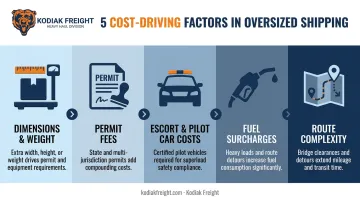
Five factors drive most of the price tag:
- Dimensions and weight — bigger and heavier loads need more specialized equipment
- Permit fees — these vary by state and by load classification
- Escort and pilot car costs — driven by the number of vehicles required and mileage
- Fuel surcharges — tied to current diesel pricing, not a fixed percentage
- Route complexity — detours around low bridges or weight-restricted roads add mileage and time
Removing protruding parts or partially disassembling equipment can sometimes lower a load's classification and cost. Heavy-haul carriers routinely trim excess width or height before a load ever hits the road, cutting fees in the process.
Thing 8: Get Multiple Quotes at the Right Times to Lock In the Best Rate
Quote early, then quote again. That's the strategy that actually works for oversized freight:
- Get a ballpark quote as soon as you know the shipment is coming
- Get a firmer quote once dimensions, weight, and route are finalized
- Confirm final pricing once permits are secured and dates are locked
The cheapest bid up front isn't always the best value. A carrier without heavy-haul experience can miss a permit detail or misjudge a clearance, and the delay or damage that follows will cost far more than the savings ever offered.
Prepare Equipment, Route, and Safety Details
Trailer selection has to match your load's verified dimensions, weight, and center of gravity — not the estimate from a spec sheet.
- Step-deck trailers work well for tall equipment that needs a lower deck height
- RGN (removable gooseneck) trailers suit heavy machinery that needs to be driven or rolled on
- Landoll tilt-deck trailers allow equipment to load without a separate crane, which saves time and cost on eligible loads
- SPMTs (self-propelled modular transporters) handle extreme superloads that exceed conventional trailer capacity
With the trailer type confirmed, run a route survey before finalizing pickup dates, checking bridge clearances, overhead utilities, posted road weight limits, and turning radius at tight intersections. A route that looks fine on a map can have a 13-foot underpass nobody flagged.
Load securement isn't optional or improvised. 49 CFR Part 393, Subpart I governs cargo securement nationwide, per federal cargo securement regulations. These rules translate into three practical requirements:
- Heavy equipment weighing 10,000 lbs or more generally needs at least four tiedowns anchored near the front and rear
- Recheck tiedowns within the first 50 miles of the trip, then periodically throughout the haul
- Insurance coverage should match the equipment's declared value; underinsuring a $400,000 excavator is a mistake made only once
Choose a Heavy-Haul Partner You Can Trust
General freight carriers know dry van and reefer. They typically don't know permitting nuances, escort coordination, or how to match a trailer to a load's center of gravity — and that gap shows up as delays, fines, or damaged equipment.
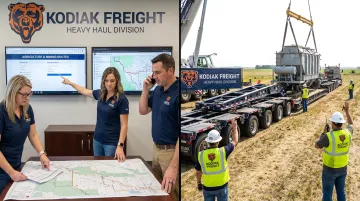
Kodiak Freight operates a dedicated Heavy Haul Division built specifically for agriculture, manufacturing, mining, and railroad shippers. That means:
- State-by-state permit and pilot car coordination handled directly, not outsourced
- Landoll tilt-deck trailers, crane and rigging, and power-only units matched to the actual load
- Route surveys and DOT compliance built into every move, not treated as an afterthought
- Personalized attention from a team that already understands what a haul truck or a rail component needs on the road
Before booking any heavy-haul carrier, check these four things:
- How do they handle permits — in-house, or outsourced to a third party?
- What's their safety record and DOT compliance history?
- How do they communicate updates during transit and delays?
- Do they have real experience in your specific industry?
A carrier that can answer all four confidently is one worth trusting with a six-figure piece of equipment.
Frequently Asked Questions
What is considered oversized cargo?
Oversized cargo exceeds standard legal width, height, or length limits set by the state you're traveling through. It typically requires special permits, escort vehicles, and specialized trailers to move legally and safely.
What is the cheapest way to ship oversized items?
Savings come from accurate quotes, realistic timelines, and evaluating whether your load is divisible to minimize fees tied to permits or escorts. Working with an experienced heavy-haul specialist often beats the lowest bid, since mistakes from inexperienced carriers cost more than they save.
How far in advance should I book oversized freight shipping?
Book as soon as your dimensions and weight are confirmed. Permit approval and escort scheduling can take anywhere from a few days to several weeks, depending on the states involved.
Do all oversized loads require a special permit?
Most loads exceeding legal width, height, or weight limits require a permit, but the exact triggers vary by state, county, and city. Always verify requirements for every jurisdiction on your route.
What happens if my cargo is misclassified as standard freight?
Misclassification can lead to fines, roadside delays, outright shipment refusal, or safety violations. Accurate classification upfront avoids all of these headaches.
Can I ship oversized cargo internationally?
Yes, but international oversized cargo typically moves through specialized ocean, breakbulk, RO-RO, or air freight services rather than standard trucking. This guide focuses on domestic U.S. heavy-haul trucking, which is where Kodiak Freight operates.