Drop and hook trucking exists specifically to solve this problem.
This article covers what drop and hook means, how it works step by step, how it compares to live loads, and a clear-eyed look at the pros and cons for both drivers and shippers.
Key Takeaways
- Drop and hook eliminates dock wait time by swapping pre-loaded trailers instead of waiting for loading or unloading
- DAT data shows drop and hook averages under one hour; live loads can exceed three hours
- Drivers never handle cargo, but remain legally responsible for pre-trip inspection and weight compliance under FMCSA rules
- Best suited for high-volume shippers with adequate yard space and a rotating trailer pool
- Not suited for temperature-sensitive freight, urgent same-day shipments, or loads requiring specialized rigging and securement at pickup
What Is Drop and Hook Trucking?
Drop and hook is a freight exchange model where a driver arrives at a facility, unhooks their current trailer, and immediately hooks to a pre-loaded trailer already staged in the yard. No waiting for dock crews to load or unload. No freight handling. The driver exchanges trailers and rolls.
You'll also see it called "drop and pick" on some load boards and in regional dispatch communications — same concept, different terminology.
How It Relates to No-Touch Freight
Drop and hook is always no-touch freight — the driver never handles cargo. But the reverse isn't true. A live load can also be no-touch if facility workers handle all loading while the driver waits at the dock. The real difference is dwell time: drop and hook eliminates it entirely, while a no-touch live load does not.
Drop and Hook vs. Live Loads: Key Differences
A live load means the driver arrives at an appointment window and waits at the dock while warehouse staff load or unload in real time. That wait adds up fast.
According to FreightWaves SONAR data, average dwell time per pickup or delivery reached 119 minutes in 2024. DAT reports live loads can exceed three hours in some cases.
Drop and hook eliminates most of that wait by decoupling the loading process from the driver's arrival.
| Factor | Drop and Hook | Live Load |
|---|---|---|
| Turnaround time | Under 1 hour (DAT average) | 2+ hours typical; 3+ hours possible |
| Scheduling pressure | Low — broader pickup windows | High — tight appointment coordination |
| Yard requirements | Trailer pool + adequate space | Minimal |
| Cargo control | Less — shipper pre-loads | More — real-time oversight |
| Detention risk | Reduced | Elevated |
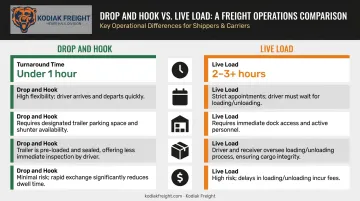
The table makes the trade-off clear: drop and hook wins on speed and scheduling flexibility, but only where yard infrastructure supports it. Live loads fit any facility size — the cost is measured in driver hours spent waiting at the dock.
How Drop and Hook Trucking Works
The Basic Exchange Sequence
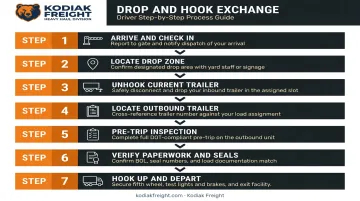
- Arrive at the facility and check in with the gate or dispatch office
- Locate the drop zone — the designated area where incoming trailers are staged
- Unhook the current trailer, positioning it correctly in the assigned spot
- Locate the outbound trailer assigned for pickup using the BOL or yard management system
- Conduct a thorough pre-trip inspection before coupling
- Verify paperwork and seals — confirm the Bill of Lading matches the trailer and seals are intact
- Hook up and depart
Pre-Trip Inspection: Still Your Responsibility
Even though the driver didn't load the trailer, federal regulations are clear. Under 49 CFR 392.7, a driver may not operate a CMV until satisfied that brakes, lights, tires, steering, and coupling devices work properly. Under 49 CFR 396.13, the driver must review the last inspection report and confirm the vehicle is in safe operating condition.
These obligations apply regardless of who loaded the trailer or how tight the yard schedule runs.
Weight Compliance
Weight verification follows directly from pre-trip inspection. Drivers must confirm the pre-loaded trailer doesn't exceed federal limits (80,000 lb gross, 20,000 lb single axle, 34,000 lb tandem axle) before pulling out. Under 49 CFR 392.9, cargo must be properly distributed and secured. If a shipper has overloaded the trailer, the driver must return it for adjustment before departure.
Real-World Complications
Not every yard runs smoothly. Common friction points include:
- Trailers buried behind other units and requiring a yard spotter to reposition
- Mislabeled or incorrectly positioned trailers that don't match the assignment
- Overflow lots that add distance and time to the exchange
Even with these delays, the overall turnaround typically stays well under a live load scenario.
Pros of Drop and Hook Trucking
Faster Turnaround, More Miles
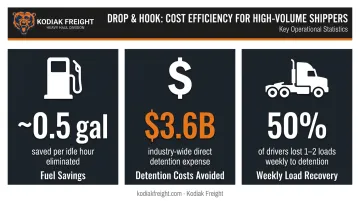
DAT reports drop and hook averages under one hour, versus live loads that regularly exceed two or three hours. For drivers, that recovered time translates to additional loads per week. OOIDA data shows half of surveyed drivers lost one or two loads weekly to detention — time that drop and hook arrangements can reclaim.
Reduced Detention Risk
ATRI estimated detention cost the trucking industry $3.6 billion in direct expenses and $11.5 billion in lost productivity in 2023. Fewer hours at the dock means fewer detention triggers. Carriers also gain more predictable transit windows, making it easier to quote accurate delivery times.
Scheduling Flexibility
Shippers can pre-load trailers during off-peak hours instead of staging everything around a precise driver appointment. Drivers gain a wider pickup window — the trailer is ready when they arrive, not contingent on dock crew availability.
No Freight Handling or Lumper Fees
Drivers don't touch, move, or help secure cargo. That eliminates:
- Physical strain from manual loading assistance
- Liability exposure for cargo damaged during handling
- Out-of-pocket lumper fees at unloading facilities
Cost Efficiency for High-Volume Shippers
For operations running consistent, high-frequency freight, the fuel savings alone are measurable. FleetOwner reports a truck consumes roughly 0.5 gallon of fuel per idling hour. Cutting two hours of dock time per stop across dozens of weekly loads adds up. Beyond fuel, reduced dock congestion lowers labor coordination costs and reduces overall dock congestion across the week.
Cons of Drop and Hook Trucking
Trailer Quality Is Unknown
When hooking a trailer from a shipper's pool, the driver has no history with that equipment. Worn tires, damaged marker lights, faulty brake lines, or structural corrosion become the driver's problem the moment they exit the yard. A thorough pre-trip isn't optional — it's the only protection against inheriting someone else's maintenance neglect.
Yard Delays Still Happen
Drop and hook is faster on average, but it's not immune to friction. Trailers get blocked, mislabeled, or moved to overflow areas. Yard spotters aren't always available immediately. What should be a 30-minute swap can stretch to 90 minutes in a poorly managed yard.
Not Practical for All Freight Types
Several freight categories are operationally incompatible with standard drop and hook:
- Temperature-controlled or perishable freight — trailer temperature status is unknown after sitting in a yard
- Oversize and overweight loads — require state-specific permits, pilot car coordination, custom securement, and specialized trailers; these cannot simply be pre-staged and exchanged
- Hazmat shipments — require driver-present verification and documentation at each transfer point
- Urgent or last-minute freight — shippers need advance lead time to pre-load; same-day pickups don't fit the model
The oversize category is a clear example. Loads like mining excavators, combines, and industrial machinery require Landoll tilt-deck trailers, custom axle configurations, and permit packages built for specific routes. A power-only pickup can work when the customer supplies their own specialized trailer and logistics are coordinated in advance. But the permitting complexity and equipment specificity of these loads make a standard drop and hook model impractical — which is why Kodiak Freight's heavy-haul operations handle each oversize move as a fully coordinated engagement, not a yard swap.
Lead Time and Planning Requirements
Drop and hook is a scheduled model. Shippers need adequate notice to pre-load trailers, enough units in rotation to avoid gaps, and yard staff or spotter trucks to manage positioning. For smaller operations or reactive shipping scenarios, live loads are simply more practical.
Who Uses Drop and Hook — and When Does It Make Sense?
Operations That Benefit Most
- Large retailers and e-commerce fulfillment centers — Amazon's freight network and Uber Freight's Powerloop program (which has handled over 220,000 loads) are documented examples of drop and hook at scale
- LTL terminal networks — linehaul drivers relay pre-loaded trailers between service centers without touching freight
- Manufacturers and agricultural operations with predictable, high-frequency outbound freight and their own trailer pools
For manufacturing, agriculture, and mining clients with consistent freight volumes and significant equipment investments, drop and hook keeps supply chains moving without staging freight around driver arrival windows. Standard trailers and conventional cargo are where the model performs best.
Specialized OD equipment is a different story — the daily reality for Kodiak Freight's customers. In those cases, power-only arrangements with customer-supplied trailers provide the same scheduling flexibility without shoehorning non-standard freight into a standard trailer exchange.
Facility Requirements for Shippers
To make drop and hook viable, a shipper needs:
- Yard space large enough to park multiple trailers simultaneously
- A trailer pool sized to handle peak-period demand without running short
- Yard management capability — staff or spotter trucks to move trailers into position
Without these three conditions in place, drop and hook is impractical no matter the freight volume.
When Live Load Remains the Right Choice
- Smaller facilities without trailer pools
- Fragile, high-value, or hazmat cargo requiring real-time loading oversight
- Any freight type where the driver's dock presence is operationally necessary
- Same-day or reactive shipments with no pre-staging window
Frequently Asked Questions
What does drop and hook mean in trucking?
Drop and hook means a driver arrives at a facility, unhooks their current trailer in a designated drop zone, and immediately hooks to a pre-loaded trailer already staged in the yard — cutting out the wait for loading or unloading.
How long does a drop and hook typically take?
Most exchanges wrap up in under an hour, per DAT's 2023 benchmarks — well short of the 119-minute average dwell time FreightWaves recorded for standard pickup and delivery stops. Even with yard complications, drop and hook rarely approaches that threshold.
Does drop and hook pay more than a live load?
The per-mile rate isn't always higher, but faster turnarounds mean more loads completed per week with less unpaid waiting. Reduced detention exposure keeps more of the day in productive driving miles.
What types of shipments are not suitable for drop and hook?
Several shipment types don't work well with drop and hook:
- Temperature-sensitive or perishable freight
- Oversize and overweight loads requiring special permits and securement
- Hazmat shipments with handling compliance requirements
- Urgent same-day freight where the shipper can't pre-stage a trailer
Do drivers need their own trailer for drop and hook freight?
Most drop and hook is power-only — the driver brings their tractor, hooks to the shipper's or carrier's pre-staged trailer, and leaves their previous trailer in the yard. A personal trailer is generally not required.