The problem for most shippers is that equipment hauling rates don't follow a simple formula. Load dimensions, trailer type, distance, permit requirements, and fuel surcharges all interact to produce a final number that can look wildly different from one quote to the next — even for the same piece of equipment.
This guide breaks down per-mile rate ranges by trailer type, explains every cost component in a typical quote, walks through the factors that move prices up or down, and gives you a practical framework for building an accurate budget before you ever request a bid.
Key Takeaways
- Standard flatbed rates average $2.50/mile spot and $3.12/mile contract (March 2024, including fuel); oversize loads run significantly higher
- Oversize and overweight hauls add costs for permits, pilot car escorts, and route surveys on top of the base per-mile rate
- Short hauls under ~300 miles are typically priced on a day rate, not per mile
- Every state sets its own permit thresholds — a multi-state haul requires a permit for each state crossed
- Accurate quotes require exact weight, dimensions, origin, destination, and timeline — missing details lead to price changes mid-haul
Equipment Hauling Rates: What Does It Actually Cost?
Equipment hauling rates are not fixed prices you can look up in a catalog. A carrier builds a quote from a base linehaul rate, then adjusts it based on load specs, route requirements, trailer configuration, and add-on services. The result is a layered number — not a flat fee.
Standard Trailer Rate Benchmarks
The most reliable published benchmark for standard freight comes from DAT RateView data, reproduced in a March 2024 flatbed market outlook:
| Trailer Type | Spot Rate (with fuel) | Contract Rate (with fuel) |
|---|---|---|
| Standard flatbed | $2.50/mile | $3.12/mile |
| Flatbed (March 2023 comp.) | $2.72/mile | $3.27/mile |
These figures cover legal-dimension freight on standard flatbeds across national lanes over 250 miles. They are not equipment-haul guarantees — stepdeck, RGN/lowboy, and hot shot loads each carry their own pricing based on equipment specifics and lane.
A few things to note about these benchmarks:
- They include fuel. Some carrier quotes separate linehaul and fuel surcharge — confirm which you're comparing
- They exclude short hauls. DAT's methodology omits lanes under 250 miles, where per-mile rates are typically higher
- They apply to legal-dimension loads. Once a load is classified as oversize or overweight, you're in a different pricing tier entirely
Oversize and Overweight Load Pricing
Oversize loads — those exceeding federal width thresholds (102 inches/8'6") or state height limits (typically 13'6" to 14') — don't have a reliable published national per-mile rate. FHWA doesn't issue OS/OW permits; each state does, with its own thresholds and fee schedules — which is exactly why no single national rate exists.
What you can budget for is the layered cost structure that every oversize haul carries:
- Base linehaul rate (higher than standard flatbed due to trailer cost, driver certification, and setup time)
- State-by-state permit fees for every state crossed
- Escort/pilot car vehicles when load dimensions trigger legal requirements
- Route survey and engineering review for complex or superheavy moves
- Potential travel restrictions (time-of-day, day-of-week, seasonal)
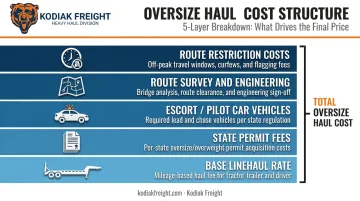
State permit fees alone show how quickly costs stack. Texas charges $60 base for a general single-trip permit, plus a maintenance fee of $150–$375 depending on gross weight, plus a $35 supervision fee above 200,000 lbs. California's single-trip permit starts at $16. Cross four states and those fees add up fast — before escorts or engineering enter the picture.
Short-Haul and Day Rates
For moves under roughly 300 miles, per-mile pricing breaks down. Fixed costs — driver time, positioning, permits, and loading setup — don't scale with distance the way linehaul costs do. Carriers typically quote these moves on a day rate or minimum charge instead.
Key questions to ask when requesting a short-haul quote:
- What is the minimum billable time (half-day, full day)?
- Are mobilization and return positioning included or billed separately?
- How are waiting time and loading delays handled?
Key Factors That Affect Equipment Hauling Rates
Equipment hauling rates reflect a combination of load characteristics, route demands, and market conditions — and each variable compounds the others. Understanding which factors drive cost helps you anticipate what you'll actually pay before a quote lands in your inbox.
Equipment Size, Weight, and Dimensions
Weight determines axle configuration — heavier loads require more axles, which increases trailer cost and permit complexity. Dimensions determine classification: a load that's even a few inches over a state's legal width or height threshold moves from standard to oversize, triggering permits, escort requirements, and restricted travel windows.
Federal baselines:
- Max width: 102 inches (8'6") on the National Network
- Max gross weight: 80,000 lbs GVW (20,000 lbs single axle; 34,000 lbs tandem)
- Max height: Set by individual states, typically 13'6" to 14'
Height is the trickiest variable: there is no federal height limit. Route clearance must be verified state by state, and sometimes bridge by bridge.
Distance and Route Complexity
Longer hauls spread fixed costs over more miles, which generally lowers the per-mile rate — but total cost still rises with distance. Route complexity adds cost regardless of mileage:
- Bridge weight restrictions may require detours
- Low clearances trigger route surveys
- Urban corridors and mountain terrain slow transit and increase escort hours
- Multi-state hauls multiply permit requirements
Trailer Type Required
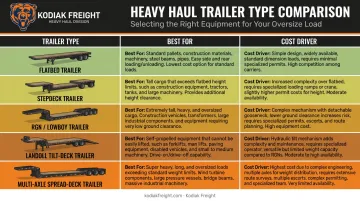
The cargo's dimensions and weight dictate which trailer can legally carry it. Each trailer type carries a different cost structure:
| Trailer Type | Best For | Cost Driver |
|---|---|---|
| Flatbed | Standard-dimension freight | Lowest base rate; broad carrier availability |
| Stepdeck | Equipment that's too tall for a flatbed but can self-load | Mid-tier rate; moderate availability |
| RGN/Lowboy | Tall or very heavy equipment requiring low deck height | Higher rate; specialized equipment and driver certification |
| Landoll tilt-deck | Equipment that drives on without a crane | Efficient for self-propelled loads; reduces crane costs |
| Multi-axle configurations | Extreme weights exceeding standard axle limits | Highest cost; engineered load plans required |
Permits, Escorts, and Compliance Costs
Each state sets its own permit thresholds. A haul from Texas to Michigan crossing six states needs six permits — each with its own fee structure, processing time, and dimensional rules.
Escort vehicles are triggered by load dimensions, not by distance. Texas, for example, requires one escort for loads 14–16 ft wide, front and rear escorts above 16 ft wide, and a height pole for loads over 17 ft tall. There is no federal escort standard — rules vary by state and road type.
Permit procurement and pilot car coordination are typically managed by the carrier as part of the hauling service. These costs should appear as explicit line items in any legitimate quote, not buried in the base rate. Kodiak Freight's Heavy Haul Division handles both as standard practice, so clients see exactly what compliance is costing them.
Fuel Prices and Market Timing
The EIA reported a 2025 annual US on-highway diesel average of $3.660/gallon, but EIA explicitly does not calculate or regulate carrier fuel surcharges — those are negotiated between carrier and shipper. A legitimate quote identifies the fuel index used, the baseline diesel price, the assumed MPG, and the adjustment interval.
Flatbed tender rejections ran at 13% in the first half of 2023 and dropped to 9% in the second half — a material capacity shift that directly affects rate exposure. Booking during peak construction or harvest season, when agriculture equipment moves dominate Midwest capacity, typically means tighter availability and higher rates. Scheduling ahead of those windows translates directly into better pricing.
What Goes Into Your Equipment Hauling Quote
A complete equipment hauling quote has several distinct components. Understanding each one lets you verify you're comparing apples to apples — and catch a cheap-looking quote that's actually missing half the costs.
Linehaul / Base Rate
The foundational charge for moving the load from origin to destination. Calculated per mile for long hauls, or as a day rate for short moves. Varies by trailer type and load classification.
Fuel Surcharge
A variable add-on tied to current diesel prices. Should appear as a separate line item with a named index, not folded into the base rate. When fuel prices shift, this number moves — and it will affect your actual invoice.
Permits and Escort Vehicles
Permit fees are charged per state, per haul. Escort vehicle costs are triggered by load dimensions and billed on top. A carrier that handles oversize freight regularly procures permits as part of the job and includes these costs explicitly in the quote.
Load Assistance and Specialized Handling
Cranes, rigging crews, and specialized loading equipment are often quoted separately. Agree on all handling requirements before transport begins — surprise charges at the pickup point are avoidable when scoped upfront.
Common add-ons to confirm before signing:
- Crane and rigging fees — required when equipment can't self-load; carriers like Kodiak Freight offer this alongside Landoll tilt-deck transport as a bundled option
- Landoll self-load savings — equipment that loads via a Landoll trailer skips crane costs entirely, which can meaningfully reduce the total quote
- Laydown yard staging — holding equipment at a secure facility between transport legs, relevant to multi-phase project moves
How to Estimate the Right Budget for Your Equipment Haul
Start with These Inputs
No carrier can give you an accurate quote without this information:
- Equipment weight (loaded, including any attachments)
- Height, width, and length (at maximum points)
- Origin and destination addresses (not just cities — site access matters)
- Required delivery timeline
- Site access limitations (overhead clearances, ground bearing, road width)
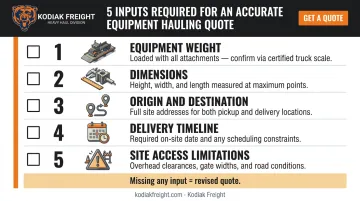
Missing or estimated dimensions are the single most common cause of quotes that change after the haul begins.
Consider Disassembly to Reduce Classification
If removing an attachment, lowering a boom, or partially disassembling equipment brings dimensions within legal limits, the permit and escort costs may disappear entirely. FHWA defines a nondivisible load as one requiring more than eight work hours to dismantle — if your equipment can be broken down in less time, it may not qualify for oversize treatment at all.
Run the math on both options: assembled oversize transport versus disassembly plus standard-dimension transport. The cheaper path isn't always obvious until you've compared both scenarios — which also puts you in a stronger position when evaluating quotes.
Watch for These Red Flags in Quotes
A quote that looks attractively low may be missing real costs. Warning signs:
- No itemized breakdown — linehaul, fuel, permits, and escorts should each be listed separately
- No mention of permits for a load that clearly exceeds legal dimensions
- Vague delivery windows with no explanation of travel restrictions or curfews
- Full payment requested upfront without a clear scope of services
- No fuel surcharge line item — means fuel is either hidden in the base rate or not accounted for
Any of these signals suggests the carrier is either unfamiliar with oversize freight compliance or has excluded costs that will resurface later.
Work with a Heavy-Haul Specialist for Complex Loads
For oversize or overweight equipment — agricultural machinery, mining assets, manufacturing lines, railroad components — a generic flatbed carrier typically isn't equipped for the permitting, escort coordination, and route planning that non-standard loads require. They often underquote because those costs simply aren't on their radar.
A dedicated heavy-haul specialist brings the right trailer, handles multi-state permitting, coordinates pilot cars, and builds a quote that accounts for all of it upfront — so your invoice doesn't change at mile 400.
A complete, itemized quote from a carrier with heavy-haul experience is worth more than a low headline number that excludes half the actual costs.
Frequently Asked Questions
How much per mile does it cost to haul equipment?
Standard flatbed freight runs approximately $2.50/mile spot or $3.12/mile on contract (2024 national averages, including fuel). Stepdeck, RGN/lowboy, and hot shot loads are priced by load-specific quote. Oversize and overweight loads run significantly higher once permits, escorts, and route complexity are factored in.
How much does it cost to move heavy equipment?
Total cost ranges from a few hundred dollars for a short local move to several thousand for a long-distance or oversize haul. Final cost depends on distance, equipment dimensions, trailer type, and add-ons like permits and escort vehicles — there's no reliable flat figure without a routed, load-specific quote.
What type of trailer is best for heavy equipment hauling?
Flatbeds handle standard-dimension loads; lowboys and RGNs are used for tall or very heavy equipment requiring a lower deck for legal clearance. Landoll tilt-deck trailers work well for self-propelled equipment that can be driven on without a crane. The right choice depends on height, weight, and whether crane-assisted loading is needed.
Do I need permits to haul heavy equipment across state lines?
Yes — any load exceeding a state's legal thresholds for width, height, length, or gross weight requires a state-issued permit, and each state crossed on a multi-state haul requires its own permit. A qualified heavy-haul carrier manages this permitting process as part of the job.
How far in advance should I book equipment hauling?
Book as early as possible, particularly during peak construction season or agricultural harvest periods when carrier capacity tightens. Expedited moves are available but typically cost more and limit your route and carrier options.
What information do I need to get an accurate equipment hauling quote?
Have the equipment's weight, height, width, length, pickup and delivery addresses, required delivery timeline, and any site access restrictions ready before reaching out. Incomplete information produces a quote that will likely be revised once the carrier gets the full picture — and revised costs rarely come down.