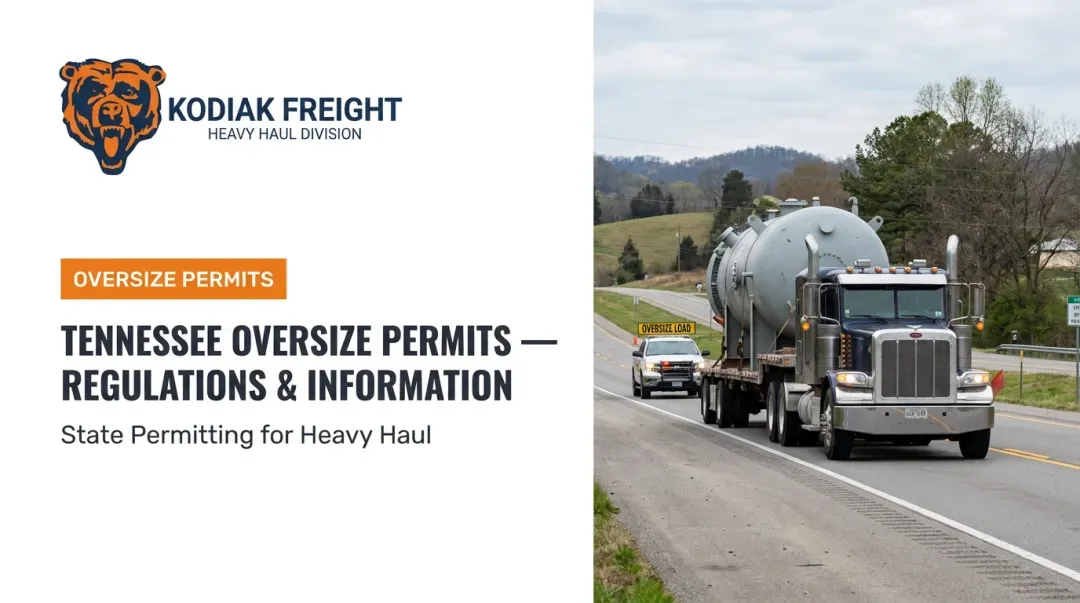
 Tennessee sits at the crossroads of major US freight corridors — I-40, I-24, I-65, and I-75 collectively move substantial volumes of agricultural equipment, industrial machinery, mining hardware, and railroad components through the state daily. According to TDOT's 2023 Statewide Multimodal Freight Plan, Interstate routes average 4,671 truck AADT — with peaks reaching 16,519 — making Tennessee one of the more active states for heavy-haul operators in the Southeast.
Getting the permit wrong here isn't just a paperwork problem. Fines, load holds, and forced re-routes are real consequences for operators who misread Tennessee's rules.
This guide covers everything you need: legal limits, permit types and current costs, escort requirements, travel restrictions, and superload rules.
Key Takeaways
- Legal width limit: 8'6" — anything wider requires a permit
- Legal height limit: 13'6"; legal gross weight: 80,000 lbs
- Single-trip oversize permit: starts at $20 through TDOT's TNTrips portal
- Superload triggers: over 165,000 lbs GVW, 16 feet wide, or 15'6" tall
- Escort required: widths over 12'6", heights over 15'1", or lengths over 90 feet
Tennessee Legal Limits: What Qualifies as an Oversize Load?
Core Dimensional Thresholds
Tennessee requires a permit when any single dimension exceeds these legal maximums:
| Dimension | Legal Maximum |
|---|
| Width | 8'6" (102 inches) |
| Height | 13'6" |
| Semitrailer length | 50 feet (from attachment point to tractor) |
| Gross vehicle weight | 80,000 lbs |
| Single axle | 20,000 lbs |
| Tandem axle | 34,000 lbs |
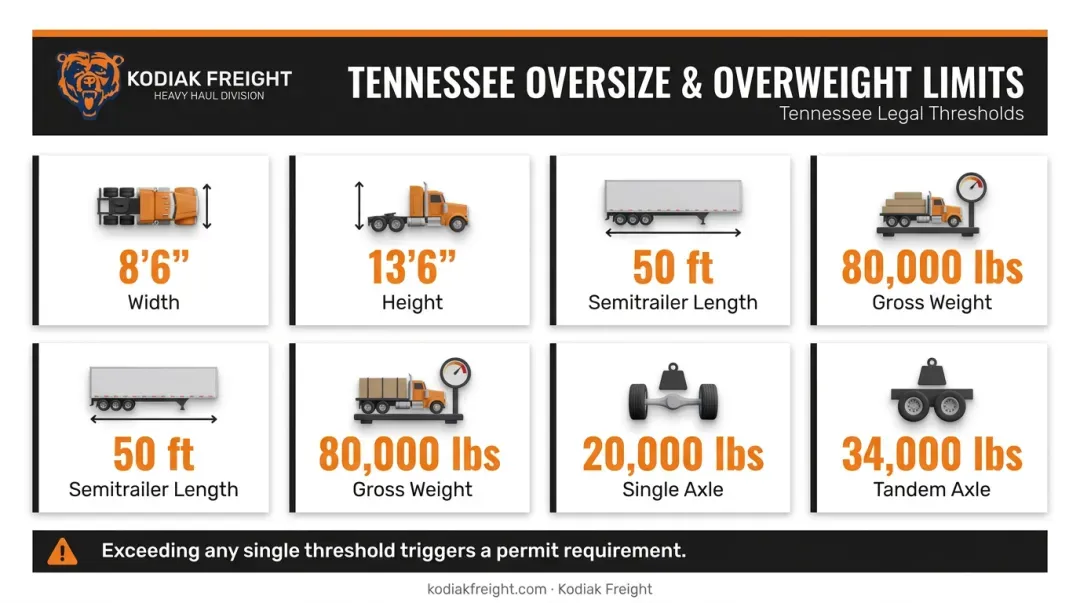
Exceeding any single threshold triggers the permit requirement. All four don't need to be exceeded at once.
Interstate qualifier: Vehicles above 73,280 lbs gross, 18,000 lbs on a single axle, or 32,000 lbs on a tandem may operate on the Interstate system only when axle distribution satisfies the TCA 55-7-203 bridge formula. Special permits raise tandem limits to 40,000 lbs and tridem limits to 60,000 lbs.
What Triggers Flagging Requirements
Tennessee Rule 1680-07-01 requires marking when a load component projects:
- More than 4 inches beyond either side of the vehicle
- More than 4 feet beyond the rear
Projections within those limits don't require flags — but anything beyond them does, regardless of whether a permit is needed.
Non-Divisible Load Rule
Only non-divisible loads qualify for oversize/overweight permits. Tennessee defines eligible articles as those that cannot be "reasonably dismantled or conveniently transported otherwise." Tennessee explicitly treats sealed containerized cargo units as non-divisible.
If a load can be broken down to legal dimensions, it must be. TDOT will not issue a permit for a load that's separable.
A Common Length Measurement Mistake
The 50-foot semitrailer limit is measured from the tractor attachment point to the rearmost point of the trailer, not overall vehicle length. Carriers running a 53-foot trailer should also note that for towed vehicles over 48 feet, the kingpin-to-rearmost-axle distance is limited to 41 feet. Rear overhang beyond the axles can push a load into permit territory even when the trailer itself appears compliant.
Tennessee Oversize Permit Types and Costs
Single-Trip Permits
Single-trip permits are available through TDOT's TNTrips online portal. Current pricing from TDOT's official fee schedule:
| Permit Type | Cost |
|---|
| Width: 8'6" to 14' | $20 |
| Width: 14'1" to 16' | $30 |
| Width: over 16' | $30 + $5 per additional foot or fraction |
| Excess length | $20 |
| Excess height | $20 |
| Excess weight | $20 + $0.06 per ton-mile |
Annual Permits
Annual permits are vehicle-specific — each truck requires its own application. Current annual weight permit tiers:
| Weight Threshold | Annual Fee |
|---|
| Up to 100,000 lbs | $750 |
| Up to 120,000 lbs | $1,500 |
| Up to 140,000 lbs | $2,250 |
| Up to 155,000 lbs | $3,000 |
| Up to 165,000 lbs | $3,500 |
Annual overdimension permits covering height up to 13'10", width up to 13'6", or length up to 90 feet are available at $100 per dimension.
Loads Over 150,000 lbs
Loads above the standard annual permit ceiling follow a separate approval track with additional review requirements:
- 150,001–165,000 lbs: Special permit from the Commissioner of Transportation
- Over 165,000 lbs: Mandatory TDOT Structures Division bridge review before any permit is issued
Bridge review fees: $100 for loads up to 250,000 lbs; $300 for 251,000–500,000 lbs; actual cost for loads over 500,000 lbs.
For carriers managing multi-state moves through Tennessee — particularly in agriculture, mining, or manufacturing — Kodiak Freight's Heavy Haul Division handles permit acquisition as part of the full-service transport process.
Escort and Pilot Car Requirements
Width-Based Escort Requirements
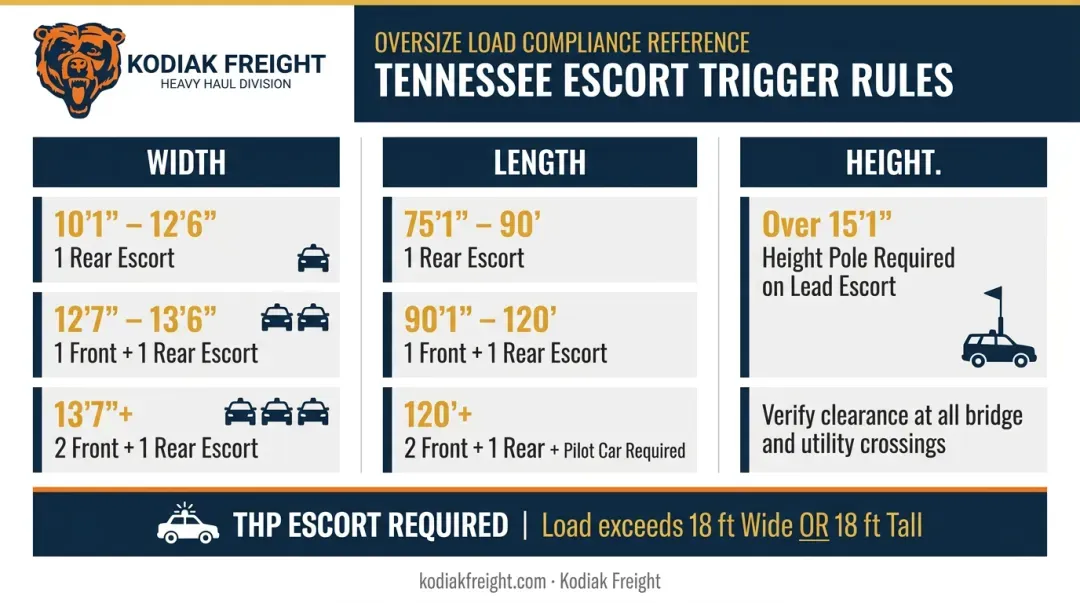
Current TDOT thresholds for width-triggered escorts:
| Width | Two-Lane Roads | Four-Lane/Interstate |
|---|
| 10'1" – 12'6" | Front escort (if pavement under 24 feet) | No escort required |
| 12'7" – 13'6" | Front escort | Rear escort |
| 13'7" or greater | Front and rear escorts | Front and rear escorts |
Length-Based Escort Requirements
- 75'1" – 90': Amber rotating or strobe light on the rear sign (visible 500 feet in all directions); no escort vehicle required per the live TDOT FAQ
- 90'1" – 120': Rear escort vehicle required
- Over 120': Front and rear escorts; city limit travel restrictions apply
Height-Based Escort Requirements
Any load exceeding 15'1" in height requires a front escort vehicle equipped with a height pole. The escort must maintain radio communication with the driver at all times to warn of insufficient clearance ahead.
Tennessee Highway Patrol Escort
THP escort is mandatory for:
- Loads over 18 feet wide on Interstate or federal-aid highways
- Loads over 18 feet tall on any highway
THP costs: $65 per hour per officer plus $0.13 per mile, with a minimum four-hour billing period. Advance scheduling is required. Budget at least 10 business days to account for THP processing and officer availability.
Travel Restrictions, Hours, and Holiday Rules
Baseline Movement Rules
- Non-escorted oversize/overweight loads: May travel continuously, including nights and weekends
- Superloads, houseboats, and mobile homes: Daylight hours only — 30 minutes before sunrise through 30 minutes after sunset, local time
Rush-Hour Curfews for Escorted Loads
Loads 85 feet or longer and/or over 12'6" wide cannot travel within city limits or heavily trafficked areas:
- Monday–Friday, 7:00–9:00 AM and 4:00–6:00 PM
The same windows apply to all escorted OS/OW loads on Interstates in Davidson (Nashville), Rutherford, Knox (Knoxville), Shelby (Memphis), and Hamilton (Chattanooga) counties.
Those daily curfews address time-of-day limits — but calendar restrictions add another layer for escorted moves.
Holiday Restrictions
Escorted load movement is prohibited on seven holidays:
- New Year's Day
- Good Friday
- Memorial Day
- Independence Day
- Labor Day
- Thanksgiving Day
- Christmas Day
Closure windows vary by holiday — Good Friday restrictions in 2026 begin at 6:00 PM Thursday, while most other holidays begin at noon the preceding day. Non-escorted loads are not subject to these restrictions. Confirm exact windows using the current TDOT holiday travel notice before scheduling any escorted move.
Signs, Flags, and Lighting Requirements
"Oversize Load" Banner Requirements
Required for all loads exceeding 10 feet wide or 75 feet long. Banners must be placed front and rear and meet these specs:
- Minimum 7 feet long × 18 inches high
- Yellow background with solid black lettering at least 10 inches tall with a 1 5/8-inch stroke width
- Material: durable wood or metal; securely mounted heavy canvas is acceptable
- Must be clean, legible, and in good repair at all times
Flag Requirements
Tennessee's rules establish two separate flag standards, each covering a different type of load condition:
- Rule .20 (oversize load marking): Solid red, 18-inch-square flags
- Rule .02(13) (projection marking): Red flags at least 12 inches square, placed where a component extends more than 4 inches beyond a side or more than 4 feet beyond the rear
Flags must be visible to traffic approaching from both directions.
Lighting Requirements
Lighting requirements apply based on load length and movement time:
- Loads over 75 feet: Amber rotating or strobe light on the rear sign, visible from 500 feet in all 360 degrees
- Nighttime movement: One red side-marker lamp on each side at maximum overhang; two red lamps and two red reflectors on the rear marking maximum width
Tennessee Superloads: When Standard Permits Aren't Enough
Superload Thresholds
A load becomes a Tennessee superload when it exceeds any one of these:
- Gross weight over 165,000 lbs
- Width over 16 feet
- Height over 15 feet 6 inches
Length alone does not trigger superload status in Tennessee.
What the Application Requires
Superload applications go to the TDOT Supervisor of Overweight and Overdimensional Permits and must include:
- Detailed description and sketch of the vehicle and load
- Tire sizes and contact pressures
- Axle spacings and per-axle load distribution
- Overall dimensions (length, width, height)
- A detailed traffic control plan
Additional requirements by dimension:
- Over 16 feet wide or over 15 feet high: Letter of necessity demonstrating the move is essential to public welfare, safety, or national defense
- Over 15'6" high and/or over 16 feet wide: Carrier-conducted route survey using a front escort vehicle with a height pole set 6 inches above the load height (not merely equal to it)
Processing Timelines
Superload review is manual. TDOT exercises sole discretion on issuance, and processing times vary based on gross weight:
| Weight Range | Processing Time |
|---|
| Up to 165,000 lbs | Up to 3 business days |
| 165,001 – 250,000 lbs | Up to 5 business days |
| 250,001 – 500,000 lbs | Up to 15 business days |
| Over 500,000 lbs | Up to 30 business days |
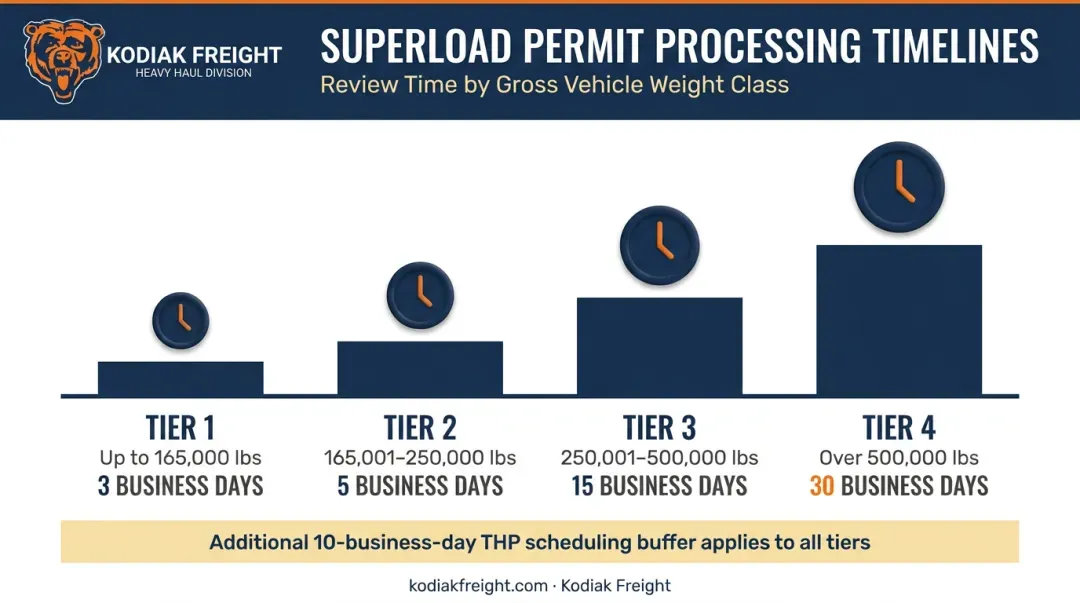
These timelines cover permit processing only. Moves requiring THP escort carry a separate advance notice requirement — budget at least 10 additional business days for THP scheduling.
Operators in mining, railroad, or manufacturing moving oversized components through Tennessee often engage Kodiak Freight's Heavy Haul Division to manage route surveys, bridge evaluations, and permit documentation before the move begins.
Frequently Asked Questions
What are Tennessee oversize regulations?
Tennessee requires a permit for any load exceeding 8'6" wide, 13'6" high, 50 feet in semitrailer length, or 80,000 lbs gross weight. Rules cover permit types, fees, escort requirements, travel hour restrictions, and signage, all enforced by TDOT under Rule 1680-07-01.
How wide can a load be in Tennessee without a permit?
The legal maximum width without a permit is 8'6" (102 inches). Anything wider requires an oversize permit and proper flagging before travel. Widths over 12'7" on four-lane roads also trigger escort vehicle requirements.
How much overhang is allowed in Tennessee?
Tennessee requires flagging when a load projects more than 4 inches beyond either side or more than 4 feet beyond the rear. TDOT's official rules don't set a general five-foot total overhang maximum; the flagging thresholds are the operative limits.
Can you drive oversize at night in Tennessee?
Non-escorted oversize loads may travel 24 hours a day, 7 days a week in Tennessee. Escorted loads face rush-hour curfews on weekdays, and superloads plus houseboats are limited to daylight hours only (30 minutes before sunrise through 30 minutes after sunset).
What is considered a superload in Tennessee?
A Tennessee superload is any load exceeding 165,000 lbs gross weight, 16 feet in width, or 15 feet 6 inches in height. Superloads require manual TDOT review, a detailed application package including a traffic control plan, and often THP escort.
Do I need a pilot car for oversize loads in Tennessee?
Escort requirements depend on dimensions: widths over 12'7" on four-lane roads, heights over 15'1", or lengths over 90 feet all trigger pilot car requirements. The number and positioning of escorts increase as load dimensions grow, with THP required once width or height exceeds 18 feet.
Need an oversize load moved through Tennessee?
Tell us about your load and we'll handle the permits, escorts, and routing.
Get a Quote