
What counts as heavy haul
When Your Freight Outgrows a Flatbed
Once a load goes past about 80,000 pounds gross, or wider than 8 feet 6 inches, or taller than 13 feet 6 inches, you are out of legal limits and into permit territory. That is where we live.
Heavy haul is not just a bigger truck. It is a different trailer, route, and set of permits for every state line you cross, and often a pilot car or two. Get any one of those wrong and your load sits on the shoulder while the clock runs. We plan for all of it before the wheels turn.
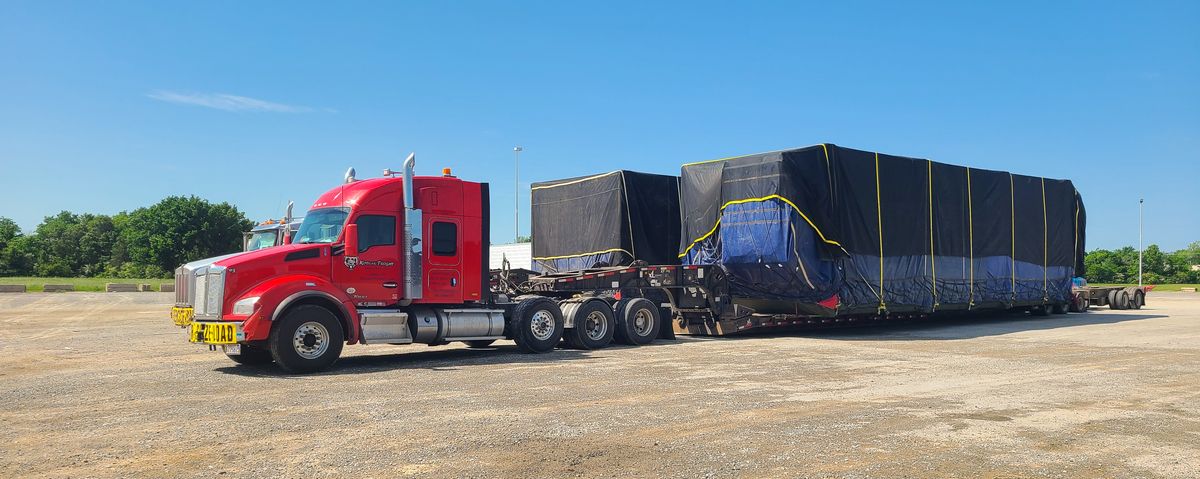
How we run a heavy haul move
The Work That Happens Before the Truck Shows Up
- 1
We start with the real dimensions.
Not the ones on the PO. Actual length, width, height, weight and center of gravity, plus how it can be picked and where it can be secured. Most problems on a heavy haul trace back to a number somebody guessed.
- 2
We match the trailer to the load.
Deck height drives everything. A load that clears on a double drop might be illegal on a step deck. We work backward from your height and weight to the configuration that keeps you legal and permit costs down.
- 3
We route it and survey it.
Bridges, overpasses, utility lines, turn radii, construction and curfews. On tighter moves we drive the route physically before we quote a date.
- 4
We pull the permits.
In house, state by state, with the travel restrictions each one carries. Some states will not let an oversize load move at night, on weekends or through certain counties during harvest. We build that into the schedule instead of discovering it later.
- 5
We move it and you hear from us.
Escorts arranged, securement to spec, and a real person who tells you where the load is.
Equipment we put underneath it
The Right Trailer Is Half the Job
Deck height and axle count decide whether your load is a routine permit or a route survey and a police escort. We have over 300 trailer configurations so we can pick the one that solves the problem rather than the one that happens to be sitting in the yard.
| Configuration | Typical deck height | Well or deck length | Capacity | Best for |
|---|---|---|---|---|
| Step deck | 36–42 in | 37–43 ft lower deck | 43,000–48,000 lb | Loads just over legal height |
| Double drop | 18–24 in | 24–29 ft well | 38,000–45,000 lb | Tall freight that needs a low well |
| RGN | 18–24 in | 24–29 ft well | 38,000–42,000 lb standard | Rolling stock that can drive on |
| Multi axle RGN | 18–30 in | 24–30+ ft well | 80,000–150,000+ lb | Heavy freight that needs weight spread |
| Stretch RGN / stretch step | 18–42 in, depending on type | 38–63 ft stretch step; 28–50+ ft stretch low well | 36,000–45,000 lb typical; specialized units vary | Long freight with overhang concerns |
| Perimeter trailer | Load-specific; often 12–24 in effective clearance | Custom, load-specific | 100,000–200,000+ lb | Tall, heavy units like transformers |
Problems we solve
The Stuff That Usually Goes Wrong
The load is heavier than the paperwork said.
We weigh and verify before we commit to a route because a 15,000 pound surprise can invalidate a permit.
The route has a bridge that will not take it.
We find that in the survey, not at the bridge.
The site cannot handle a truck that long.
We check access and turn radius up front, and stage nearby if the site is not ready.
Everything shows up at once and there is nowhere to put it.
That is what our laydown yards are for.
The schedule moves.
It always does. Because we own the equipment, we can re-sequence without renegotiating with an outside carrier.
Why Kodiak
Asset Based, Which Means Accountable
A lot of heavy haul quotes come from companies that do not own a single trailer. They take your load, post it, and hope somebody good picks it up. When it goes sideways they are as surprised as you are.
We are not doing that. It's Kodiak drivers in the seats of our trucks pulling our trailers using permits our team pulled and storing equipment in our owned laydown yards. If something goes wrong, we fix it and you know exactly who to call. And when a project needs capacity beyond what we own, we pull it through Sims Global rather than through a load board.
- In house permitting and route planning
- Owned, specialized fleet
- Terminals and laydown yards
- Experienced CDL drivers with over-dimensional miles behind them
- 48 state coverage
- Direct access to your project team
FAQ
Heavy Haul Questions Answered
How much can you haul?
Our standard configurations cover most heavy freight. Past that we move into the superload category, which needs engineering, utility coordination and sometimes a police escort. If you are not sure which side of the line you are on, send us the dimensions and we will tell you.
How long do permits take?
Most states turn around routine oversize permits in one to three business days. Superload permits and anything needing a route survey or bridge analysis can take two to six weeks. The earlier you call, the more of that runs in parallel with your build schedule instead of after it.
Do I need pilot cars?
That depends on the dimensions and the state. Requirements change at the state line, so a load that needs one escort in Kansas might need two and a height pole in Missouri. We coordinate all of it, so you get one plan.
Can you store my freight if the site is not ready?
Yes. We run secured laydown yards and can hold your equipment and release it to the jobsite in the order you need it.
Do you handle loading and unloading?
Yes. We provide crane and rigging service at our yards and at jobsites.
What do you need from me to quote?
Dimensions, weight, origin, destination and your target date. Photos and a drawing help. If you have pick points and a center of gravity, even better.
Send Us the Dimensions
We will tell you what it takes, what it costs and how long the permits will run.