 Picture this: a procurement manager schedules delivery of a new industrial press, assuming it will move like any other freight shipment. Three days before pickup, the carrier calls—the load is 11 feet wide and requires permits from four states, a route survey, and two pilot cars. The delivery window shifts by two weeks. The project timeline slips.
This scenario plays out constantly across U.S. supply chains, and it's entirely avoidable. Knowing whether your load qualifies as oversize before you book transport is the difference between a smooth delivery and an expensive scramble.
This guide covers the federal definition of oversize cargo, why state rules vary so dramatically, which industries generate the most oversize loads, what equipment moves them, and what the permit process actually involves.
Key Takeaways
- Oversize cargo exceeds 8.5 ft wide, 13.5–14 ft tall, or 80,000 lbs gross vehicle weight—exceeding even one threshold triggers oversize requirements
- Every state along a route requires its own permit; the most restrictive state's conditions govern the entire move
- Agriculture, manufacturing, mining, and railroad industries generate the highest volume of oversize loads
- Early planning—permits, route surveys, and equipment selection—prevents most oversize shipment delays
What Is Considered Oversize Cargo?
Oversize cargo is any freight that exceeds the legal dimensional or weight limits established for public road travel. The critical point most shippers miss: exceeding any single threshold qualifies the load as oversize. All four dimensions don't need to be exceeded—just one.
The Federal Baseline Thresholds
FHWA's federal size regulations establish the following National Network standards:
| Dimension | Federal Standard |
|---|
| Width | 102 inches (8.5 ft) on the National Network |
| Height | No federal maximum; states generally set limits at 13.5–14 ft |
| Length | Federal law protects a minimum 48-ft semitrailer; all states allow 53-ft trailers on designated highways |
| Gross Vehicle Weight | 80,000 lbs on Interstate highways, subject to Bridge Formula |
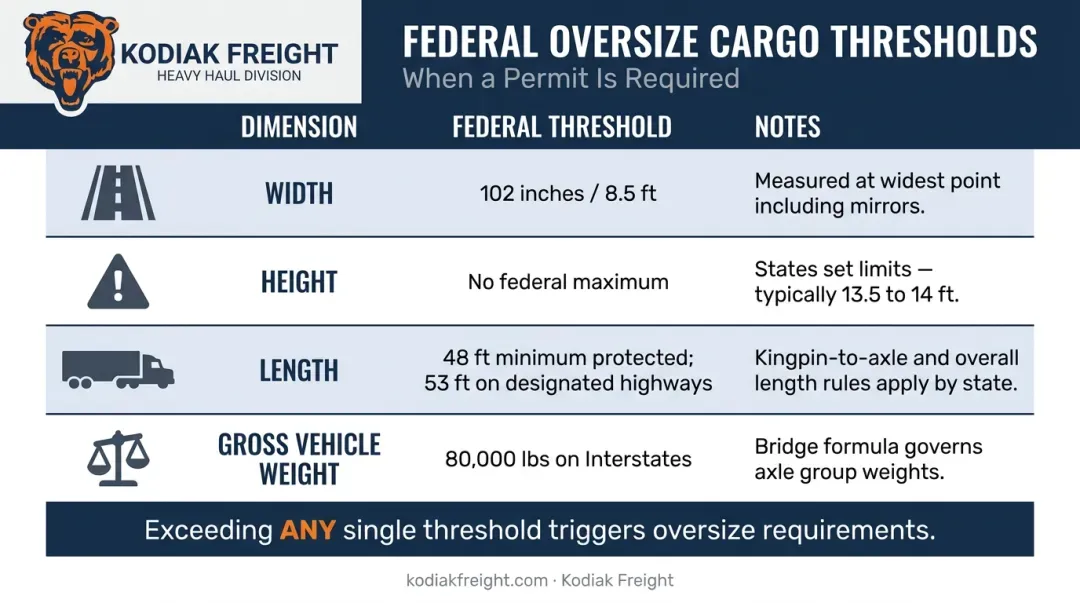
There is no single federal height limit. States set their own maximums, which generally fall in the 13.5–14 ft range. Similarly, 53 feet is not a universally guaranteed safe harbor for length — state kingpin-to-rear-axle rules and route-specific restrictions can still apply.
Oversize vs. Overweight: Not the Same Thing
Understanding federal thresholds is step one. The next distinction matters just as much for permitting purposes — oversize and overweight are separate classifications, not interchangeable terms:
- Oversize = a dimensional exceedance (width, height, or length)
- Overweight = a mass exceedance (gross vehicle weight or per-axle weight)
A load can be oversize but not overweight, overweight but not oversize, or both. Each condition triggers different permit requirements and safety obligations.
What About Super Loads?
At the far end of the oversize spectrum sit super loads — freight that dramatically exceeds even standard permitted thresholds. State definitions vary considerably:
- Texas triggers superheavy single-trip classification at 254,300 lbs total gross weight
- Vermont requires engineering review at 150,000 lbs, 100 ft long, 15 ft wide, or 14 ft high
These moves require manual engineering analysis, bridge and pavement studies, utility coordination, and permit timelines that can stretch weeks longer than routine oversize loads.
What Is NOT Oversize Cargo
A fully loaded 53-foot flatbed at 79,000 lbs gross vehicle weight is not oversize — it falls within legal limits on both gross weight and trailer length. Large, heavy freight is not automatically oversize freight. The classification comes down to measured numbers against applicable thresholds. If those numbers don't cross a limit, standard operating rules apply and no oversize permit is needed.
Federal vs. State Oversize Thresholds: Why the Rules Vary
Federal rules set the floor. Every U.S. state builds its own permit system, travel restrictions, and dimensional thresholds on top of that foundation. FHWA is explicit: the federal government does not issue oversize/overweight permits. That authority belongs entirely to the states.
How State Rules Diverge: Four Examples
New York restricts most permitted moves to weekdays, between one-half hour before sunrise and one-half hour after sunset. Weekend movement is banned for most loads, with a narrow Saturday-morning exception for qualifying loads no wider than 12 ft and no longer than 85 ft at legal height.
Minnesota requires a rear certified escort on divided roads when width exceeds 15 ft (bottom measurement) or length exceeds 110 ft. Both front and rear escorts are required above 150 ft. Holiday blackout runs from 2:00 p.m. the day before through 2:00 a.m. after the holiday for loads over 12.5 ft wide or 110 ft long.
Michigan applies spring weight restrictions annually, cutting legal axle weights by 25% on rigid pavement and 35% on flexible pavement. During these periods, the state also denies single-trip permits for overweight loads or anything exceeding 14 ft wide, 11 axles, or 150 ft long.
Colorado targets a two-hour turnaround for standard single-trip permits submitted before 3:00 p.m. MT. Chapter 6 special review moves to three to five business days, and temporary backlogs have extended this to two to three weeks.
The Multi-State Reality
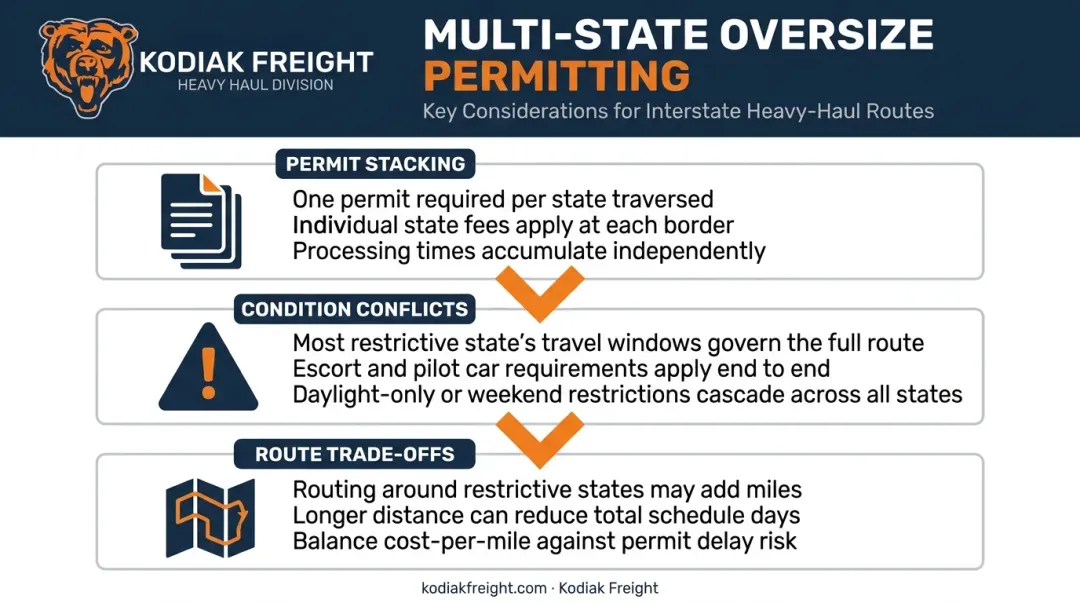
Multi-state shipments require a separate permit from each state along the route. Beyond the paperwork, the most restrictive state's conditions govern the entire move. If one state in a four-state corridor bans weekend travel for loads over 12.5 ft wide, that single rule controls the shipment timeline for all four states.
Multi-state planning typically involves three practical considerations:
- Permit stacking: One permit per state, each with its own fees and processing time
- Condition conflicts: The tightest travel windows, escort requirements, and weight limits apply end to end
- Route trade-offs: Routing around a restrictive state may add miles but cuts days off the schedule
Common Types of Oversize Cargo by Industry
Agriculture
Combines and large-frame harvesters are among the most common oversize loads on U.S. roads. John Deere's X9 series combines with 30-inch tracks measure approximately 3.8 meters (12.5 ft) wide—well above the 8.5-ft National Network standard. Large tractors, grain handling systems, and irrigation equipment also regularly trigger oversize requirements.
Agricultural hauls are frequently time-sensitive. Equipment needs to arrive before planting or harvest windows open, and delays translate directly into revenue losses. These moves concentrate heavily along Midwest and Great Plains corridors, where seasonal deadlines make scheduling and permitting lead time critical.
Manufacturing and Industrial
Manufacturing produces some of the most extreme oversize loads in any industry. Ohio DOT documented a 2024 silicon-chip-manufacturing "cold box" at approximately 23 ft high, 20 ft wide, 280 ft long, and 916,000 lbs—a move requiring months of coordination. More routine manufacturing oversize loads include:
- Large generators and power transformers
- Pressure vessels and reactor components
- Industrial presses and CNC machinery
- Structural steel and prefabricated building sections
Many of these loads cannot be disassembled for transport. That makes specialized heavy-haul carriers the only viable option—particularly for plant build-outs, factory relocations, and equipment upgrades where crane and rigging services are also required at the destination.
Mining
Mining equipment sits at the extreme end of oversize cargo. Key examples illustrate the scale:
- Caterpillar 785 haul truck: 24.72 ft wide, 39.23 ft long
- Komatsu 320XPC drill: 27 ft 11 in wide, 107 ft 10 in long (mast down), 339,400 lbs
Loads at this scale routinely trigger super load classification, requiring engineering-level permit review rather than automated processing. Excavators, haul trucks, drilling rigs, and crushers all demand custom axle configurations and multi-state permit coordination.
Energy
Wind energy generates some of the most dimensionally complex oversize cargo. The U.S. Department of Energy reports an average rotor diameter of 133.8 meters for land-based turbines installed in 2023—and completed blades cannot be folded or bent, severely constraining route options. Large power transformers fall into the hundreds-of-tons class, requiring extensive route surveys and utility coordination before a single wheel turns.
Railroad and Infrastructure
Railroad equipment—including components for track infrastructure, signal systems, and maintenance-of-way machinery—generates consistent oversize freight demand. These moves require permitting, escort coordination, and specialized transport capabilities that go beyond standard flatbed freight—making them a natural fit for dedicated heavy-haul carriers.
Equipment Used to Haul Oversize Loads
Oversize cargo requires trailer configurations matched to the specific dimensions and weight of the load. Wrong equipment selection voids permits and triggers compliance violations, not just operational delays.
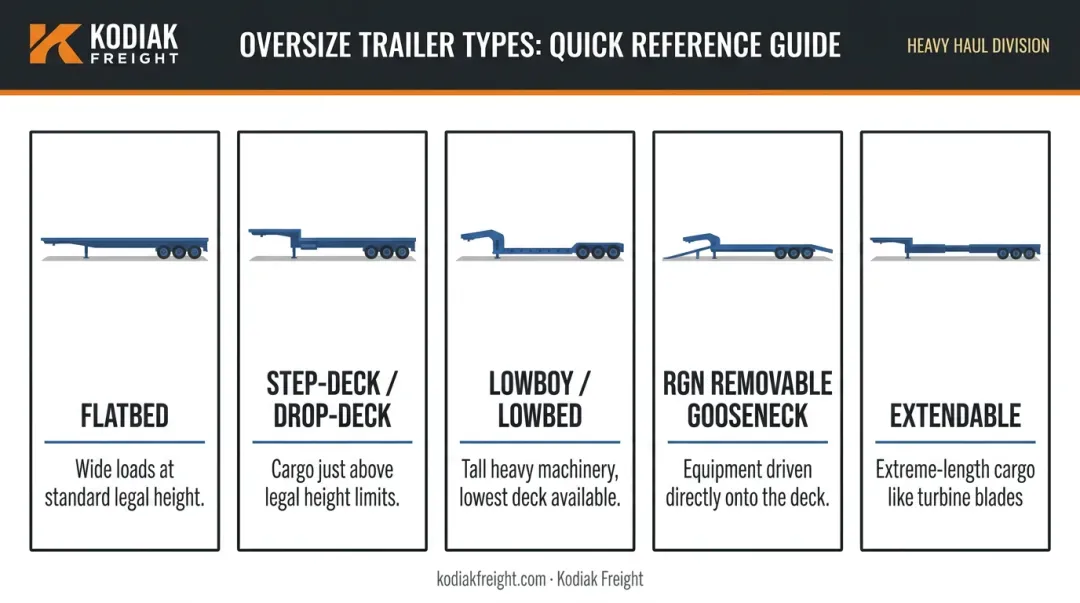
Primary Trailer Types
| Trailer Type | Best Use Case |
|---|
| Flatbed | Wide loads at standard height; open-deck transport for steel, pipe, building materials |
| Step-deck / Drop-deck | Cargo just above legal height; deck height of 33–40 inches accommodates taller freight |
| Lowboy / Lowbed | Tall, heavy construction and industrial machinery requiring the lowest possible deck |
| RGN (Removable Gooseneck) | Heavy equipment driven or rolled directly onto the trailer deck |
| Extendable | Long cargo such as turbine blades; deck extends to accommodate extreme lengths |
Kodiak Freight also operates Landoll hydraulic tilt-deck trailers, which allow heavy equipment—construction machinery, agricultural implements, industrial vehicles—to be loaded without a crane. The deck hydraulically tilts toward the ground so equipment drives or rolls on directly, eliminating crane mobilization costs and cutting load time.
Multi-Axle Configurations
Additional axles distribute weight across more contact points, reducing the per-axle load on road surfaces and bridge structures. The FHWA's Bridge Formula calculates allowable weight for every group of two or more consecutive axles. More axles don't override per-axle limits or gross weight caps—they allow weight to be spread in a way that satisfies those limits. The number of axles required is often specified directly in the permit.
Flags, Escorts, and Warning Equipment
- Warning flags: Federal regulations (49 CFR 393.87) require at least 18-inch-square red or orange fluorescent flags when a load projects more than 4 inches beyond the sides or more than 4 feet beyond the rear
- Pilot/escort vehicles: Required when width, length, or height exceeds state-specific thresholds—requirements vary by state and permit
- Oversize load banners and amber lighting: Placement and configuration are state-specific; no national standard exists
Permits, Regulations, and Route Planning for Oversize Cargo
The Permit Procurement Process
Each state along the route requires a separate permit application. Minnesota's permit guidance, for example, requires:
- Loaded dimensions and overhang measurements
- Load and axle weights with axle spacing
- Origin, destination, and proposed route
- Load description and vehicle configuration
- Requested travel dates
Processing times vary widely. Automated systems for routine permits can turn around approvals in minutes. Texas requests superheavy applications three to four weeks before the needed permit date. Vermont allows up to 10 working days for engineering review on super loads.
Kodiak Freight manages state-by-state permit procurement as an integrated part of its heavy-haul service, not as a standalone add-on. For shippers without in-house permit expertise, this is a meaningful operational advantage.
Route Surveys
Minnesota DOT requires a physical route survey for any load exceeding 16 ft high, 20 ft wide, or 175 ft long. Surveys document:
- Turn-by-turn routing
- Overhead power and utility conflicts
- Bridge clearance measurements
- Required lateral clearances
When conflicts arise—a low bridge, a weight-restricted overpass, overhead utility lines—logistics teams resolve them through rerouting, temporary utility raises, or police-coordinated intersection management. Skipping this step is how shipments end up stranded at a bridge with inadequate clearance.
Lead Time: Start Earlier Than You Think
No single timeline applies to every oversize move. Lead time requirements break down roughly like this:
- Routine automated permits: Minutes to hours in best-case scenarios
- Standard oversize moves: Generally 1–2 weeks for permit coordination and route planning
- Super loads and multi-state engineered moves: Several weeks to months; Texas recommends 3–4 weeks minimum for superheavy permits
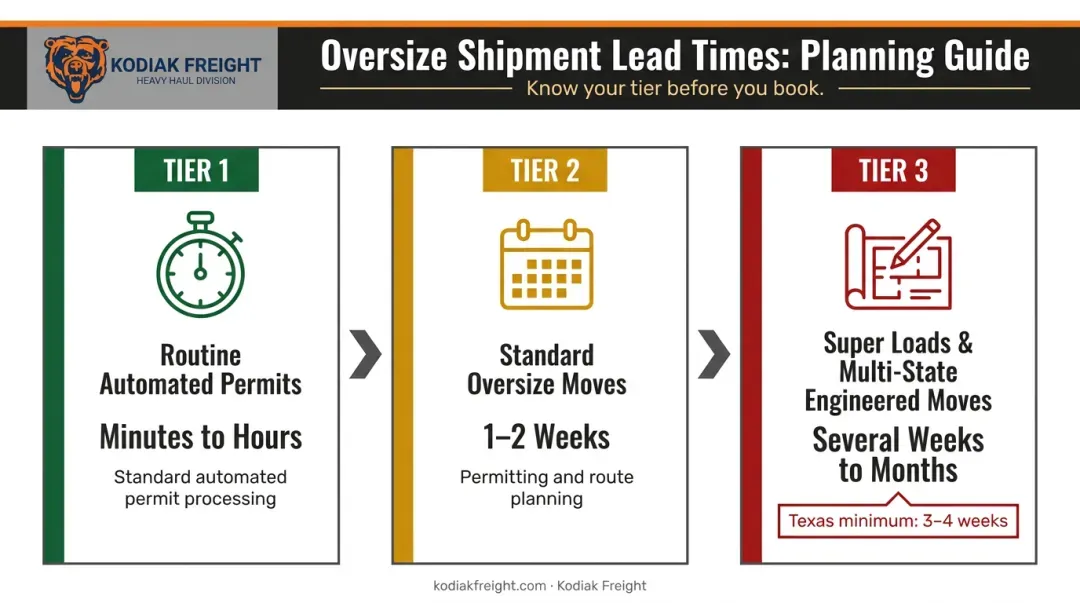
The single most common cause of oversize shipment delays is insufficient lead time. Starting the permitting and planning process late compresses every subsequent step—route surveys, escort coordination, utility notifications—into a timeline that doesn't accommodate the unexpected.
Frequently Asked Questions
What is oversized cargo?
Oversized cargo is freight that exceeds standard legal limits for width (8.5 ft), height (generally 13.5–14 ft depending on state), length, or gross vehicle weight (80,000 lbs). Any single excess qualifies the load as oversize and requires special permits, equipment, and handling for legal transport on public roads.
How many slots does oversized cargo take up?
Oversize loads occupy an entire trailer and cannot share space with other freight due to securement requirements and size requirements. These shipments move as dedicated loads—not consolidated with standard freight.
What are the legal size limits for oversize cargo in the US?
The federal baseline thresholds are 102 inches (8.5 ft) wide and 80,000 lbs gross vehicle weight on the Interstate system. Height limits are set by individual states and generally range from 13.5 to 14 ft. States may set stricter conditions or additional requirements on top of these federal standards.
What permits are required to transport oversize cargo?
A separate permit is required from each state along the route, specifying exact dimensions, weight, route, and travel dates. Some moves also require utility coordination, police escort arrangements, or route survey documentation before a permit is issued.
What equipment is typically used for oversize cargo shipping?
Common options include flatbed, lowboy, step-deck, RGN, extendable, and Landoll hydraulic tilt-deck trailers. The right configuration depends on the cargo's height, width, length, and weight.
How far in advance should I plan an oversize cargo shipment?
Standard oversize moves generally require at least 1–2 weeks of lead time for permitting and route planning. Super loads or complex multi-state moves may require several months of advance coordination, particularly when engineering reviews and utility notifications are involved.