Industries / Transformers and Electrical Equipment
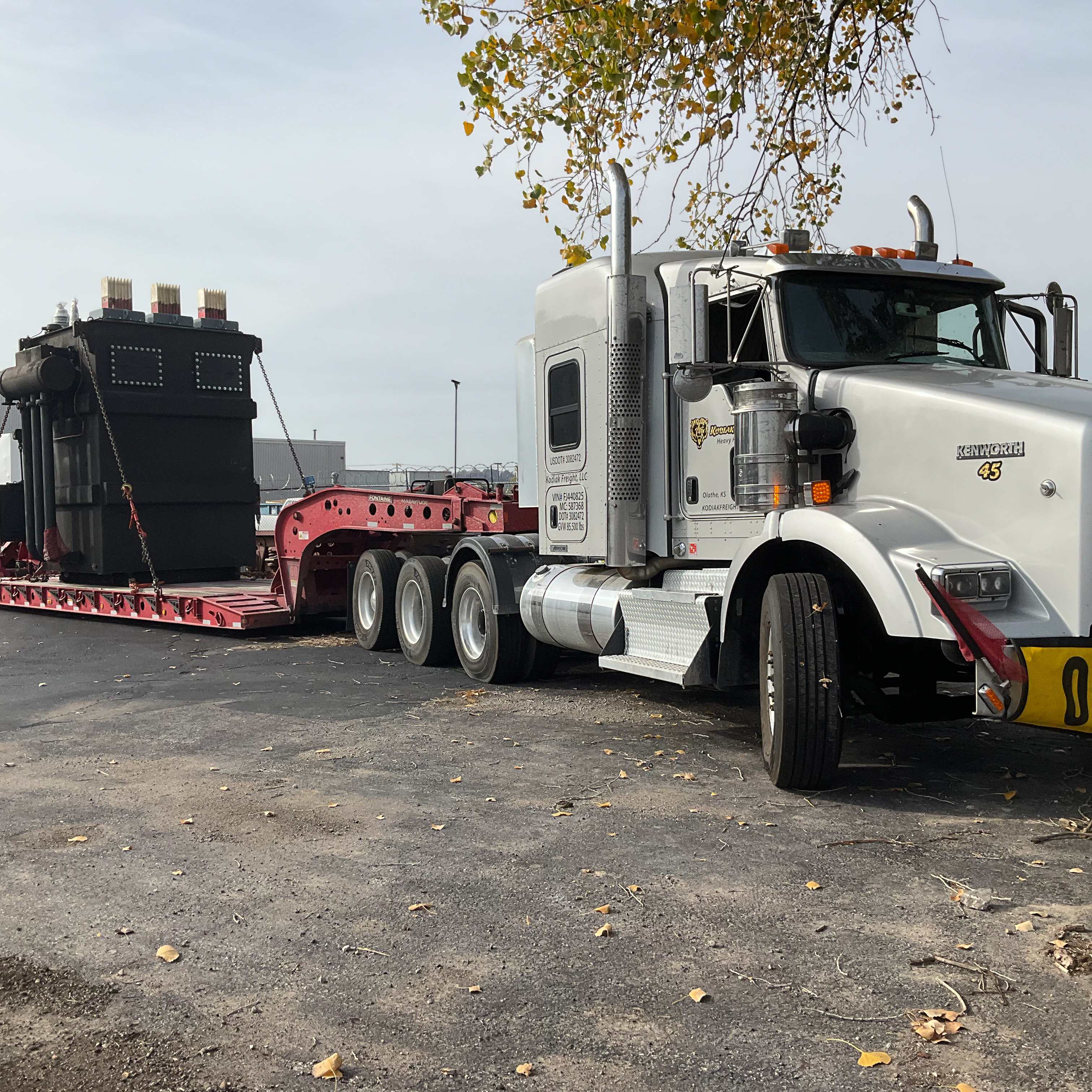
Power transformers, switchgear and substation equipment moved on trailers built for the height and the weight, by a team that treats a two year lead time with the respect it deserves.
Why transformers are their own problem
Most oversize freight is difficult in one dimension. Transformers manage to be difficult in all of them at once.
They are dense, so weight concentrates in a small footprint and axle loading becomes the constraint. They are tall, so deck height decides whether the route works. They are sensitive to shock and tilt, which is why they ship with impact recorders and why handling matters more than speed.
With the current lead times, a damaged unit is not a claim, it is a project delay measured in quarters.
Power and substation transformers, generator step up (GSU) units, autotransformers, unit substations, pad mount, pole mount and dry type.
Medium and low voltage lineups, switchboards, motor control centers, panelboards, busway and bus duct.
Circuit breakers, reclosers, reactors, capacitor banks, control houses and relay buildings.
Inverters, rectifiers, UPS systems, battery cabinets, BESS containers.
Radiators, bushings, conservators, oil handling equipment and spare parts crates that ship separately from the main unit.
Large transformers often ship dismantled, with radiators, bushings and oil moving separately from the main tank.
How we move them
The order matters. Pick the trailer to the unit, because deck height and axle count determine the route, and the route determines the permits.
Under ~48,000 lb
Step deck or double drop
Often a routine oversize permit
~48,000 to 100,000 lb
Double drop or multi axle
Multi state permits, escorts likely
100,000 to 200,000 lb
Multi axle RGN or perimeter
Route survey, possible bridge analysis
Over 200,000 lb
Perimeter, dual lane, high axle count
Superload. Engineering, utilities, police escort
A perimeter trailer carries the unit inside the frame rather than on top of a deck, which drops the effective height by several feet. On a tall transformer that is frequently the difference between a manageable route and an impossible one.
Handling and protection
Manufacturers ship large transformers with impact recorders that log shock and tilt in three axes, and they will be read on arrival. If the numbers are out of spec, the unit may need an internal inspection before it can be energized, and that inspection is measured in weeks.
So we drive to the equipment, not to the clock. If the manufacturer has a handling spec, we work to it and give you the record.
01
Tied down to the manufacturer's specification.
02
Routes chosen to avoid the roughest surfaces.
03
A record from pickup to set.
Storage and staging
Transformers routinely arrive long before the foundation is ready. Our yards receive them, inspect and photograph them on arrival, and hold them on secured, monitored, crane accessible ground until your site or your outage window is ready. Then we deliver to the schedule.

Why Kodiak
Transformer moves punish improvisation. The trailer has to be right, the route has to be verified, the securement has to match the spec, and the crane plan has to be settled before the unit leaves. None of that is exotic.
Our equipment, drivers, permits, yards, and cranes. One team, one accountable phone number.
Weight, dimensions and where it is going. We will tell you the trailer, the route and the permit path, and how early to start.