 Moving a combine harvester, a mining haul truck, or a 40-ton industrial press isn't like booking a standard truckload. One wrong permit, one missed bridge clearance, and a shipment that took months to plan can sit stranded on the shoulder of a highway.
For agriculture, mining, manufacturing, and rail operators, that's not a minor inconvenience. It's a production line waiting on a machine that isn't arriving, or a harvest window closing while paperwork gets sorted out.
The challenge isn't just that over-dimensional (OD) freight has rules. It's that those rules stack — federal baselines, state-specific permits, and escort requirements that can change the moment a truck crosses a state line. For first-time shippers of heavy equipment, that complexity is often the biggest risk factor of all.
This guide breaks down what qualifies as over-dimensional freight, the permits and regulations you'll encounter, what happens when something goes wrong, and how working with a specialized heavy-haul partner cuts that risk down to size.
Key Takeaways
- OD shipping thresholds typically start at 8'6" wide, 13'6"+ tall, or 80,000 lbs, though limits vary by state
- Permits are issued state by state, so a five-state route requires five separate approvals, each with different rules
- Missing or invalid permits can trigger fines, out-of-service orders, and added liability exposure
- A heavy-haul specialist familiar with agriculture, mining, manufacturing, and rail equipment cuts delays and penalty risk
What Is Over-Dimensional Shipping?
Over-dimensional shipping — also called ODC (oversize/overweight/overdimensional cargo), oversize freight, or overweight freight — refers to any load that exceeds standard legal size or weight limits for public roads. These shipments require special permits, custom equipment, and often a completely different route than a standard truck would take.
Federal baselines set the floor, not the ceiling. Every state builds its own permitting system on top of these numbers:
| Measurement | Federal Baseline | Notes |
|---|
| Width | 102 in (8'6") | Standard on the National Network |
| Gross weight | 80,000 lbs | Interstate max, subject to the Bridge Formula |
| Single axle | 20,000 lbs | Interstate limit |
| Tandem axle | 34,000 lbs | Interstate limit |
| Height | No federal standard | Set state by state (Texas and California generally use 14 ft) |
These figures come from FHWA's federal size regulations for commercial motor vehicles. Treat them as screening thresholds: the point where a load starts needing permits, not a universal rule for every road in the country.
Divisible vs. Non-Divisible Cargo
Meeting those thresholds only gets a load into the permitting conversation. The cargo also has to be non-divisible, meaning it can't be broken down without one of the following happening:
- Compromising its intended use or function
- Destroying its value
- Requiring more than eight work hours to disassemble with the right equipment
A combine harvester can't be split into legal-sized pieces without ruining it. That's what makes it a textbook OD load.
Common OD Cargo Across Kodiak's Core Industries
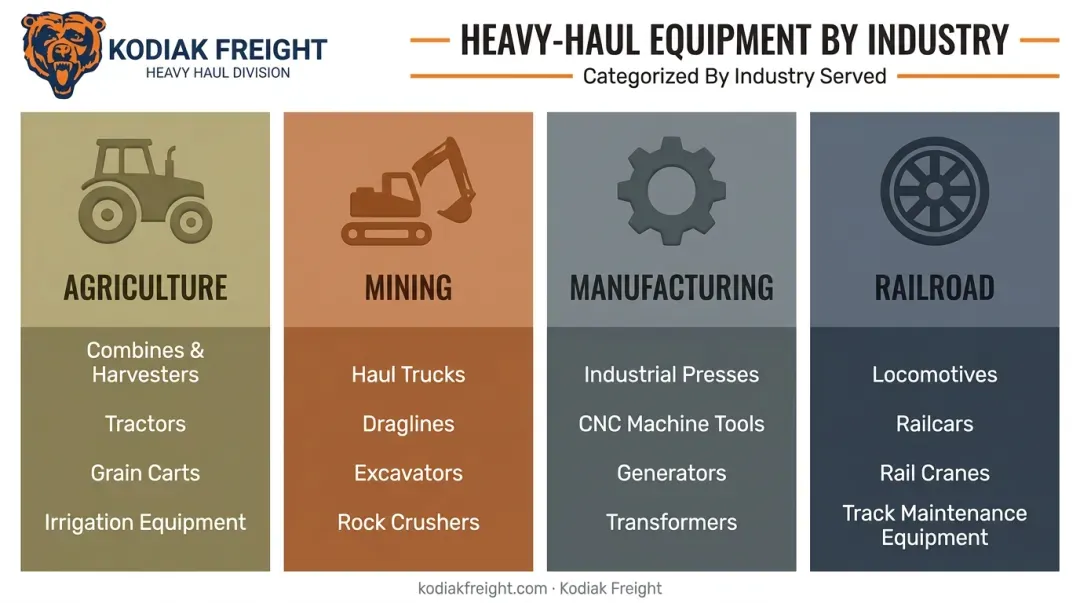
- Agriculture: Combines, tractors, harvesters, grain handling systems, irrigation equipment
- Mining: Draglines, haul trucks, excavators, drilling rigs, crushers
- Manufacturing: Industrial presses, generators, production-line machinery
- Railroad: Locomotive components, rail cars, track maintenance equipment
Regular Freight vs. Over-Dimensional Freight: What's the Difference?
Standard freight fits within legal size and weight limits: no permits, escorts, or route surveys needed. Load it, dispatch it, deliver it.
Over-dimensional freight is a different animal entirely:
- Permits required — often one per state
- Route surveys to check bridge clearances and turning radii
- Possible pilot car escorts depending on dimensions
- Specialized trailers built to handle the weight or shape
The gap between these two categories is where most first-time shippers underestimate the planning timeline.
What Counts as Overweight Shipping?
Overweight is a separate concept from oversize. Overweight refers specifically to gross vehicle weight or axle weight exceeding federal or state limits — regardless of the load's physical dimensions.
A shipment can be perfectly legal in width and height and still be overweight because of:
- Gross vehicle weight exceeding 80,000 lbs on the Interstate
- Single axle weight over 20,000 lbs
- Tandem axle weight over 34,000 lbs
- Bridge Formula violations, which limit how much weight can concentrate over a given axle spread
That last point trips up a lot of shippers. A load can meet every individual axle limit and still fail the Bridge Formula if the axles are spaced too closely together for the total weight.
Permits & Regulatory Requirements
Every OD shipment needs the right permit, and getting the type wrong is one of the fastest ways to delay a load.
Types of Permits
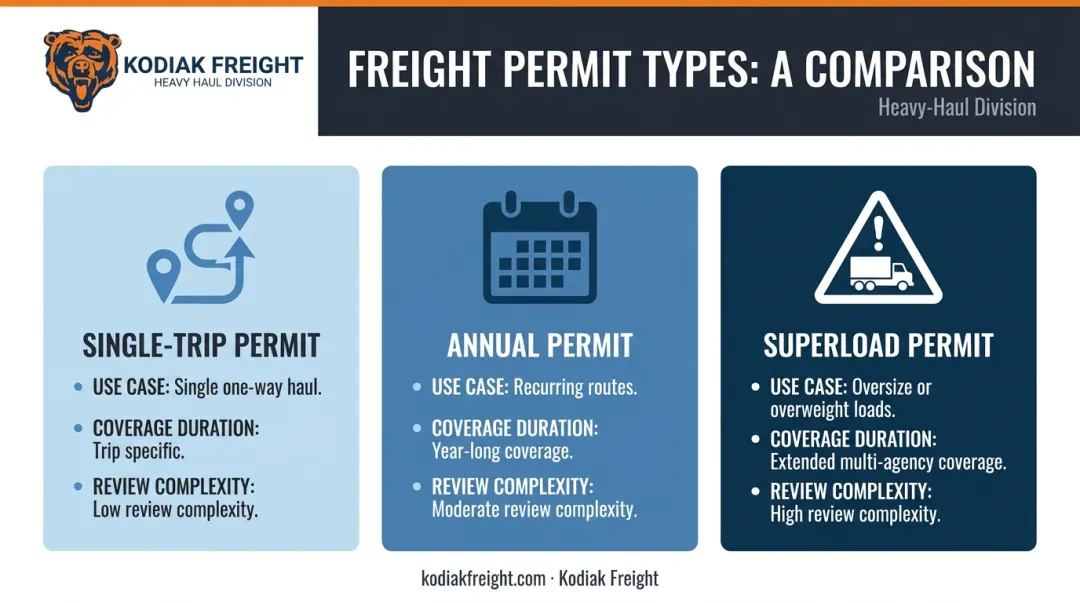
- Single-trip permits — cover one nondivisible movement from a specific origin to a specific destination
- Annual permits — allow repeated moves within a defined size and weight envelope, useful for equipment dealers making regular deliveries
- Superload permits — required for the largest or heaviest shipments, triggering additional review, bridge analysis, and sometimes engineering sign-off
Texas, for example, escalates from a general single-trip permit to superheavy review once a load exceeds 254,300 lbs, hits certain axle limits, or falls between 200,001–254,300 lbs with less than 95 ft of axle spacing. These thresholds come from TxDMV's superheavy permit guidelines, and applications should be submitted 3-4 weeks before movement to allow time for route and bridge analysis.
Permits Are State-Specific, Every Time
A multi-state route doesn't mean one permit. It means one permit per state, each with:
- Its own approved route
- Different travel windows (many states restrict OD moves at night, weekends, or holidays)
- A separate validity period
Federal rules define what counts as OD in the first place, but states retain full authority over how and where a load actually moves. That local knowledge is what separates a smooth multi-state haul from one that stalls at a border.
Escort and Pilot Car Requirements
Escort thresholds vary by state. Texas generally requires:
- One escort over 14–16 ft wide (position depends on road type)
- Front and rear escorts over 16 ft wide
- A height-pole escort over 17–18 ft tall
- Escorts for loads over 110–125 ft long
Washington's thresholds are different, kicking in escorts as low as 11 ft wide on two-lane highways. Applying one state's rule to another state's road is a common, costly mistake.
Documentation You'll Need
- Route survey (required in Texas once a load exceeds 20 ft wide, 18'11" high, or 125 ft long)
- Bridge analysis for heavier or longer loads
- Insurance certificates (required by some states, like Georgia)
- Permit surety bond or USDOT number
Most states now run digital permitting portals. Texas's TxPROS system, for instance, supports GIS-based routing, real-time restriction updates, and self-issuance for eligible permits. However, it still requires the applicant to know the load's exact dimensions and weight before submitting anything.
Route Planning, Equipment & Cost Factors
Getting a permit approved is only half the job. The route itself has to hold up to the load's actual size and weight.
What Route Planning Has to Account For
- Bridge clearances and weight ratings
- Turning radii at intersections and interchanges
- Construction zones and temporary restrictions
- Curfews and travel-time windows unique to OD loads
Matching Equipment to the Load
Trailer selection determines what permits will be approved:
| Trailer Type | Best For |
|---|
| Flatbed / step-deck | Wide loads with moderate height |
| RGN / lowboy / double-drop | Tall or heavy machinery needing a lower deck height |
| Multi-axle configurations | Distributing weight to meet axle and Bridge Formula limits |
| Landoll tilt-deck | Self-propelled or wheeled equipment loaded without a crane |
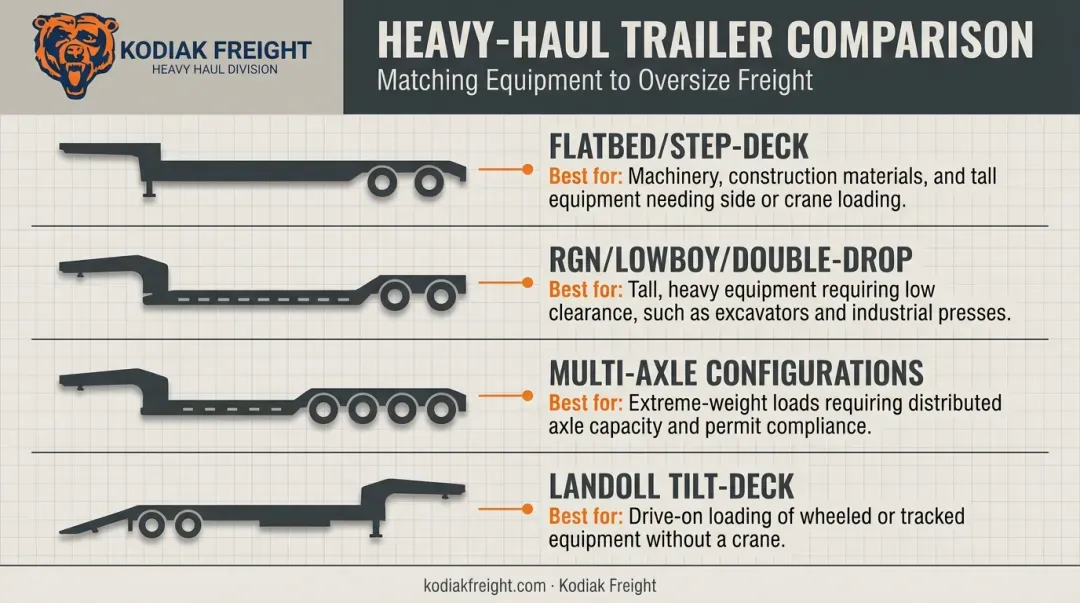
Kodiak Freight's Heavy Haul Division uses Landoll tilt-deck trailers for equipment that can be driven or rolled on without crane assistance, which works well for agricultural machinery and some manufacturing equipment. For shippers who already own a specialized trailer, power-only service provides just the tractor and driver, no trailer commitment needed.
Axle spacing and deck height directly determine what a permit reviewer will approve. Choose the wrong trailer, and you may need to reroute or reapply before the load ever leaves the yard.
What Drives the Cost
- Permit fees: vary by state and load classification (Texas charges $60 for a general single-trip permit, plus maintenance fees that scale with weight)
- Escort/pilot car costs: scope changes based on escort count, position, and whether a height pole is required
- Distance and fuel: mileage and current diesel prices add up quickly on long-haul OD moves
- Number of states traversed: each one adds its own fee and paperwork
Technology-driven route engineering, including GPS mapping and bridge clearance databases, helps flag hazards before departure. That upfront visibility is usually cheaper than discovering a low bridge mid-route.
Risks & Consequences of Getting It Wrong
The stakes on an OD shipment are higher than standard freight, and the penalties reflect that.
Financial risk shows up fast, often before a shipment even reaches its destination:
- Washington stacks per-pound overweight fines on base penalties: $0.03 per pound over the limit, rising to $2,640 plus $0.30 per pound for loads more than 20,000 lbs overweight.
- Texas treats certain permit violations as misdemeanors, with fines up to $500 per offense.
- FMCSA violations resulting in an out-of-service order add extra severity points to a carrier's Safety Measurement System score, per FMCSA's SMS methodology.
Liability exposure is the bigger long-term concern. If an improperly permitted or poorly secured load causes an accident, damages a bridge, or blocks a roadway, the carrier or shipper can face:
- Legal claims from third parties
- Infrastructure repair costs
- Regulatory scrutiny on future permits
Operational risk rounds out the picture. Inaccurate dimensions, incomplete permit paperwork, and rushed route planning are the most common reasons OD shipments get delayed. These oversights seem minor individually, but they compound quickly once a load is already on the road.
Why Partner with a Heavy-Haul Specialist Like Kodiak Freight
Everything covered so far—permits, escorts, routing, liability—is exactly why most shippers don't manage OD freight in-house. The margin for error is too thin, and the rules change every time a load crosses a state line.
Kodiak Freight built its Heavy Haul Division around this exact problem. Headquartered in Flower Mound, Texas, the division focuses on oversize and overweight equipment for agriculture, manufacturing, mining, and railroad shippers. In these industries, a delayed shipment doesn't just cost money; it stalls a harvest, a production line, or an extraction operation.
What that looks like in practice:
- Permit and escort coordination across every state on the route, handled as a standard part of service rather than an add-on
- Route surveys that check bridge clearances and legal pathways before the load departs
- Equipment matching, including Landoll tilt-deck trailers for self-propelled machinery and power-only service for shippers with their own specialized trailers
- Crane and rigging support for equipment that standard loading methods can't handle
- Laydown yard staging for multi-phase projects where equipment needs to arrive in sequence
- Dedicated fleet capacity for shippers with recurring lanes, alongside spot moves for one-off shipments
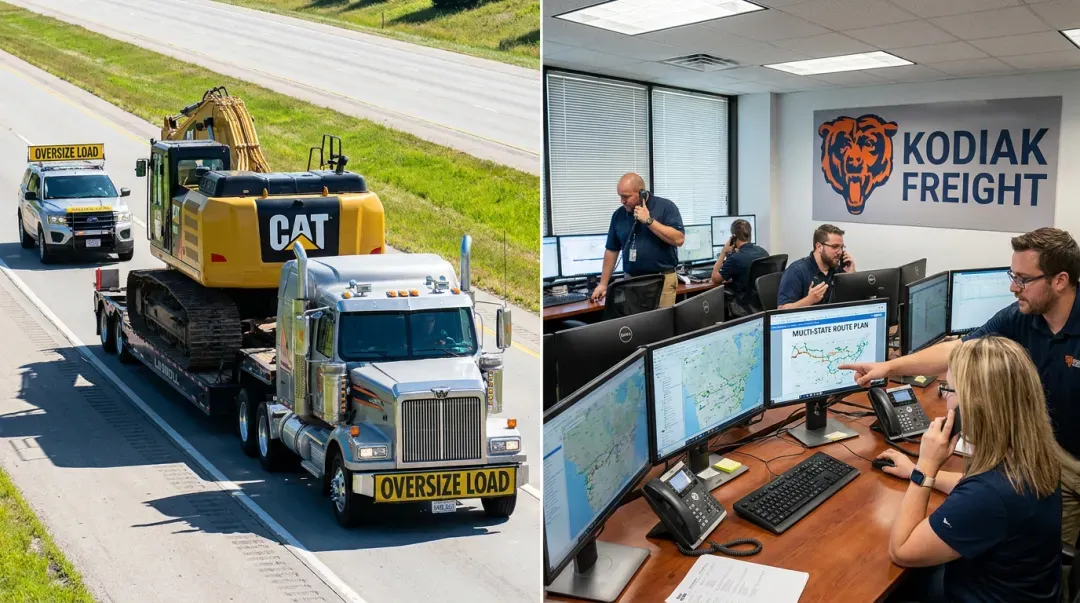
That range spans a single spot move for a harvest-season delivery to dedicated capacity for an ongoing mining operation. Kodiak flexes to whatever a shipper actually needs instead of forcing every load into the same model.
If you're planning your next oversize or overweight shipment, reach out to Kodiak Freight at [email protected] or 913-210-5144 for a consultation.
Frequently Asked Questions
What is over-dimensional shipping?
Over-dimensional shipping refers to freight that exceeds standard legal size or weight limits, requiring special permits, specialized equipment, and custom route planning. It applies to loads that can't be broken down without damaging their function.
What is the difference between regular and over-dimensional shipping?
Regular freight fits within legal dimensions and needs no special permits or escorts. Over-dimensional freight requires state permits, route surveys, and sometimes pilot car escorts and specialized trailers.
What is considered overweight shipping?
Overweight refers to gross vehicle weight or axle weight exceeding federal or state limits, independent of a load's physical size. A load can be legal in dimension and still be overweight due to axle or Bridge Formula limits.
Who is responsible for obtaining OD permits?
Carriers or their logistics partner typically handle permit acquisition on the shipper's behalf, coordinating directly with each state's transportation department to secure approvals for the specific route and load.
How much do over-dimensional permits typically cost?
Costs vary by state, load size, weight, and how many permits the route requires. Getting a tailored quote from your carrier is the most reliable way to estimate total permit costs for a specific shipment.
Are pilot/escort vehicles always required for oversized loads?
No. Escort requirements depend on each state's specific width, height, and length thresholds, not a universal rule. A load requiring escorts in one state might not require them in another.