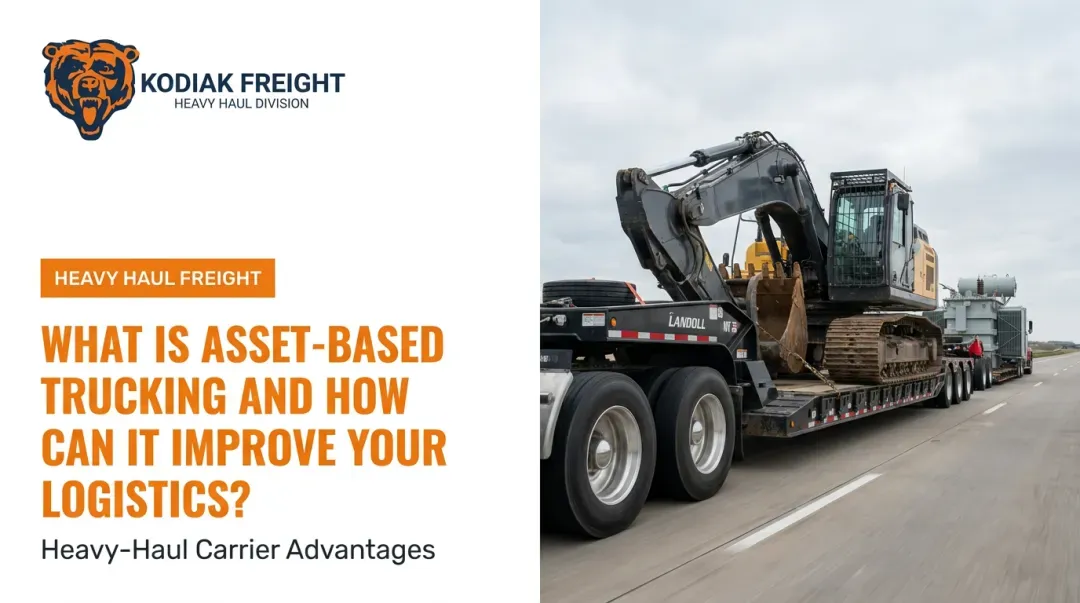
 Logistics managers moving heavy or specialized freight face a recurring problem: too many handoffs, too little accountability. A broker books your load, hands it to a carrier you've never vetted, and if something goes wrong — a missed permit, an under-maintained rig, a late delivery — you're chasing answers through layers of intermediaries.
Asset-based trucking cuts through that. When a carrier owns its own trucks, trailers, and equipment, you have a direct line to the people actually moving your freight. No middleman, no guesswork.
This article explains what asset-based trucking means, how it differs from freight brokers and 3PLs, what types of carriers exist, and when this model is the strongest fit — particularly for industries moving heavy, oversize, or overweight loads.
Key Takeaways
- Asset-based carriers own or lease their trucks and equipment, giving shippers direct access to the team executing the haul
- Owning assets means greater reliability, accountability, and quality control than broker-only arrangements
- Specialized asset-based carriers are built for heavy-haul, oversize, and high-value freight that standard brokers aren't equipped to handle
- The right choice between asset-based carriers, brokers, and 3PLs depends on freight type, volume, and shipment complexity
What Is Asset-Based Trucking?
Asset-based trucking is a transportation model where the carrier owns or leases its own trucks, trailers, and equipment — rather than relying on third-party providers to move freight. The word "asset-based" refers specifically to that physical ownership: the company controls the tools required to haul your load.
What Carriers Control In-House
Because they own the equipment, asset-based carriers manage the full transport process internally:
- Hire and train CDL drivers directly — no third-party sourcing
- Inspect and maintain vehicles under their own standards
- Coordinate routes and dispatch in-house from origin to delivery
- Handle permitting and escort coordination for specialized freight
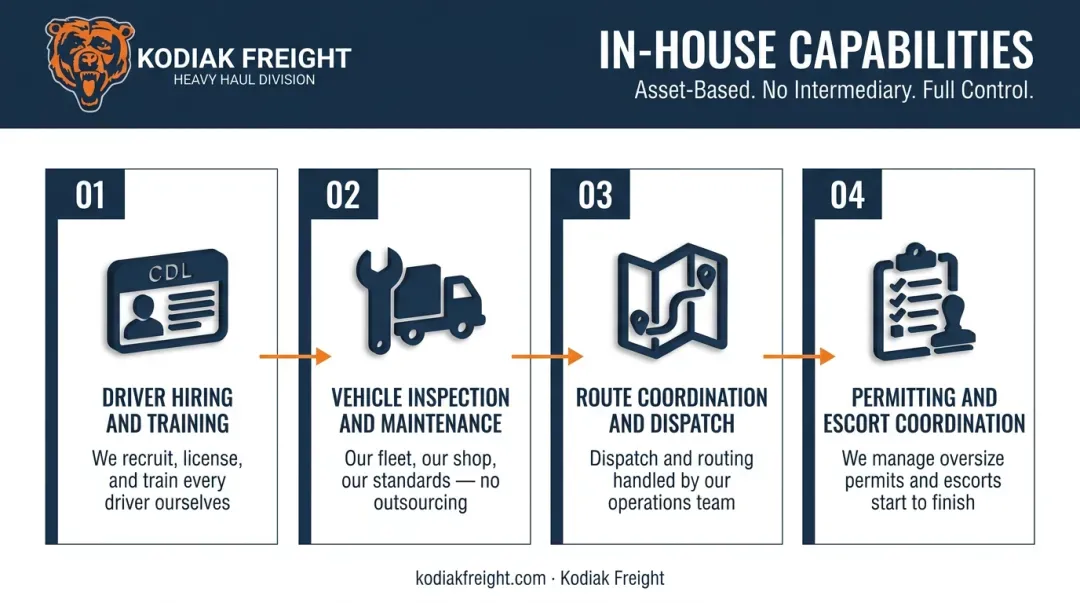
There's no intermediary in the freight process. When you call an asset-based carrier, you're talking to the company actually moving your freight.
Company Drivers vs. Owner-Operators
Two driver models operate under the asset-based umbrella. Company drivers are employed directly by the carrier — the carrier controls their training, dispatch, and compliance. Owner-operators are independent drivers who own their equipment and contract with a carrier. FMCSA notes that an owner-operator may occupy both the employer and driver role, and federal safety regulations still apply to both models.
What Freight Asset-Based Carriers Can Haul
The freight modes available depend on what equipment a carrier owns. Common categories include:
- Full truckload (FTL) shipments
- Flatbed and open-deck freight
- Heavy haul and oversize/overweight loads
- Specialized loads requiring lowboys, step-decks, or extendable trailers
This contrasts with brokered transportation, where an intermediary connects shippers with a pool of third-party carriers — a distinction that matters considerably when freight is complex or specialized.
Types of Asset-Based Carriers
Not all asset-based carriers are built the same. Size, geography, and equipment type vary widely.
By Operating Range
- Long-haul carriers move freight hundreds to thousands of miles, with drivers running multi-day routes across regions or states
- Regional carriers operate within a state or multi-state corridor on shorter rotations
- Local carriers handle final-mile or urban deliveries to end destinations
Specialized vs. General Freight Carriers
General dry-van carriers handle enclosed, standard-dimension freight. Specialized carriers invest in purpose-built equipment — flatbeds, step-decks, lowboys, heavy-haul rigs — to transport freight that exceeds standard dimensional or weight thresholds.
According to the ATA, 91.5% of nearly 580,000 active U.S. carriers with at least one tractor operate 10 or fewer trucks. Specialized heavy-haul carriers serving agriculture, manufacturing, mining, construction, and railroad industries often fall into this smaller-fleet category.
Fleet size does not determine service quality. In technical freight niches, equipment specificity and compliance expertise matter far more than truck count.
Key Benefits of Working With an Asset-Based Trucking Company
Reliability and Capacity Consistency
Asset-based carriers commit capacity from their own fleet — they don't depend on the spot market to find a truck when yours is ready to move. That distinction matters most when demand spikes.
The spot market is genuinely volatile. DAT data shows the van load-to-truck ratio hit 5.6 in October 2021 (meaning over five loads were competing for every available truck). A broker searching that market during peak demand may not secure capacity at all, or may scramble to find a carrier that isn't the right fit for your freight. An asset-based carrier with a dedicated fleet delivers consistent availability regardless of market conditions.
Accountability and Direct Communication
With a broker, you may be four or five calls removed from the driver handling your load. With an asset-based carrier, accountability is direct: one company employs the driver, maintains the truck, and executes the haul. When a question comes up — a route change, a permit issue, an arrival window — you reach the people responsible, not a coordinator relaying messages between parties.
This directness is especially valuable for complex shipments where real-time decisions affect timing, safety, and compliance.
Quality Control and Safety Standards
Asset-based carriers oversee driver training, vehicle maintenance, and cargo-handling protocols themselves. FMCSA's 2023 inspection data shows a 22.6% vehicle out-of-service rate nationally — which means the maintenance standards of the carrier executing your load matter significantly. When a carrier owns its fleet, you can audit its maintenance practices, safety ratings, and inspection history directly, rather than inheriting whoever a broker books.
For oversize and overweight shipments, this hands-on quality control is non-negotiable. Improper load securement, under-maintained equipment, or a missed permit requirement creates safety and compliance exposure that a broker cannot absorb on your behalf.
Specialized Equipment for Complex Freight
Asset-based carriers that invest in specialized equipment can execute freight that generic broker networks can't reliably source on demand. Landoll hydraulic tilt-deck trailers, heavy-haul flatbeds, and crane and rigging capability aren't available on short notice through a spot-market broker call.
Kodiak Freight's Heavy Haul Division is built around this operational depth. The division runs:
- Landoll tilt-deck trailers that load heavy equipment hydraulically, eliminating the need for a separate crane at origin
- Power-only units for shippers supplying their own specialized trailers
- Crane and rigging services for precision loading and placement
That equipment coverage spans agriculture, manufacturing, mining, railroad, and data center freight — and it's what makes the difference between a carrier that executes your oversize load correctly and one that's working around its own limitations.
Asset-Based Trucking vs. Freight Brokers and 3PLs
Defining the Models
- Freight brokers arrange transportation without owning equipment. The FMCSA defines them as intermediaries who connect shippers with third-party carriers but never take possession of the freight.
- 3PLs (third-party logistics providers) bundle transportation with warehousing, inventory management, and supply chain coordination. The U.S. 3PL market reached $323.4 billion in 2025, with asset-based dedicated contract carriage at $32B and non-asset domestic transportation management at $128.3B. Like brokers, most 3PLs do not own the trucks moving your freight.
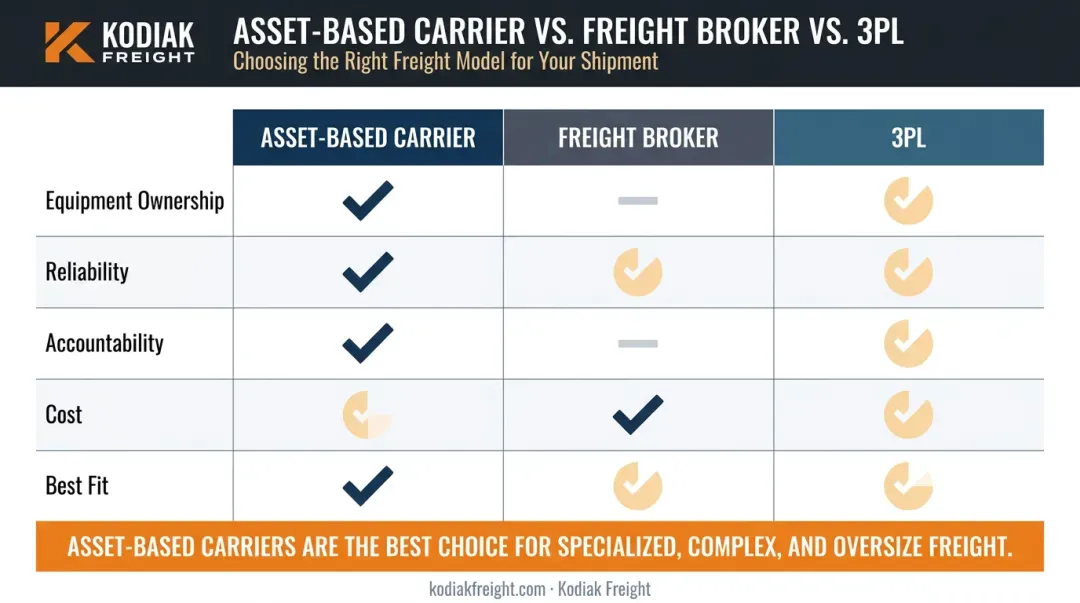
Head-to-Head Comparison
| Dimension | Asset-Based Carrier | Freight Broker | 3PL |
|---|
| Equipment ownership | Owns/leases fleet | No | Varies (often no) |
| Reliability | High — committed capacity | Variable — spot dependent | Variable |
| Accountability | Direct — single responsible party | Indirect — broker selects carrier | Layered |
| Cost | Predictable, contracted | Lower spot rates possible; volatile | Varies by service scope |
| Best fit | Specialized, recurring, complex freight | Flexible, high-volume, varied lanes | Multi-service supply chain programs |
Where Brokers and 3PLs Win
A broker's broad carrier network is useful when:
- Freight moves across many lanes with irregular volume
- You need access to a wide variety of equipment types quickly
- Demand is too unpredictable for committed capacity
3PLs add the most value when logistics requirements extend beyond transportation — into warehousing, inventory management, or multi-mode supply chain coordination. Some carriers try to bridge both worlds, which is where the hybrid model comes in.
The Hybrid Model Trade-Off
Some carriers operate a hybrid approach: owning core assets while brokering overflow loads to vetted carriers. This expands capacity but introduces a trade-off. On brokered loads, direct accountability diminishes: the shipper is no longer dealing exclusively with the carrier executing the haul.
When Asset-Based Trucking Makes the Most Sense for Your Industry
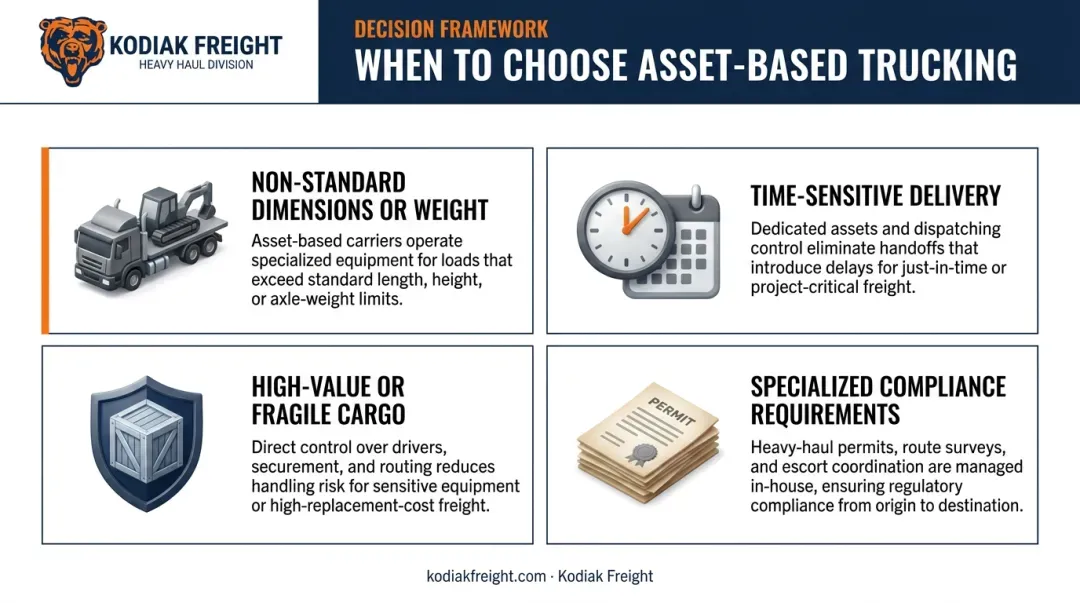
Asset-based trucking is the stronger choice when freight characteristics make errors costly:
- Non-standard dimensions or weight — loads exceeding legal limits require specialized equipment and state-by-state permitting expertise
- Time-sensitive delivery — missed windows in manufacturing or project construction create downstream production consequences
- High-value or fragile cargo — direct oversight reduces the risk of damage from improper handling
- Specialized compliance requirements — multi-state permits, pilot car coordination, and route surveys require a carrier with direct operational knowledge
Industries where this applies consistently include agriculture (combines and planting equipment), manufacturing (industrial machinery and components), mining (excavators and bulk equipment), railroad (infrastructure components), oil and gas, utilities, and data center logistics.
For these freight types, a broker-only approach introduces specific risk: the broker's network may not reliably source the specialized trailer required, last-minute carrier substitutions create accountability gaps, and cargo damage or a delayed delivery can cascade into production shutdowns.
Kodiak Freight operates at this intersection — a personalized, asset-based heavy-haul carrier with dedicated equipment, in-house permitting, and escort coordination. Direct accountability from quote to delivery means a missed permit or an unplanned route change gets caught before it becomes a production problem.
Frequently Asked Questions
What does asset-based mean in trucking?
"Asset-based" means the trucking company owns or leases its own trucks and equipment rather than relying on third-party carriers. This gives the carrier direct control over operations, drivers, maintenance, and delivery quality — with no intermediary between its equipment and your freight.
What is the difference between asset-based trucking and 3PL?
Asset-based carriers own their equipment and directly haul freight. 3PLs are logistics managers that coordinate transportation and supply chain functions through a mix of owned and contracted resources — they may hire an asset-based carrier to execute your haul, but the 3PL itself isn't the carrier.
What is an example of an asset-based business in trucking?
A carrier that owns its fleet of semi-trucks and flatbed trailers is an asset-based business. Kodiak Freight is a more specialized example: an asset-based heavy-haul carrier operating Landoll hydraulic tilt-deck trailers, crane and rigging equipment, and power-only units specifically for oversize and overweight industrial freight.
Is asset-based trucking better for heavy-haul shipments?
For oversize and overweight freight, yes. Asset-based carriers with purpose-built equipment, permitting expertise, and trained drivers put compliance, load securement, and routing decisions in the hands of one accountable party — something brokered arrangements can't consistently guarantee.
How do I know if I need an asset-based trucking company?
If your freight is time-sensitive, non-standard in size or weight, requires specialized equipment, or your operations depend on consistent lane performance, an asset-based carrier is the stronger choice. The higher the cost of a service failure — in production delays, damaged equipment, or compliance exposure — the more direct accountability matters.